Showing posts with label Tunisia. Show all posts

Tuesday, July 14, 2020

Freedom of speech makes Muslim assholes cry. Normal people, aka atheists, make Muslim scum cry. If you're a Muslim moron get off my planet you stupid fucking asshole.

Coronavirus: Blogger Emna Charqui given jail term over Koran-style post

Emna Charqui, who was charged with offending common decency and incitement to violence, speaks to reporters outside a court in the capital Tunis, 28 May 2020Image copyrightGETTY IMAGES
Image captionEmna Charqui, seen here in May, said she never intended to shock, only to amuse
A blogger in Tunisia has been sentenced to six months in prison after sharing a satirical post about Covid-19 written in the form of a verse from the Koran.
Emna Charqui, 28, was arrested in May for sharing a message on Facebook urging people to follow hygiene rules in the style of Islam's holy book.
Charqui said in a recent interview that she had no intention of provoking shock, but found the post amusing.
She was found guilty in a Tunis court of "inciting hatred between religions".
She is not yet in custody as she intends to file an appeal.
On 2 May, Charqui shared a post on social media mimicking a Koranic verse. In it, the text called for people to wash their hands and observe social distancing in response to the coronavirus pandemic.
The image was reportedly designed and originally shared by an Algerian atheist who lives in France.
Charqui's post appeared during the fasting month of Ramadan and while Tunisia was still largely under lockdown.
It caused a stir online, with some social media users labelling it offensive and calling for Charqui, an openly avowed atheist, to be punished.
Days later she was questioned by police.
On 27 May, following news that Charqui was facing trial over the Facebook post, Amnesty International released a statement calling for the Tunisian authorities to halt the prosecution.
"The prosecution of Emna is yet another illustration of how, despite Tunisia's democratic progress, the authorities continue to use repressive law to undermine freedom of expression," Amnesty's North Africa director Amna Guellali said.
Ms Guellali said the right to freedom of expression extended to what "some might consider shocking or offensive" and called on the Tunisian government to amend the law "so they are compliant with human rights".

Tuesday, June 30, 2020

"The bloc will allow visitors from 15 countries, but the United States, Brazil and Russia were among the notable absences from the safe list."

New York Times

E.U. Formalizes Reopening, Barring Travelers From U.S.

The bloc will allow visitors from 15 countries, but the United States, Brazil and Russia were among the notable absences from the safe list.

By Matina Stevis-Gridneff

June 30, 2020

BRUSSELS — The European Union will open its borders to visitors from 15 countries as of Wednesday, but not to travelers from the United States, Brazil or Russia, putting into effect a complex policy that has sought to balance health concerns with politics, diplomacy and the desperate need for tourism revenue.

The list of nations that European Union countries have approved includes Australia, Canada and New Zealand, while travelers from China will be permitted if China reciprocates.

The plan was drawn up based on health criteria, and European Union officials went to great lengths to appear apolitical in their choices, but the decision to leave the United States off the list — lumping travelers from there in with those from Brazil and Russia — was a high-profile rebuke of the Trump administration’s handling of the coronavirus crisis.

Travelers’ country of residence, not their nationality, will be the determining factor for their ability to travel to countries in the European Union, officials said, and while the policy will not be legally binding, all 27 member nations will be under pressure to comply. If not, they risk having their European peers close borders within the bloc, which would set back efforts to restart the free travel-and-trade zone that is fundamental to the club’s economic survival.

Still, some European countries, especially those in the south that see millions of visitors from all over the world throng to beaches and cultural sites during the summer, have been eager to permit more travelers in a bid to salvage their ravaged, and vital, tourism industries.

The United States was the first country to bar visitors from the European Union in March as the pandemic devastated Italy and other European nations.

The bloc implemented its own travel ban in mid-March and has been gradually extending it as the pandemic spreads to other parts of the world. It had set July 1 as the date to begin allowing non-European Union travelers to return, even as Portugal and Sweden, both members, and Britain, which is treated as a member until the end of the year, still grapple with serious outbreaks. Others, such as Germany, are seeing new localized outbreaks drive up their national caseloads.

Britain was exempt from consideration for the list because of its current E.U. status, and countries like Spain and France are considering allowing direct flights from Britain to bring in crucial tourism revenue.

The list of safe countries will be reviewed every two weeks to reflect the changing realities of the coronavirus outbreaks in individual nations, officials said, and countries could be added or removed from the list. Experts say the approach is a sensible way navigate the continent’s reopening as the spread of the virus shifts and ebbs. But it is also bound to create logistical problems for airlines trying to plan routes, and could reap uncertainty for would-be travelers.

The full list of the first 15 countries that the European Union will open up to includes Algeria, Australia, Canada, Georgia, Japan, Montenegro, Morocco, New Zealand, Rwanda, Serbia, South Korea, Thailand, Tunisia, Uruguay and China, provided that China also opens up to travelers from the bloc. It also includes four European microstates, Andorra, Monaco, San Marino and the Vatican.

Exceptions are also being made for travelers from countries outside the safe list, including health care workers, diplomats, humanitarian workers, transit passengers, asylum seekers and students, as well as “passengers traveling for imperative family reasons” and foreign workers whose employment in Europe is deemed essential.

Although travel between the United States and Europe has been severely limited by the earlier lockdown restrictions, exceptions have been made. A regular flight between Newark and Amsterdam, for example, has shuttled essential travelers such as diplomats and health care professionals and repatriated Europeans from the United States.

The prolonged severance of travel ties between the bloc and the United States has disrupted a critical economic, cultural and diplomatic relationship. Business travelers on both sides of the Atlantic are desperate to resume their visits, couples and families have been split up for months, and the differences between the European and American approaches to combating the pandemic have brought to the fore divergent views on science and policy.

While most European nations went into strict lockdowns early in their outbreaks and have promoting the wearing of masks and other measures to try and control the resurgence of the illness, the United States has seen a patchwork response and the number of new cases has continued to balloon.

The different policy approaches and their subsequent results became obvious to officials tasked with drafting the safe list. The benchmark scientific metric used was new cases over the past two weeks per 100,000 people. The average among the 27 European Union countries was 16 in mid-June; in the United States, it was 107.

Secretary of State Mike Pompeo last week said that the United States and the European Union were working together to reopen travel between the two areas.

“We’re working with our European counterparts to get that right,” he told a German Marshall Fund conference last week. “There’s enormous destruction of wealth.”

Matina Stevis-Gridneff is the Brussels correspondent for The New York Times, covering the European Union. She joined The Times after covering East Africa for The Wall Street Journal for five years. @MatinaStevis

Monday, October 29, 2018

BBC News - 'Woman blows herself up' in Tunisia

Tunis attack: 'Woman blows herself up' in Tunisia

Was she wearing a black tent to hide her bomb?

Muslims blow themselves up every day. Thousands of these stupid fucking assholes are waiting in line to kill themselves for Allah.

Tunis attack: 'Woman blows herself up' in Tunisia


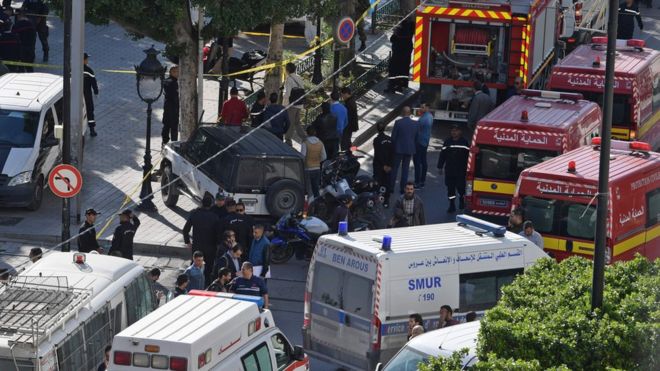
A picture taken on October 29, 2018, shows police and firemen gathering at the site of a suicide attack in the centre of the Tunisian capital TunisImage copyrightAFP

At least nine people were injured when a 30-year-old woman blew herself up in the centre of Tunisia's capital, Tunis, the interior ministry says.
The ministry said the woman had no previous known military background and described the blast as a "terrorist explosion".
Eight of those hurt in the explosion on Avenue Habib Bourguiba, which runs through the middle of the city, were police officers.
No deaths have been reported.
No group has said they are behind the attack.
The attack comes at a time when the country's vital tourism industry is starting to show signs of recovery, more than three years after two deadly terror attacks decimated visitor numbers.
The first, an attack on the capital's Bardo Museum in March 2015, left 22 people dead. Just a few months later, in June, another 38 people were killed in a resort in Sousse.

Where did the attack happen?

Pictures from the scene of the attack show a large number of emergency service personnel in the area.
The explosion was 200 metres from the French Embassy and on the same road as the interior ministry, local journalist Souhail Khmira told the BBC.
He arrived at the scene 15 minutes after the explosion and says a cloud of black smoke was visible from far away.
He says shops were shut on what is usually one of the busiest streets in the capital, and that police have barricaded the street.

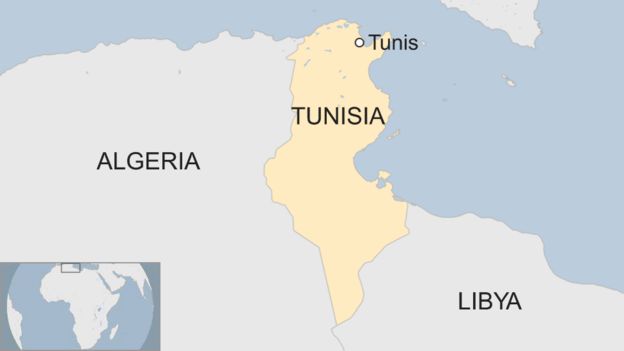
A map showing Tunis is Tunisia

Tunisia has been under a state of emergency since 2015 when a suicide bomber killed 12 security agents on a bus for presidential guards, reports AFP news agency.
This state of emergency was extended earlier this month until November 6, ahead of elections planned for next year, AFP adds.

Related Topics