"Darwin was the first to use data from nature to convince people that evolution is true, and his idea of natural selection was truly novel. It testifies to his genius that the concept of natural theology, accepted by most educated Westerners before 1859, was vanquished within only a few years by a single five-hundred-page book. On the Origin of Species turned the mysteries of life's diversity from mythology into genuine science." -- Jerry Coyne
Bloomsbury Sigma; Skull 17 from the Sima de los Huesos site in Sierra de Atapuerca, Spain. (Photo by Javier Trueba/Madrid Scientific Films)
Exasperated with the governors of Texas and Mississippi for lifting coronavirus restrictions, President Biden said, “The last thing we need is Neanderthal thinking” (story). I realize Biden is angry at Republicans’ chronic mismanagement of the pandemic, but that’s no reason to impugn the dignity and intelligence of Neanderthals.
I’ve developed an intense appreciation for these distant relatives since reading Rebecca Wragg Sykes’s new book, “Kindred: Neanderthal Life, Love, Death and Art.” It’s a revelatory investigation into the bipeds who interbred with us more than 50,000 years ago (story). Sykes’s book includes not only the latest, fascinating discoveries about Neanderthal bodies and customs, but also the history of our evolving attitudes toward these “Most Hench Hominins.” The result is a delightfully accessible work of anthropology and cultural criticism.
“Fundamentally, the long obsession over the Neanderthals’ fate reflects our deep dread of annihilation,” Sykes writes. “In the face of obliteration, we desire comforting parables where we are always the Ones Who Lived. What's more, we want to feel special: most of the stories we've told about Neanderthals have been narcissistic reassurances that we ‘won’ because we're outstanding, destined to survive. Yet the Neanderthals were never some sort of highway service station en route to Real People. They were state-of-the art humans, just of a different sort.”
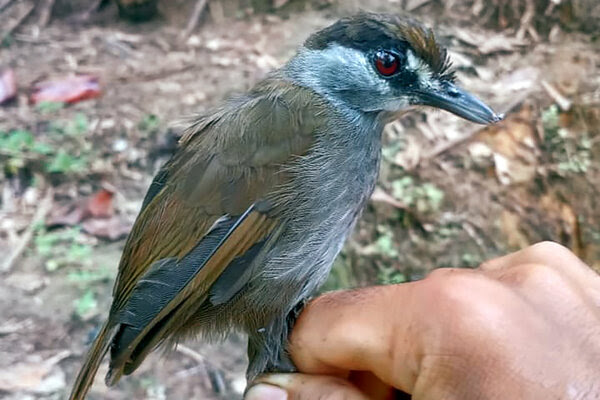
9. What might be Asia’s longest-missing bird just came out of hiding.
For the first time in 170 years, the black-browed babbler was found in an Indonesian forest. Ornithologists first described the bird around 1850, after the one and only known specimen of the species was collected. Then the enigmatic bird disappeared.
One conservationist said the discovery was “as shocking as rediscovering the passenger pigeon or Carolina parakeet.”
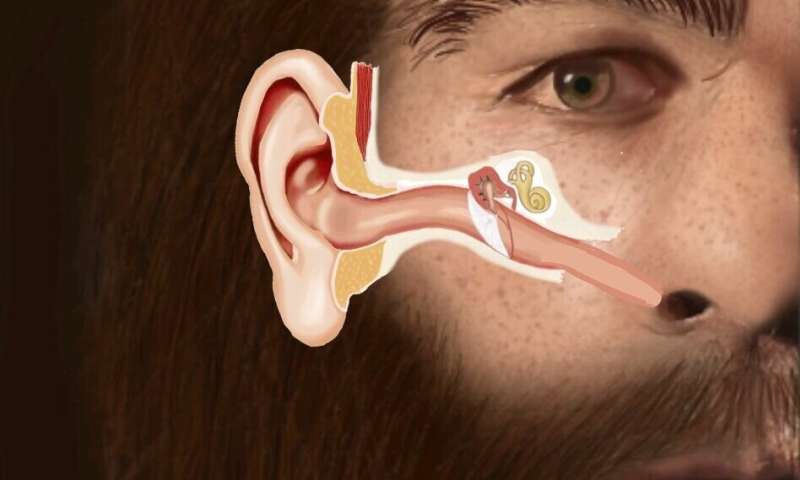
In other discoveries, a team of scientists reconstructed the outer and middle ear of Neanderthals and concluded that they listened to the world much like we do, adding a new piece to the puzzle of whether early humans could speak.
Homo sapiens (anatomically modern humans) emerged close to 300,000 to 200,000 years ago, most likely in Africa, and Homo neanderthalensis emerged at around the same time in Europe and Western Asia. H. sapiens dispersed from Africa in several waves, from possibly as early as 250,000 years ago, and certainly by 130,000 years ago, the so-called Southern Dispersal beginning about 70–50,000 years ago leading to the lasting colonisation of Eurasia and Oceania by 50,000 years ago. Both in Africa and Eurasia, H. sapiens met with and interbred witharchaic humans. Separate archaic (non-sapiens) human species are thought to have survived until around 40,000 years ago (Neanderthal extinction), with possible late survival of hybrid species as late as 12,000 years ago (Red Deer Cave people).
Geneticists tell us that somewhere between 1 and 5 percent of the genome of modern Europeans and Asians consists of DNA inherited from Neanderthals, our prehistoric cousins.
At Vanderbilt University, John Anthony Capra, an evolutionary genomics professor, has been combining high-powered computation and a medical records databank to learn what a Neanderthal heritage — even a fractional one — might mean for people today.
We spoke for two hours when Dr. Capra, 35, recently passed through New York City. An edited and condensed version of the conversation follows.
Q. Let’s begin with an indiscreet question. How did contemporary people come to have Neanderthal DNA on their genomes?
A. We hypothesize that roughly 50,000 years ago, when the ancestors of modern humans migrated out of Africa and into Eurasia, they encountered Neanderthals. Matings must have occurred then. And later.
One reason we deduce this is because the descendants of those who remained in Africa — present day Africans — don’t have Neanderthal DNA.
What does that mean for people who have it?
At my lab, we’ve been doing genetic testing on the blood samples of 28,000 patients at Vanderbilt and eight other medical centers across the country. Computers help us pinpoint where on the human genome this Neanderthal DNA is, and we run that against information from the patients’ anonymized medical records. We’re looking for associations.
What we’ve been finding is that Neanderthal DNA has a subtle influence on risk for disease. It affects our immune system and how we respond to different immune challenges. It affects our skin. You’re slightly more prone to a condition where you can get scaly lesions after extreme sun exposure. There’s an increased risk for blood clots and tobacco addiction.
To our surprise, it appears that some Neanderthal DNA can increase the risk for depression; however, there are other Neanderthal bits that decrease the risk. Roughly 1 to 2 percent of one’s risk for depression is determined by Neanderthal DNA. It all depends on where on the genome it’s located.
Was there ever an upside to having Neanderthal DNA?
It probably helped our ancestors survive in prehistoric Europe. When humans migrated into Eurasia, they encountered unfamiliar hazards and pathogens. By mating with Neanderthals, they gave their offspring needed defenses and immunities.
That trait for blood clotting helped wounds close up quickly. In the modern world, however, this trait means greater risk for stroke and pregnancy complications. What helped us then doesn’t necessarily now.
Did you say earlier that Neanderthal DNA increases susceptibility to nicotine addiction?
Yes. Neanderthal DNA can mean you’re more likely to get hooked on nicotine, even though there were no tobacco plants in archaic Europe.
We think this might be because there’s a bit of Neanderthal DNA right next to a human gene that’s a neurotransmitter implicated in a generalized risk for addiction. In this case and probably others, we think the Neanderthal bits on the genome may serve as switches that turn human genes on or off.
Aside from the Neanderthals, do we know if our ancestors mated with other hominids?
We think they did. Sometimes when we’re examining genomes, we can see the genetic afterimages of hominids who haven’t even been identified yet.
This illustration shows the structure of the Eustachian Tube in Neanderthal Man
It is one of the great unsolved mysteries of anthropology. What killed off the Neanderthals, and why did Homo sapiens thrive even as Neanderthals withered to extinction? Was it some sort of plague specific only to Neanderthals? Was there some sort of cataclysmic event in their homelands of Eurasia that lead to their disappearance? A new study from a team of physical anthropologists and head & neck anatomists suggests a less dramatic but equally deadly cause.
Published online by the journal The Anatomical Record, the study, "Reconstructing the Neanderthal Eustachian Tube: New Insights on Disease Susceptibility, Fitness Cost, and Extinction" suggests that the real culprit in the demise of the Neanderthals was not some exotic pathogen.
Instead, the authors believe the path to extinction may well have been the most common and innocuous of childhood illnesses—and the bane of every parent of young children—chronic ear infections.
"It may sound far-fetched, but when we, for the first time, reconstructed the Eustachian tubes of Neanderthals, we discovered that they are remarkably similar to those of human infants," said co-investigator and Downstate Health Sciences University Associate Professor Samuel Márquez, Ph.D., "Middle ear infections are nearly ubiquitous among infants because the flat angle of an infant's Eustachian tubes is prone to retain the otitis media bacteria that cause these infections—the same flat angle we found in Neanderthals."
In this age of antibiotics, these infections are easy to treat and relatively benign for human babies. Additionally, around age 5, the Eustachian tubes in human children lengthen and the angle becomes more acute, allowing the ear to drain, all but eliminating these recurring infections beyond early childhood.
But unlike modern humans, the structure of the Eustachian tubes in Neanderthals do not change with age—which means these ear infections and their complications, including respiratory infections, hearing loss, pneumonia, and worse, would not only become chronic, but a lifelong threat to overall health and survival.
"It's not just the threat of dying of an infection," said Dr. Márquez. "If you are constantly ill, you would not be as fit and effective in competing with your Homo sapien cousins for food and other resources. "In a world of survival of the fittest, it is no wonder that modern man, not Neanderthal, prevailed."
"The strength of the study lies in reconstructing the cartilaginous Eustachian tube," said Richard Rosenfeld, MD, MPH, MBA, Distinguished Professor and Chairman of Otolaryngology at SUNY Downstate and a world-renowned authority on children's health. "This new and previously unknown understanding of middle ear function in Neanderthal is what allows us to make new inferences regarding the impact on their health and fitness."
"Here is yet another intriguing twist on the ever-evolving Neanderthal story, this time involving a part of the body that researchers had almost entirely neglected," said Ian Tattersall, Ph.D., paleoanthropologist and Curator Emeritus of the American Museum of National History. "It adds to our gradually emerging picture of the Neanderthals as very close relatives who nonetheless differed in crucial respects from modern man."
This is from one of Idiot America's bible websites. Millions of American fucktards agree with this ridiculous bullshit.
"God created the first two humans about 6,000 years ago, according to His own eyewitness account. All people, including Neanderthals are descended from them."
The mysterious Denisovans may have occupied a cave in what is now Siberia for more than 250,000 years.
Researchers in the Denisova Cave in Siberia, including archaeologist Katerina Douka, second left. They have found that the cave was continuously occupied for over 300,000 years.
Over the past decade, the Denisova Cave in Siberia has yielded some of the most fascinating fossils ever found. To the naked eye, they are not much to look at — a few teeth, bits of bone.
But the fossils contain DNA dating back tens of thousands of years. That genetic material shows that Denisovans were a distinct branch of human evolution, a lost lineage.
At some point in the distant past, the Denisovans disappeared — but not before interbreeding with modern humans. Today, people in places like East Asia and New Guinea still carry fragments of Denisovan DNA.
One of the biggest obstacles to understanding the Denisovans is their age. Standard methods for dating these fossils have left scientists perplexed.
“Everyone said, ‘These Denisovans, we have no idea how old they are,’” said Katerina Douka, an archaeologist at the Max Planck Institute for the Science of Human History in Germany.
Over the past six years, Dr. Douka and other experts have been creating a sort of history of the Denisova Cave. They have dated 103 layers of sediment on the cave floor, as well as 50 items found in them, including bones, pieces of charcoal and tools.
The scientists unveiled this chronology in a pair of papers published on Wednesday. That timeline shows that humans occupied the cave for perhaps as long as 300,000 years. And it raises some intriguing hints that Denisovans may have been capable of sophisticated thought, on par with modern humans.
In an accompanying commentary, Robin Dennell of the University of Exeter in England wrote that Dr. Douka and her colleagues have created “a rigorous and compelling timeline.”
Bone points and pierced teeth from the early Upper Paleolithic layers of Denisova Cave.
Denisova Cave sits about 30 yards above the Anuy River. The cave has a large main chamber with a high ceiling; from there, passageways lead to smaller chambers. Over the past few hundred thousand years, sediment has slowly built up on the cave floor.
In the 1970s, Russian scientists began digging into that sediment, finding fossils of animals like hyenas and bears, fragments of humanlike bones and thousands of stone tools, as well as bracelets, beads and other ornaments.
In 2010, researchers at the Max Planck Institute of Evolutionary Anthropology announced they had found DNA in teeth and bones from the cave. In addition to Denisovan DNA, they found a few bone fragments that contained Neanderthal DNA.
By comparing the mutations in this DNA, the scientists got a better sense of how Denisovans and Neanderthals fit into the human family tree.
As it turned out, modern humans share a common ancestor with Denisovans and Neanderthals that lived roughly 600,000 years ago. Later — approximately 400,000 years ago — the Neanderthal and Denisovan lineages split.
Ever since the digging began, Russian researchers have carefully mapped the sedimentary layers in which they found bones and tools. They tried to estimate the ages of the layers, but “the dates were all over the place,” said Dr. Douka.
She and her colleagues at the University of Oxford are experts on determining the age of carbon. Researchers from the University of Wollongong in Australia tried an alternate method called optical dating.
The researchers combined results from the two methods to assemble a single chronology of the cave. The findings are largely in agreement: “It’s definitely a unified story,” said Zenobia Jacobs, an archaeologist at the University of Wollongong.
The earliest signs of human life in the cave — simple stone tools — are more than 287,000 years old. The tools alone cannot tell us if those first people were Denisovans or Neanderthals.
But they are not the style known to be made by Neanderthals, suggesting Denisovans may have been the creators.
It’s not until about 200,000 years ago that the oldest Denisovan DNA comes to light. The researchers estimated it to be between 217,000 and 185,000 years old. A Neanderthal DNA sample comes from a layer that formed between 205,000 and 172,000 years ago.
In the millenniums that followed, both Denisovans and Neanderthals left more genetic evidence in the cave. It may have been continually occupied for thousands of years by one group, then abandoned and reoccupied by others.
But Neanderthals and Denisovans must have overlapped at least once during those tens of thousands of years.
The entrance of the cave, which Russian scientists have been investigating since the 1970s. In the floor sediment, they have found fragments of animal and human bones, as well as ornaments and tools.
The researchers found no Neanderthal remains in more recent layers of the cave floor — only Denisovan. A Denisovan tooth dates back to between 55,300 and 84,100 years ago; a Denisovan chip of bone is 51,600 to 76,200 years old.
Paradoxically, the most recent parts of the cave have yielded some of its biggest mysteries.
Starting around 45,000 years ago, new kinds of artifacts begin showing up in the cave floor. They include pointed pieces of bone, as well as ornaments like stone bracelets and beads. One possibility is that these new tools were made by newly arrived modern humans.
Modern humans evolved in Africa and then expanded out to other continents. They may have made it to what is now Siberia: One human fossil discovered there dates to about 45,000 years ago.
But Michael Shunkov, a co-author of the new studies and the director of Institute of Archaeology and Ethnography at the Russian Academy of Sciences, disagrees with that interpretation.
The sophisticated tools in the Denisova Cave show “no clear indications for outside influences,” he said in an email. Instead, Dr. Shunkov believes that the Denisovans who occupied the cave for perhaps 250,000 years developed this technology on their own.
One way to resolve this question would be to find human fossils from that period.
Dr. Douka and her colleagues have discovered a bone dating back between 45,900 and 50,000 years ago that contains humanlike proteins — but no DNA. It could belong to a modern human, a Neanderthal or a Denisovan.
Researchers are scouring the cave floor for still more fossils. A fossil from around 45,000 years ago could be loaded with surprises.
What if the ornaments from that period were made by hybrids of modern humans and Denisovans?
“This dichotomy, that it has to be one or the other, is a little bit old-fashioned,” Dr. Douka said.
Recent reporting about Neanderthals and Denisovans
Imagine this scene: Inside a cave in Spain, a group of people gather around the grave of a toddler. Hearths with lit fires, marked by 30 horns of animals including bison and red deer, surround the grave. A rhinoceros skull is nearby.
At a conference this fall, archaeologist Enrique Baquedano and his colleaguesdescribedthis scene as a probable funeral ritual held 40,000 years ago by Neanderthals.
That announcement contains a mix of both hard data — the child's bones and the animal horns and skull — and informed speculation suggesting that these data point to a community funeral ritual.
The archaeologists' scenario relates closely to questions I have been thinking about: Did the Neanderthals practice religion? How would we know it, if they did?
Let's approach these questions by placing Neanderthals in evolutionary context. It's now clear that Neanderthals are our cousins, not our direct ancestors or early members of our own speciesHomo sapiens. Known formally asHomo neandertalensis,Neanderthals lived in Europe and Asia, overlapping in certain places at certain time periods withHomo sapiens —and almost certainly interbreeding with them (with us!) on occasion.
Even though populations of Neanderthals vanished around 40,000 years ago, genes of Neanderthals do live on today, tucked into the bodies of some of us and potentiallyaffecting our health.
For much of the time since their initial discovery in the 19th century, Neanderthals have been cast as enduring symbols of dumb, brutish cave people. We know better now, though.
But does any of the evidence suggest that they were religious? It's notably tricky to infer religious behavior from material culture, as I'vewritten about herebefore regarding Gobekli Tepe, a possible 11,000-year-old modern-human temple.
We do see hints of ceremonial responses to the dead at Neanderthal sites other than the Spanish cave. AtTeshik-Tashin Uzbekistan, a Neanderthal child was buried and encircled by goat horns. At Regourdou in France, bear bones, plus a slab of rock topped by tools and another bear bone, were placed at a Neanderthal body positioned at the bottom of a depression. Bear bones in an adjacent room at Regourdou suggest to some archaeologists that bear meat might have been consumed there as a funeral rite.
Skeptics like archaeologist Rob Gargett point out bothformallyandinformallythat natural (ortaphonomic) explanations may suffice to explain some of these occurrences: In other words, it may not be Neanderthal agency that we're seeing at all.
Looking at the evidence collectively, though, I think at least this conservative conclusion is warranted:Some Neanderthals buried their deadwith purpose and care.
Next comes our central question: Did Neanderthals engage in some way with the supernatural or the sacred?
Caution is required here. The bones and artifacts, after all, don't clue us in to themeaning-makingthat went on in Neanderthal groups, and we can't just overlay present customs onto the past.
Perhaps the Neanderthals simply wanted to bury their companions' bodies in order to protect themselves from predators, or disease, or both.
But, then, why mark the burials as elaborately as the Neanderthals have done in some places?
Maybe the symbolic marking was the Neanderthals' way of showing respect and care for people they had known and loved in their lives.
Either or both of these explanations may be wholly adequate to explain the evidence.
Yet, I wonder.
Given their intelligence, it seems to me likely that the Neanderthals contemplated, in some way, the mysteries of life. Wouldn't they have wondered not only about unexpected and surprising weather events and sky events but also what happens when our lives comes to an end? If they thought about these questions, did they do so with awe, dread or reverence?
More relevantly for a scientific analysis is this question: Did they come together in groups to evoke gods, spirits or ancestors to help themselves make sense of the world?
I emailed anthropologist and Neanderthal expertJohn Hawksat the University of Wisconsin to ask for his thoughts about Neanderthals and religion.
His response, in part, was this:
"Religion, as many people recognize it, is built from highly detailed symbolic narratives. If we separate that out, though, and look only at the material manifestations that an archaeologist might find, there is really very little in most religious traditions that is different from what Neanderthals do.
"So I don't think it is at all improbable that the Neanderthals had a humanlike religious capacity. But to be honest, I think this is not what many Americans or Europeans would recognize as religion."
Hawks' basic idea fits withmy own: Religion is best understood across cultures and time periods aspracticerather than onlybelief. Some religions, of course, feature sacred texts in which a set of beliefs is set forth. In these cases, what you believe about a god or other sacred forces may really matter. In many human societies past and present, though, no text exists, just everyday life — appeasing gods or spirits, honoring the ancestors — that is shot through with a sense of the sacred or the supernatural.
It's within this context that the case for Neanderthal religion — for ritual practices steeped in connecting to the sacred world — is most convincingly made.
It's no accident that I'm writing about this topic in December. It's a month that, for many people, includes sacred holiday celebrations. Even for those of us who aren't religious, it's a time of the year packed with meaning-making through social gatherings and rituals.
How fascinating it is to take seriously the idea that the deep roots of human meaning-making ritual, and even of religiosity, may go as far back as the time of the Neanderthals.
Barbara J. King is an anthropology professor emerita at the College of William and Mary. She often writes about the cognition, emotion and welfare of animals, and about biological anthropology, human evolution and gender issues. Barbara's most recent book on animals is titledHow Animals Grieve,and her forthcoming book,Personalities on the Plate: The Lives and Minds of Animals We Eat, will be published in March.You can keep up with what she is thinking on Twitter:@bjkingape