The Atlantic
SCIENCE
Elon Musk Is Maybe, Actually, Strangely, Going to Do This Mars Thing
From his private Cape Canaveral, the billionaire is manifesting his own interplanetary reality—whatever it costs.
Story by Marina Koren
The little havanese likes to sit in a window of the one-story house, looking out onto the quiet street in Boca Chica, Texas. From its perch, it can watch neighbors passing by, glossy black grackles pecking in the grass, and palm trees swaying in the breeze. The dog’s presence is usually a sign that its owner, Elon Musk, is in town. That, and the Tesla parked in the driveway.
There are other, more conspicuous signs that Musk has gotten comfortable in this remote part of South Texas, near the U.S.-Mexico border. The hulking manufacturing tents just down the road. The steel strewn on the ground. The mechanical hum of machinery as workers in hard hats assemble spaceship after spaceship.
Musk has built a shipyard here. This is the staging area for SpaceX’s founding dream, the reason Musk got into the rocket business: to put human beings on Mars, not to drop a flag and go home, but to stay and survive. That Mars might be a terrible place to live is irrelevant. Musk believes that humankind should exist on more than one planet, and that we should start soon.
Musk intends to make a leap in that direction with Starship, a reusable spaceship-and-rocket system that he hopes will redefine travel—first by jetting from continent to continent, then from Earth to the moon, and finally from Earth to Mars. At a glance, this plan sounds like the kind of idealistic dream you’d expect from a wealthy entrepreneur who is often compared, without irony, to a comic-book hero. Or maybe, depending on your view of Musk, a self-aggrandizing fantasy from one of the most trollish, publicly chaotic figures of our time. But the fantasy is swiftly crystallizing into a feasible reality. The South Texas shipyard is churning at all hours. A Starship prototype finally stuck its landing last night (without bursting into flames minutes later). And the world’s top space agency believes in the effort too.
NASA has given SpaceX a $2.9 billion contract to develop a version of Starship to land American astronauts on the surface of the moon for the first time since the Apollo program. Jeff Bezos’s rocket company, Blue Origin, which partnered with a few longtime NASA contractors to bid on the same job, has formally challenged NASA over its decision to choose a single contractor. The agency has put the contract on hold for the time being, but it appears that the next visitors to the moon—including, NASA has promised, the first woman and person of color—could be flying SpaceX.
America has now tied one of its biggest space dreams to SpaceX, which means the country has tied it to Elon Musk, the company’s CEO and chief engineer. To build Starship, the billionaire has overhauled Boca Chica into his private Cape Canaveral, and has started referring to the area as “Starbase.” He has mocked Bezos and other competitors; he has chafed at federal oversight. He has also made Boca Chica the one place on Earth where the dream of getting to Mars feels most real. The Starship work that SpaceX is doing now, if it pans out, will be the company’s most impressive achievement. More impressive than landing rocket boosters upright on a ship in the ocean. More impressive than enveloping the planet in a bubble of hundreds of internet satellites. More impressive than launching astronauts to the International Space Station, and bringing them home safely.
Musk now says that Starship could land people on the moon in 2024, and take them to Mars within the decade. He is famous for his aspirational, and usually unrealistic, timelines. But the Starship project could bring humankind closer than it has been in 50 years to reaching another world again. If the idea of SpaceX sending people to the moon, let alone Mars, seemed like an abstraction a decade ago, then a decade from now, it might seem like a given.
Twenty years ago, if people were familiar with Elon Musk, they knew him as the nerdy powerhouse behind a couple of internet companies—Zip2, a software company that was eventually folded into the AltaVista search engine, and X.com, an online bank that eventually merged with PayPal. In 2002, after the entrepreneur from South Africa had sold off one business and left the other, a friend asked what he wanted to do next. Space exploration, Musk said—he’d always been interested in that. Born in 1971, the year of the third moon landing, Musk assumed that NASA had a plan to reach Mars, and soon. When he went searching for a schedule on NASA’s website, he told Wired in 2012, he found that the agency had no plans, nor a big enough budget for an Apollo-style rush to reach the red planet. “At first I thought, jeez, maybe I’m just looking in the wrong place! Why was there no plan, no schedule?” Musk said in the interview. “There was nothing.”
There had been a moment, after the moon landings, when the rest of the solar system had suddenly felt within reach, Mars especially. Even some of the Apollo astronauts had thought so, and had held out hope for a Mars mission. Instead, they became the last people to travel beyond low-Earth orbit. In the decades that followed, a wonderful assortment of space probes ventured into the solar system, to Mars and Saturn and Pluto, but human beings remained close to home, flying shuttles and building space stations.
Musk decided that he would rally some support for a Mars shot; perhaps a small greenhouse on the red planet’s surface—a beautiful juxtaposition of terrestrial life and an alien world—would capture the public’s attention. But when he looked into rocket launches, he was surprised by their steep price tags. Surely someone had figured out how to make space travel cheaper by now?
Read: The world’s richest men are brawling over the moon
Within a decade, SpaceX successfully launched a rocket into orbit, in 2008. By 2016, it had landed a 14-story rocket booster back on Earth in one piece—on the ground, and on a ship at sea—a triumph in an industry used to discarding expensive rocket bits in the ocean. SpaceX had sacrificed about a dozen boosters in this quest; there were big explosions, small explosions, mid-air explosions, made-it-to-the-barge-but-then-the-landing-legs-crumpled explosions. (The company eventually compiled the attempts all into a blooper reel.) A couple of Falcon 9 rockets carrying expensive payloads also exploded, but those failures feel distant now, and these days, the company’s mood is buoyant. To longtime SpaceX workers, the manic Muskian approach always pays off. “It went from, Holy crap, how are we going to do this? to what I would consider a quiet professional confidence,” a former SpaceX employee who worked on the company’s human-spaceflight efforts, and who requested anonymity in order to maintain future business ties with the company, told me. The Starship team’s confidence, the former employee said, is likely “sky high.”
Today, SpaceX regularly flies astronauts into orbit on a transportation system it designed from start to finish, and is the only private company to have earned that responsibility. But the Dragon capsule doing that work is a cozy, gumdrop-shaped container, not a giant spaceship, and can carry seven people at a time, not the 100 passengers Musk imagines boarding Starship someday. If successful, Starship would be unlike any other space vehicle in history, especially on its return to Earth. America’s now-retired fleet of space shuttles landed on runways like planes, Russian Soyuz capsules parachute down to the desert, and SpaceX’s Dragon capsules splash down in open water, but Musk envisions Starship landing vertically, as upright as it stood before liftoff. It is an enormous technical challenge.
Since December, workers at the Boca Chica shipyard have constructed several Starship prototypes—stocky, 150-foot-tall towers of stainless steel with fins—hauled them to a launchpad on a nearby beach on the Gulf of Mexico, and watched them launch. None of them survived until last night—the fifth attempt—when the prototype nailed the intricate maneuver it was designed to do: The spacecraft rose more than 30,000 feet into the sky, quieting its engines as it went, then flipped onto its belly and fell down, down, down, before firing up again and righting itself for a gentle landing, like a falling cat twisting around at the last minute to find its feet.
The string of fiery flights might have made it seem as if SpaceX was struggling, or unsure. But the opposite is true. SpaceX engineers jokingly call explosions RUDs, for “rapid unscheduled disassembly,” and the names of Starship prototypes start with SN, for “serial number,” a signifier that the product is not precious, but a good production line is. When one prototype is destroyed, another promptly takes its place. In the company’s early years, all those explosions might have given it pause, but now barely any SpaceX doubters are left in the industry.
Read: Why SpaceX wants a tiny Texas neighborhood so badly
Musk moved from California, where SpaceX is headquartered, to Texas last year. He appears in Boca Chica often, along with his children and his dog. SpaceX did not respond to requests for comment on this story, and hasn’t replied to other inquiries from The Atlantic in more than a year. The company has had little imperative to be forthcoming about Starship development, and it doesn’t have the same obligations to the public or the press as NASA does. Musk has also been impatient with the Federal Aviation Administration, which handles licenses for space launches and dispatches safety inspectors to Boca Chica, and has accused the agency of slowing SpaceX down. The new moon contract—a high-profile, taxpayer-funded assignment—might force a shade more transparency. SpaceX does broadcast Boca Chica’s test launches, but the best views of Starship work come from a small community that has formed to monitor the company’s efforts. Most days, anyone can drive past the secluded Starship site and take pictures, though security guards might ask you to move along if you get too close.
One of the most well-known chroniclers, Mary McConnaughey, who goes by BocaChicaGal online, has been following SpaceX’s operations since the company arrived in 2014. She lives within sight of the house where the Havanese likes to perch. McConnaughey and her neighbors in Boca Chica Village never imagined that someone might try to build a spaceship in their little coastal paradise. When I visited the village in the fall of 2019, SpaceX was trying to buy the residents’ homes. Some residents sold and left, but others remained, refusing the price SpaceX had offered them. Although Musk once indicated that SpaceX’s job would be easier if they would leave, the company appears to have stopped pursuing their properties for now. On test days, the residents are used to receiving warning notices and going somewhere else. One resident, Celia Garcia-Johnson, who wanted to avoid traveling far from home during the coronavirus pandemic, spends launch days with her dog in an Airstream parked a few miles from the village, courtesy of SpaceX.
The village is now an expanding space town. There are more Airstreams, for spaceship workers who stay overnight, and a restaurant called Prancing Pony. (In J. R. R. Tolkien’s Middle-earth, an inn of the same name provisioned travelers before they embarked on a long journey.) Boca Chica “will grow by several thousand people over the next year or two,” Musk said in March, filling up with engineers, technicians, and support personnel “of all kinds.” In April, SpaceX threw a block party in the village, with a live band, and invited everyone, employees and remaining homeowners alike. Garcia-Johnson told me she enjoyed socializing with the SpaceX employees, some of whom live in the village themselves. But she can’t shake her uneasy feelings about the future of Boca Chica. Garcia-Johnson has owned her home here for nearly 30 years. “Scripture says ‘love thy neighbor,’ and if SpaceX is my neighbor, I guess I have to love SpaceX,” she told me.
If Boca Chica becomes a 21st-century spaceport, the last stop on Earth before Mars, it is difficult to imagine SpaceX tolerating straggling residents. Musk recently said that he would donate $20 million to schools in Cameron County, where Boca Chica is located, and $10 million to Brownsville, the nearest city, for “downtown revitalization.” Some of the homeowners here have feared that county officials, who are thrilled about SpaceX’s presence, could take over their properties through eminent domain. Using that power to make way for a private spaceport—rather than, say, a highway or a stadium—would be unusual, but not a surprise. SpaceX has launched hundreds of little satellites into Earth’s orbit without much input from the rest of Earth’s inhabitants. Musk has rarely faced resistance in his attempts to shape the world around him, and this world could be just the beginning.
The first city on mars, according to musk, will be made of pressurized glass domes. No breathable air on the red planet, after all. After that, Musk has said, we’ll terraform Mars to make the planet resemble Earth. Musk is, obviously, mostly focused on the getting-there part, and his living-there plan sometimes seems almost cavalier. In a 2019 interview with Popular Mechanics, he called life on Mars “quite manageable.” “But the planning that will have gone into knowing what you’re going to do when you get there—for food, for water, for fuel,” the journalist interviewing him said, apparently giving Musk some room to address potential challenges. “Once you get there,” Musk replied, “that stuff is relatively straightforward.” Other times, he is more direct about the scale of the effort and the risks it entails. “It’s an arduous and dangerous journey where you may not come back alive, but it’s a glorious adventure,” Musk said at a recent speaking event.
Musk can get away with talking like this not just because he is the second-richest person in the world, but because he has made himself into a figure who can make outlandish plans sound plausible—who has already made outlandish plans possible. He can talk forever about the importance of turning humankind into a multiplanetary species, of bringing Earth’s plants and wildlife with us to Mars if or when some doomsday event wipes us out on this planet. The people who run NASA can’t inspire us—or scare us—like that. They certainly want to build a base on the moon, and someday plant an American flag on Mars. But they can invoke only the usual ideas, of American exceptionalism and spirit, that have underpinned the country’s space effort since its beginnings, and hold up the wonder of space travel as proof that “we can meet any challenge” on Earth, as President Joe Biden said recently. NASA can’t replicate Musk’s attitude to hardware, either. “We’re definitely going to build a lot of rockets, and probably smash a lot of them,” Musk said in a recent press conference.
And yet, the brash billionaire and the storied space agency have now linked their futures to each other. The first moon missions of the 21st century are bound to be repeats of the Apollo landings, only with much better footage from the surface. With SpaceX, Musk has brought the country back to the intoxicating moment that followed Neil Armstrong’s small step, when the air seemed to buzz with the possibility of more steps on other alien surfaces. This is the same Elon Musk who launched a Tesla into space, tweets about putting Dogecoin on the moon, and shares NSFW memes; whose posts have led to lawsuits on more than one occasion; and who is hosting Saturday Night Live this weekend, alongside the musical guest Miley Cyrus. At this point, Iron Man taking NASA astronauts to the moon would sound more believable. Until you remember that Musk really has made it this far.
Read: America’s new vision of astronauts
“NASA still does fantastic work, but when it comes to really changing the space sector as a whole, SpaceX is the one that people think of the most,” Laura Forczyk, a space analyst and the author of Rise of the Space Age Millennials, told me. Her book’s Millennial subjects pointed to SpaceX’s achievements as their source of inspiration, and she’s working on a new edition featuring interviews with members of the younger Generation Z, who say the same.
A triumphant return to the moon, or a historic voyage to Mars, is bound to captivate the public as the Apollo landings did. But it will not inspire America, or the world, in some magical, universal way. The majority of Americans believed that the Apollo program wasn’t worth the effort throughout the 1960s, with the exception of the awestruck reaction to Armstrong’s first moonwalk. Today, most Americans don’t believe going back to the moon should be a priority, and they’re not all that jazzed about astronauts setting off for Mars, either. The government can still push for the moon, regardless of public opinion, but unlike a private company like SpaceX, NASA at least has to explain where all that money is going and why. Meanwhile, a growing industry of private space tourism, with vehicles capable of flying more autonomously than ever before, is changing the profile of astronauts, and soon, perhaps, most people who go to space will not be highly trained pilots or scientists, but simply rich people. Already, a Japanese entrepreneur has purchased an entire Starship flight for as many as 12 passengers for a loop around the moon in 2024.
This future depends on Starship leaving the planet at all. The project still has a long way to go—more prototypes, more hours of tests and troubleshooting, a separate effort to engineer the behemoth rocket booster that will loft the spaceship into orbit and then return to Earth in the delicate sequence that SpaceX has nearly perfected with its other boosters. The South Texas shipyard will continue its sprawl along the coast, like a fast-growing invasive species. When Garcia-Johnson returned home after an explosive test in late March, she discovered a sign of the changing habitat—one of her windows had shattered from the force of the blast. SpaceX summoned a window company to repair it the next day, down the two-lane state highway that SpaceX fans call “the highway to Mars,” the only way into Boca Chica. Take this path all the way to Boca Chica, past the solar-panel farms and storage sheds, past the little street that used to be called Joanna Street until Musk renamed it Rocket Road, and you end up on the beach, with sky and sea stretching out before you. It’s a beautiful view on any day, and maybe, one day, it’ll be someone’s last look at Earth.
MARINA KOREN is a staff writer at The Atlantic. Twitter


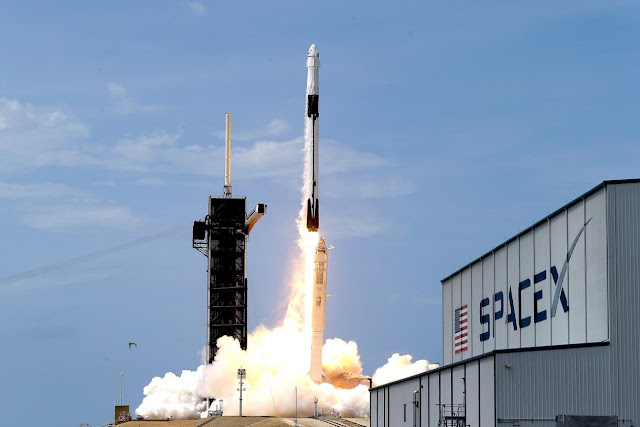
SpaceX: Musk's 'Mars ship' prototype aces 150m test flight
 SPACEX
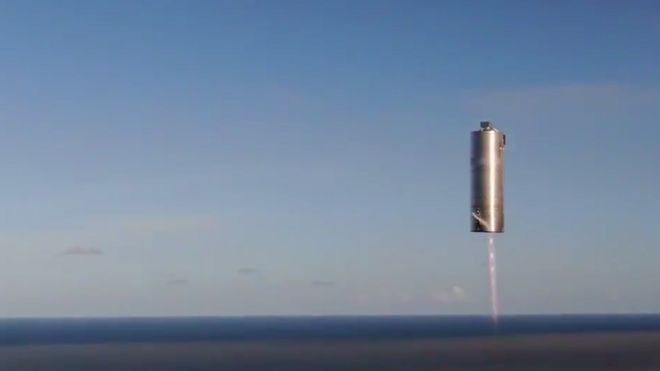
A prototype of SpaceX's next-generation Starship vehicle has successfully flown to an altitude of 150m (500ft).
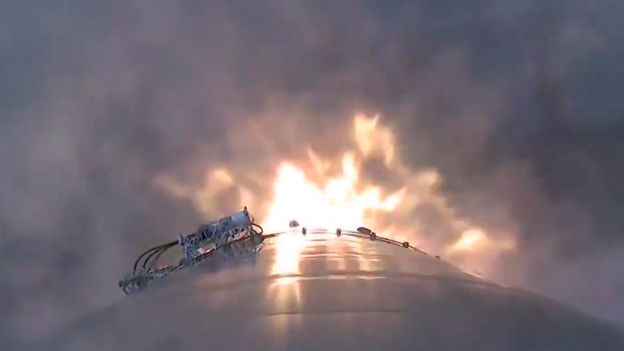
The uncrewed test vehicle rose up on a plume of exhaust before deploying its landing legs and touching down softly.
The flight was carried out at SpaceX's test site near the village of Boca Chica in south Texas on Tuesday evening.
It's the first flight test in almost a year for the Raptor engine, which will be used to power Starship.
The stainless steel test vehicle, called SN5, has been compared variously to a grain silo and water tank.
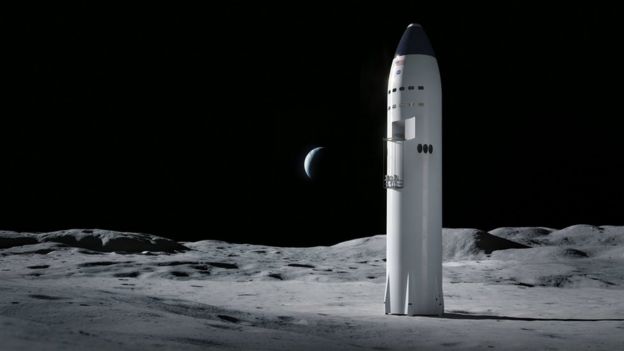
But it could pave the way for a spacecraft capable of carrying humans to the Moon and Mars.
Shortly after the test flight, which lasted just under a minute, SpaceX founder Elon Musk tweeted: "Mars is looking real."
SN5 took off from Boca Chica at 00:57 BST (18:57 local time) for the brief flight. It uses a single Raptor engine, which is powered by liquid methane and liquid oxygen.
The final Starship vehicle will feature six Raptors, standing 50m (165ft) tall. It could carry 100 people on a single flight.
But in order to overcome Earth's gravity, it will need to be launched by a massive rocket called Super Heavy, which will be equipped with 31 Raptor engines.
 SPACEX
 SPACEX
Another test vehicle called Starhopper undertook a few brief flights in 2019, also flying to a height of 150m (500ft).
The Starship vehicle is one of three shortlisted candidates to land humans on the Moon in the 2020s for Nasa. A Japanese billionaire, Yusaku Maezawa, who made his fortune in online fashion retail, has booked a trip around the Moon on Starship.
Elon Musk has long harboured plans to settle people on Mars as part of his vision to make humans a "multi-planetary species".
Follow Paul on Twitter.