"Darwin was the first to use data from nature to convince people that evolution is true, and his idea of natural selection was truly novel. It testifies to his genius that the concept of natural theology, accepted by most educated Westerners before 1859, was vanquished within only a few years by a single five-hundred-page book. On the Origin of Species turned the mysteries of life's diversity from mythology into genuine science." -- Jerry Coyne
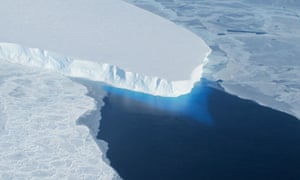
Located in West Antarctica, the enormous Pine Island and Thwaites glaciers have been losing mass for more than a decade. The survival of Thwaites is so critical that the United States and Britain have begun a targeted, multimillion-dollar research mission to the glacier. Its loss could trigger the broader collapse of the West Antarctic ice sheet, which contains enough ice to eventually raise sea levels by about 10 feet.
Just days after the earth saw its warmest January on record, Antarctica has broken its warmest temperature ever recorded. A reading of 65 degrees was taken Thursday at Esperanza Base along Antarctica’s Trinity Peninsula, making it the ordinarily frigid continent’s highest measured temperature in history.
The Argentine research base is on the northern tip of the Antarctic Peninsula. Randy Cerveny, who tracks extremes for the World Meteorological Organization, called Thursday’s reading a “likely record,” although the mark will still have to be officially reviewed and certified.
The Antarctic Peninsula, on which Thursday’s anomaly was recorded, is one of the fastest-warming regions in the world. In just the past 50 years, temperatures have surged a staggering 5 degrees in response to earth’s swiftly warming climate. Around 87 percent of glaciers along the peninsula’s west coast have retreated in that time, the majority doing so at an accelerated pace since 2008.
The WMO notes that cracks in the Pine Island Glacier “have been growing rapidly” in the past several days according to satellite imagery.
The recent spate of warmth owes to a ridge of high pressure that has lingered over the region for several days. High-pressure systems feature sinking air, which favors milder temperatures.
This effect was amplified on a local level because of a “foehn” wind, characterized by air sweeping down a mountain that begins compressing as air pressures rise near the earth’s surface. That causes additional warming.
Moreover, a look at simulated atmospheric profiles around the time it hit the record indicated warmer air aloft than at the surface — meaning any air that mixed down to ground level could have had an additional leg up in warming.
It’s been a monumental year for climate extremes, and we’re only on day 38 of 2020. January was the warmest on record globally according to atmospheric monitoring group Copernicus, with records shattered in Europe and Asia. A number of locales in Eastern Europe and particularly Russia wound up more than 12 to 13 degrees above average.
“[This record] doesn’t come as any surprise,” wrote Eric Steig, a glaciologist studying climate change at the University of Washington. “Although there is decade-to-decade variability, the underlying trend across most of the continent is warming."
He says this record will probably be broken again in the not-so-distant future.
“That warming has been particularly fast on the Antarctic Peninsula — where Esperanza is — in summer (the season [they’re] now in)," Steig wrote. “So we can expect these sorts of records to be set again and again, even if they aren’t set every single year.”
David Bromwich, a climate researcher at Ohio State University, noted, however, that while the Antarctic Peninsula has warmed strongly since the late 1940s, temperature trends in summer have been variable in recent decades, including a brief cooling spell since 1998. “So overall, this record looks to be a one time extreme event that doesn’t tell us anything about Antarctic climate change,” he wrote in an email.
Additional extreme warmth is likely in the Antarctic Peninsula in the coming days. Temperatures some 40 to 50 degrees above normal are predicted by some models.
"If the Greenland Ice Sheet melted, scientists estimate that sea level would rise about 6 meters (20 feet). If the Antarctic Ice Sheet melted, sea level would rise by about 60 meters (200 feet)."
In South Africa there is a terrible drought.
"The drought has continued into 2019, as multiple regions in Southern Africa have seen significantly reduced levels of rainfall. A report from FAO noted that, while rainfall had picked up in late December 2018, several areas within the region were suffering from a severe drought and accompanying effects."
In northwestern Illinois where I live the temperature is 46 degrees (7.7 Celsius) instead of the usual 20 degrees (-6.6 Celsius) or colder. In other words, the climate where I live is wonderful. However, the farmers complained about too much rain in 2019.
There's going to be a lot of problems and it's going to get worse every year.
China is a big part of the problem, as is the United States (thanks President Trump) and Brazil (thanks President Bolsonaro).
Warning of ‘existential threat to civilisation’ as impacts lead to cascade of unstoppable events.
The world may already have crossed a series of climate tipping points, according to a stark warning from scientists. This risk is “an existential threat to civilisation”, they say, meaning “we are in a state of planetary emergency”.
Tipping points are reached when particular impacts of global heating become unstoppable, such as the runaway loss of ice sheets or forests. In the past, extreme heating of 5C was thought necessary to pass tipping points, but the latest evidence suggests this could happen between 1C and 2C.
The planet has already heated by 1C and the temperature is certain to rise further, due to past emissions and because greenhouse gas levels are still rising. The scientists further warn that one tipping point, such as the release of methane from thawing permafrost, may fuel others, leading to a cascade.
The researchers, writing in a commentary article in the journal Nature, acknowledge that the complex science of tipping points means great uncertainty remains. But they say the potential damage from the tipping points is so big and the time to act so short, that “to err on the side of danger is not a responsible option”. They call for urgent international action.
“A saving grace is that the rate at which damage accumulates from tipping could still be under our control to some extent,” they write. “The stability and resilience of our planet is in peril. International action – not just words – must reflect this.”
Prof Tim Lenton at the University of Exeter, the lead author of the article, said: “We might already have crossed the threshold for a cascade of interrelated tipping points. The simple version is the schoolkids [striking for climate action] are right: we are seeing potentially irreversible changes in the climate system under way, or very close.”
“As a scientist, I just want to tell it how it is,” he said. “It is not trying to be alarmist, but trying to treat the whole climate change problem as a risk management problem. It is what I consider the common sense way.”
Phil Williamson at the University of East Anglia, who did not contribute to the article, said: “The prognosis by Tim Lenton and colleagues is, unfortunately, fully plausible: that we might have already lost control of the Earth’s climate.”
The scientists report that 17% of the Amazon rainforest has been lost since 1970. Photograph: Léo Corrêa/AP“We have this alarming evidence that part of the west Antarctic ice sheet may be in irreversible retreat,” said Lenton. “All the signals are that it is.” A similar situation appears to be occurring at the Wilkes basin in east Antarctica. The collapse of these ice sheets would eventually raise sea level by many metres.
The Gulf Stream current in the Atlantic, which warms Europe, has also slowed by 15% since the mid-20th century. “That is just about in the range of natural variability, but it is also hard to rule out that it is part of a longer downturn,” Lenton said.
The scientists report that 17% of the Amazon rainforest has been lost since 1970. The tipping point, where loss of forest leads to it drying out, could lie in the range 20%-40%, they said. In temperate forests, especially in North America, heating has triggered more fires and pest outbreaks, potentially turning some regions from a sink for carbon to a source. In the tropics, corals are predicted to be wiped out by 2C of heating.
A cascade of tipping points could occur because, for example, the melting of Arctic sea ice amplifies heating by exposing dark ocean that absorbs more sunlight. That may increase the melting of Greenland ice and permafrost areas. “Multiple risks can interact, with one change reinforcing another, and with warming of just a degree or two sufficient to result in dramatic cascading effects,” said Williamson.
Prof Martin Siegert, at Imperial College London, said: “The new work is valuable. They are being a little speculative, but maybe you need to be.” He pointed out that the extremely rapid rate at which CO2 was being pumped into the atmosphere was unlikely to have ever occurred on Earth before. “It may mean that tipping points can occur in unexpected ways as there is no geological precedent for this rate of CO2 change.”
The article reports that preliminary results from the latest climate models suggest global heating will be greater than expected, increasing the risk of tipping points. Prof Piers Forster, at the University of Leeds, disagreed on that point. However, he added: “I completely endorse their call for action. Although possibly low probability, the risks they identify are real.”
Lenton said action would still have real benefits, by slowing the impacts and giving more time for people to adapt. He said: “This article is not meant to be a counsel of despair. If we want to avoid the worst of these bad climate tipping points, we need to activate some positive social and economic tipping points [such as renewable energy] towards what should ultimately be a happier, flourishing, sustainable future for the generations to come.”
Paulet Island, located near the Antarctic Peninsula in the northwest Weddell Sea, is home to more than 100,000 breeding pairs of Adelie penguins. The island is a small circular volcanic cone, about one mile in diameter with rocky slopes rising more than 1,100 feet above the shoreline. Cobble beaches are favorite napping locations for Weddell seals, which you'll see in this video. Adelie penguins pop in and out of the surf as they return to shore throughout the day. They spend some time drying off and preening on the upper beaches before making their way to the nesting locations. In some cases, this is a rather difficult journey over loose scree slopes to the uppermost ledges of the volcanic cone.
Snow fields are used by the penguins to travel back and forth from a freshwater lake at the center of the island. This lake was once used by members of Dr. Otto Nordenskjold's 1901-1904 Swedish Antarctic Expedition to survive being stranded on the island. A stone hut and burial marker remain today, but the hut is now prime roosting territory for Adelie penguins.
The Tennessee Aquarium members recently explored Antarctica with a seasoned Abercrombie & Kent expedition team and Dr. James McClintock, Endowed University Professor of Polar and Marine Biology at the University of Alabama at Birmingham. One of the many stops was at Palmer Long Term Ecological Research Station where Dr. McClintock studies marine species. Learn more about the Tennessee Aquarium, located in downtown Chattanooga, at http://www.tnaqua.org/Home.aspx
Large swaths of forest have been cut down in Brazil in recent decades to make room for farming. Deforestation contributes to global warming, and reversing it will be necessary to avoid catastrophic climate change.
Humans must drastically alter food production to prevent the most catastrophic effects of global warming, according to a new report from the United Nations panel on climate change.
The panel of scientists looked at the climate change effects of agriculture, deforestation and other land use, such as harvesting peat and managing grasslands and wetlands. Together, those activities generate about a third of human greenhouse gas emissions, including more than 40% of methane.
That's important because methane is particularly good at trapping heat in the atmosphere. And the problem is getting more severe.
"Emissions from agricultural production are projected to increase," the authors warn. "Delaying action" on reducing greenhouse gas emissions, they continue, "could result in some irreversible impacts on some ecosystems."
This is the latest in a series of reports from the U.N.'s Intergovernmental Panel on Climate Change. The new report adds weight and detail to a warning put out by the same panel of scientists last fall, in which they sounded the alarm about the inadequacy of the pledges countries have made so far to reduce greenhouse gas emissions.
At that time, the panel broadly suggested that farmland would need to shrink and forests would need to grow to keep Earth from getting more than 1.5 degrees Celsius hotter than it was in the preindustrial era. Global temperatures have already risen about 1 degree Celsius in the past 150 years.
To meet that temperature target, global greenhouse gas emissions will need to fall by 40% to 50% in the next decade. Scientists say the only way to achieve that reduction is to significantly increase the amount of land that's covered in trees and other vegetation and significantly reduce the amount of methane and other greenhouse gases that come from raising livestock such as cows, sheep and goats.
The new report offers some broad suggestions for how countries might achieve that. For example, for countries that have lost tree cover in the past century, reforestation can help suck greenhouse gases out of the air, while also preventing soil from drying up. Reducing food waste can also help: The report estimates food waste accounts for as much as 10 percent of human-induced greenhouse gas emissions. (Check out these tips on reducing food waste in your own home.)
Controlling emissions from agriculture is also a food-security issue. Greenhouse gases from food production create a vicious cycle: As Earth gets hotter, farming gets more difficult in many places, which forces farmers to clear more land to grow food.
"Climate change, including increases in frequency and intensity of extremes, has adversely impacted food security and terrestrial ecosystems, as well as contributed to desertification and land degradation in many regions," the report's authors write.
If greenhouse gas emissions continue to increase, as they are doing today, it will exacerbate those challenges and eventually make it all but impossible to control global warming without creating serious food shortages.
The U.N. panel is the latest group of experts to grapple with a global conundrum: how to reduce greenhouse gas emissions from agriculture, deforestation and other land use without creating food shortages or displacing people whose livelihoods rely on practices that are unsustainable globally.
Scientists and economists have been studying the effects of our diets on the environment for years. There's a growing consensus that a transition to a more plant-centered diet would help.
Currently, about 50% of the globe's vegetated land is dedicated to agriculture — and about 30% of cropland is used to grow grain for animal feed. Given how much land it takes to grow food to feed livestock, meat production is a leading cause of deforestation.
A report released last month by the World Resources Institute finds that if current dietary patterns continue, an additional 593 million hectares — which is almost twice the size of India — would be needed to feed the projected 9.8 billion people (the anticipated population) by 2050.
Right now, agriculture generates an estimated 25% of annual greenhouse gas emissions, according to the WRI; that's when you combine food production and the land-use changes associated with farming, such as clearing vegetation and plowing.