"Darwin was the first to use data from nature to convince people that evolution is true, and his idea of natural selection was truly novel. It testifies to his genius that the concept of natural theology, accepted by most educated Westerners before 1859, was vanquished within only a few years by a single five-hundred-page book. On the Origin of Species turned the mysteries of life's diversity from mythology into genuine science." -- Jerry Coyne
Showing posts with label David Attenborough. Show all posts
Showing posts with label David Attenborough. Show all posts
Sir David demonstrates his joyful reaction on hearing President-elect Biden's statement.
"I did this! (Sir David gets up, raises his hands in the air and cheers). I can't ever remember getting out of my seat and cheering - I've never done it before!"
It took less than five hours for David Attenborough to break Instagram’s record for the fastest accumulation of 1 million followers.
Britain’s revered 94-year-old naturalist beat Jennifer Aniston’s record by 32 minutes — an achievement he said has given him “important hope” for the future amid growing concerns over “the destruction of nature” and the looming threat of an irreversible climate emergency.
Attenborough told the BBC that young people are in the best position to drive change in a world that faces an increasingly precarious future. In seeking to reach a wider — and younger — audience, Instagram seemed like a good place to start: According to the statistics database Statista, about 70 percent of Instagram’s worldwide users are younger than 35 and more than a third are younger than 25.
“It’s their world, and it’s their tomorrow,” Attenborough said. “I won’t be there. They will be.” He added that he felt “privileged” that the platform’s users were interested in “what an old bloke like me is talking about.”
It was Thursday when Attenborough — star of the upcoming Netflix documentary “A Life on Our Planet” — used an Instagram video to venture beyond his familiar radio and television mediums in a bid to reach a significantly younger demographic.
“Hello,” he says softly in a voice that is characteristically soothing, before going on to warn Instagram users that the world remains in grave danger unless people begin working together to tackle climate change and biodiversity loss.
“I’m making this move and exploring this new way of communication to me because, as we all know, the world is in trouble,” he warns. “Continents are on fire. Glaciers are melting. Coral reefs are dying,” he continues, before inviting users to join him on his mission to help solve some of earth’s most pressing problems.
The video has been viewed nearly 17 million times.
Attenborough told the BBC that he was willing to use “any medium” available to connect with people around the world to educate them on looming threats and advise them on how they could help protect the planet from myriad disasters.
He is fast approaching 5 million followers.
“We have a responsibility,” he said as he urged people not to waste food or electricity and to respect the natural world.
While Attenborough is not publishing updates to the platform himself — “Social media isn’t David’s usual habitat,” wrote his “Life on Our Planet” collaborators, who are managing the account — he promised to record a series of Instagram videos about the future of the planet in the coming weeks. “Stay tuned,” he says, smiling at the end of his first recording.
Attenborough’s Instagram debut was widely celebrated. “Not all heroes wear capes” wrote one user. Another requested that the broadcasting legend begin posting videos on TikTok, too.
Last week, Attenborough headed to Kensington Palace for a socially distanced meeting with the Duke and Duchess of Cambridge — Prince William and Catherine — and three of his biggest fans: their children, Prince George, Princess Charlotte and Prince Louis.
William joined the broadcaster for a private screening of his new Netflix documentary, which explores the changes that world has experienced at the hands of humans.
“This film is my witness statement and my vision for the future,” Attenborough says in the trailer, which promises to tell the story of his life’s work in the wild and what the world needs to do to reverse decades of devastating damage.
Following the outdoor viewing of his latest project, Attenborough was photographed laughing with the family andgave 7-year-old Prince George — who is third in line to the British throne — a fossilized shark’s tooth that he found while on vacation in Malta during the 1960s.
The prince showed much interest in the ancient tooth, which once belonged to the extinct megatooth shark species known as Carcharocles megalodon — reportedly the largest shark that ever lived. Attenborough collected fossils as a young child before carving out a career as one of Britain’s most successful scientific storytellers.
But Prince George is not the only person to be wowed by the 23 million-year-old fossil.
Maltese Culture Minister Jose Herrera told the Times of Malta on Monday that the country would like the prehistoric treasure returned to its original home, promising that he would “get the ball rolling” on its safe return.
“There are some artefacts that are important to Maltese natural heritage and which ended up abroad and deserve to be retrieved,” Herrera said.
Attenborough later told the Times of London that the three children were “charming.” Photos showed an apparently star-struck Princess Charlotte clutching her face in bewilderment as she gazed up at the Attenborough, who beamed back at her.
Discussing Britain’s nationwide shutdown, imposed in March amid the global health crisis, Attenborough said he passed weeks of stay-at-home measures “listening to birds” as he sat in his garden.
“A lot of people have suddenly realized what deep, profound joy can come from witnessing the rest of the world — the natural world,” he said as he reflected on how the pandemic has changed human behavior and united people in the face of tragedy.
PETER FROST celebrates the 160th anniversary of Darwin’s Origin of Species, but not everyone is happy about it.
IN the naval town of Portsmouth, there is a tiny museum called Genesis Expo.
This weird place is the centre of the British Creation Science Movement. This is the extreme wing of the Christian church which believes that evolution is a fraud and a lie and that the entire world and every living thing on it was created in a few days by an all-powerful God just a few thousand years ago.
Strangely the small museum shop sells a good range of real fossils but of course these too were made by God just to fool us earthlings.
The books, videos, leaflets and pamphlets on sale will explain the creationist position. Their common theme is that the scientific theory of evolution is just nonsense and the man who came up with the theory, Charles Darwin, was a liar and a fraud.
Weird their theories might be, but they seem to be mainstream thinking in Donald Trump’s reactionary and decidedly unscientific United States where the president can get away by totally denying climate change.
More than a century and a half after Darwin published his groundbreaking thesis on the development of life, evolution remains a contentious topic in the United States — and (thankfully to a much smaller extent) in Britain.
In 1925 in Dayton, Tennessee, a schoolteacher named John Scopes was fined $100 for teaching Darwin’s theory of evolution.
Even today 40 per cent of Americans think Darwin was a liar and a fraud. They believe that humankind was created in the garden of Eden less than 10,000 years ago.
Darwin’s book had the full title On the Origin of Species by Means of Natural Selection, or the Preservation of Favoured Races in the Struggle for Life. It was published on November 24 1859 — 160 years ago.
The book introduced the scientific theory of evolution that showed that populations of plants and animals evolve over the course of many, many generations through a process of natural selection.
Darwin’s theory of evolution explains that if every species had all its offspring survive, the population would grow to enormous numbers. Yet, despite periodic fluctuations, most populations remain roughly the same size.
Resources such as food and space are limited and are relatively stable over time, so there is a struggle for survival.
Individuals in a population vary significantly and often this variation comes down from parents.
Those less suited to the environment are less likely to survive and less likely to reproduce; individuals more suited to the environment are more likely to survive and more likely to reproduce and pass on their heritable traits to future generations. This is natural selection.
This process is very slow and takes many thousands of generations, but over millennia populations change to adapt to their environments, and ultimately to form new species.
Horror of horrors, Darwin said that this evolution also applied to human beings — that man shared a common ancestor with apes and the Biblical story of Adam and Eve was just an unscientific myth.
The religious establishment was horrified. They knew that God had made the Earth and every species of plant and animal had been lovingly designed by the Almighty — and that included men and women.
That debate still goes on today and TV presenter David Attenborough often refers to it. He is often asked by viewers of his programmes why he didn’t give credit to God for the design of all living things. His answer tells it far better than I can.
“They always mean beautiful things like hummingbirds. I always reply by saying that I think of a little child in east Africa with a worm burrowing through his eyeball. The worm cannot live in any other way, except by burrowing through eyeballs. I find that hard to reconcile with the notion of a divine and benevolent creator.” Thanks, David.
Darwin used his studies and observations, both in his garden, greenhouses and laboratories along with his five-year expedition all around the world on HMS Beagle, to present a body of convincing evidence that the huge diversity of life arose by common descent through a branching pattern of evolution.
His wasn’t the only, or even the first, idea of evolution. Such ideas had been put forward by a scientific community making new discoveries in biology and zoology.
Indeed, support for such ideas was gaining in strength but during the first half of the 19th century the English scientific establishment was closely tied to the church.
Many of the finest naturalists were country vicars and both the Church of England and the Roman Catholic Church held firm to the belief that species were unchanging parts of a designed hierarchy and that humans were unique, unrelated to other animals.
The political and theological implications of Darwin’s and others’ theories were hotly debated. Darwin was denounced from many a pulpit.
Even worse, Darwin had written his book for a non-specialist audience. He wanted everyone to be able to read it. In 1872 Darwin told John Murray, his publisher, of working men in Lancashire clubbing together to buy the 5th edition at 15 shillings.
He wanted it made more widely available and for the next edition the price was halved to seven shillings and sixpence by printing in smaller type to make a smaller book.
With big or small type, the book attracted widespread interest upon its publication, not just from scientists but among those who thought about the world.
Darwin’s ideas were taken seriously and the evidence he presented generated scientific, philosophical and religious discussion.
The public debate over the book contributed to the campaign by TH Huxley and fellow members of his group to secularise science and promote scientific naturalism. So enthusiastic was Huxley about these new ideas he became known as Darwin’s Bulldog.
It took only 20 years for science in general to accept the idea of evolution, with a branching pattern of common descent.
However the other arm of Darwin’s theory — natural selection — took much longer to gain general acceptance.
From the 1880s to the 1930s, various other mechanisms of evolution were given more credit but the development of the modern evolutionary synthesis in the 1930s and 1940s established Darwin’s concept of evolutionary adaption through natural selection as the centre of modern evolutionary theory.
Today Darwin’s ideas are the almost universally accepted truths throughout the study of life science.
Almost universally accepted that is, except by those who still believe, 160 years after Darwin told it like it is, that the world was totally created by a wonderful God who carefully designed a worm that could only live by eating little African children’s eyeballs.
Sorry, but there is no way I’m saying “Amen” to that.
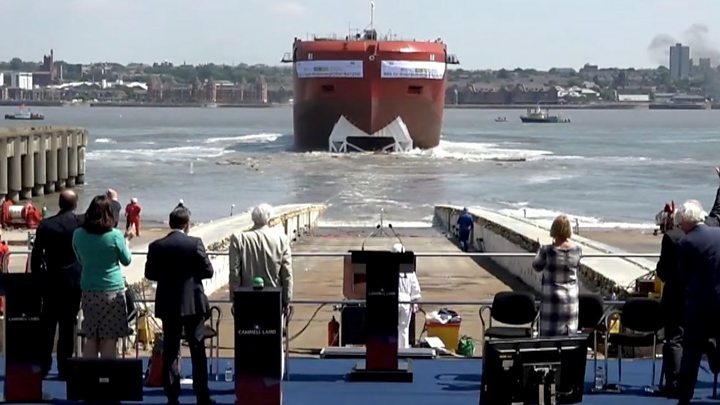
The UK's new £200m polar research ship has officially been named the "Sir David Attenborough" after the famous BBC broadcaster and naturalist.
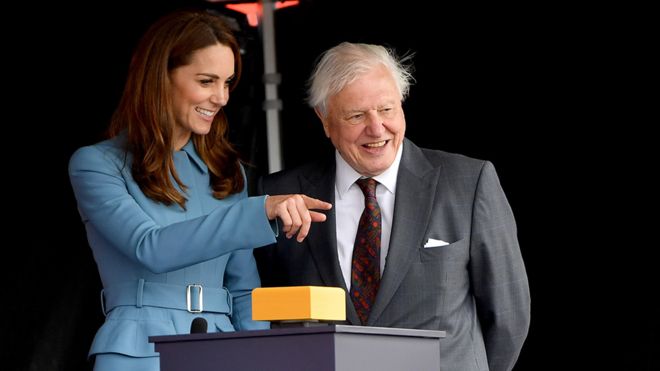
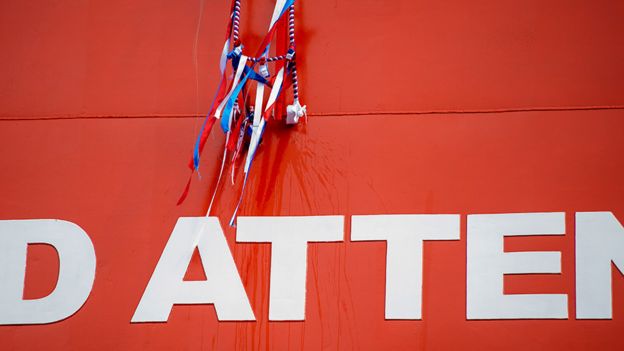
A bottle of champagne was smashed against the hull of the vessel by the Duchess of Cambridge.
Several thousand people had gathered at the Cammell Laird shipyard on the Wirral to witness the event.
Sir David was there also and spoke of the "greatest possible honour" that had been bestowed on him.
Media captionThe Sir David Attenborough research ship was nearly named Boaty McBoatface following an online poll
The ship's role, he said, would be to address the climate crisis. "This astonishing ship... will find the science with which to deal with the problems that are facing the world today and will increasingly do so tomorrow."
Just before his wife pressed a big yellow button to unleash the bottle against the paintwork, the Duke of Cambridge paid his own tribute to the naturalist and also referenced the growing concern about the pace of climate change.
"There has never been a more important moment for this ship to get to work, and there is no person more fitting for this beacon of scientific research to be named after than you, David," he said.
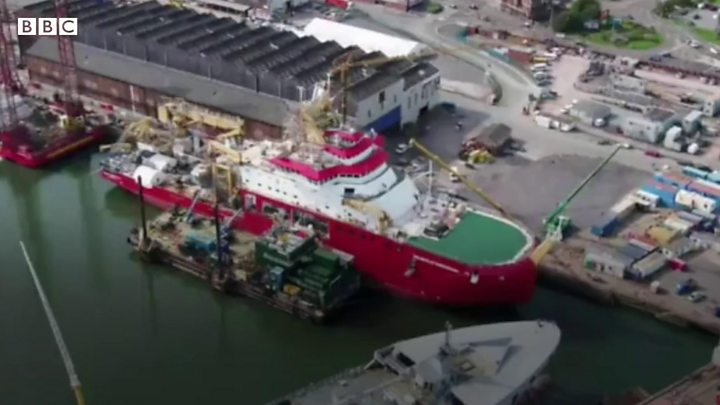
Media captionTake a flight over the RRS Sir David Attenborough
A big crowd had turned out on what was a grey, drizzly day. But their enthusiasm undimmed and they cheered the Royal couple, the speeches - and the Cybermen drummers and children dressed as penguins.
The Royal Research Ship (RRS) was commissioned to replace the James Clark Ross and the Ernest Shackleton, which between them gave almost 50 years' service in support of UK polar science.
The RRS Sir David Attenborough will now carry the union flag into the Arctic and the Antarctic.
This is the vessel an online poll had cheekily suggested be called "Boaty McBoatface" before ministers stepped in to end the joke.
That humorous moniker was given instead to the long-range robotic yellow submarines that will in future operate from the Attenborough.
Image copyrightREUTERS
The naming ceremony was a moment for great celebration and pride in Birkenhead.
Yard workers, their families, VIPs and local residents thronged the quayside to see the royals inaugurate the vessel.
Mackenzie Boyd joined Cammell Laird as an apprentice. This has been his first project, working as a plater. "It's amazing," he told BBC News.
"This ship is already famous and it hasn't even gone to sea yet. But it's going to have a massive impact."
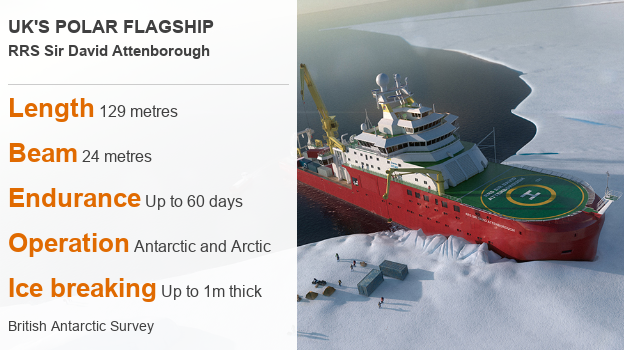
The 130m-long, 15,000-tonne "floating science lab" represents the largest commercial ship built in Britain in three decades.
Its initial keel block was laid in October 2016, with the 10,000-tonne completed hull section entering the River Mersey in July last year. Final fixtures and fittings are almost done (it took 60,000 litres to paint the outside and inside), and it is expected commissioning trials will get under way in the coming weeks.
Its entry into service comes not a moment too soon.
Wednesday witnessed the publication of the Intergovernmental Panel on Climate Change's (IPCC) special report on Earth's oceans and frozen regions.
It will be the job of the RRS Sir David Attenborough to go document the changes that are occurring and to help scientists work out how fast the melting will impinge on lower latitudes.
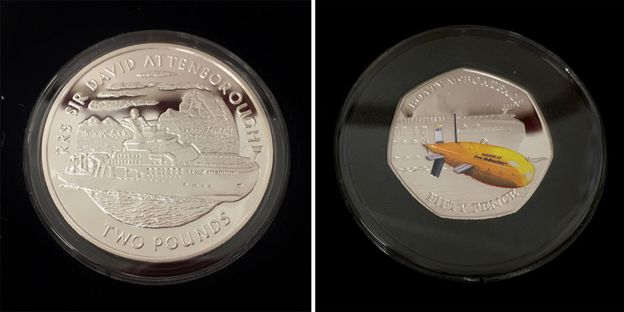
Image captionCommemorative coins: A £2 Sir David Attenborough piece; and a 50p Boaty McBoatface
Already sea levels are rising globally by about 5mm per year (taken over the past five years), with ice losses at the poles now considered to be the major driver of this trend.
By the year 2100, according to some scenarios, the oceans could be 1.1m higher than they are now, which would pose a major challenge to the viability of many coastal settlements worldwide.
"The oceans take up a lot of the carbon dioxide and the heat that we generate, but we don't really know how and where it goes, particularly in the Southern Ocean - this big, deep ocean around Antarctica," said Dame Jane Francis, director of the British Antarctic Survey (BAS).
"We're talking about big numbers and they're critical to understanding how the whole climate system operates."
And Dr Kelly Hogan, a BAS marine geophysicist, added: "What's different about the way we'll do research with the Attenborough is we're going to be able to use a lot of different instruments and technologies to study a large number of components, including the atmosphere, the ice itself, the surface ocean, the deep ocean and the muds at the bottom of the sea; and that way we'll be able to tackle the really big questions."
Media captionA three-year build: This is how the completed hull entered the water
Why does this ship matter?
BAS, which manages the UK's polar fleet, needs a modern platform from which to conduct world-leading research.
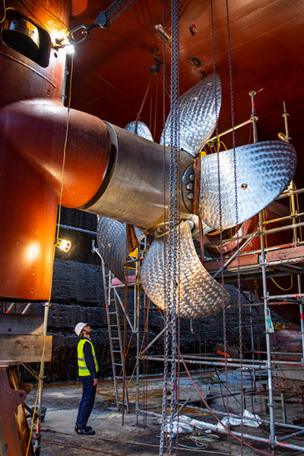
Image captionThere is 750km of power and data cabling running through the ship
The chartered RRS Ernest Shackleton has already been returned to its owner; the RSS James Clark Ross will be sold next year.
It is the view of the funding agency, the Natural Environment Research Council, that the more advanced Attenborough can fulfil the tasks of both the earlier vessels - in research and in logistics. So, not only can its gear and labs do cutting-edge science, but it can carry numerous freight containers to resupply bases and expeditions in the field.
How special is the ship?
It is an icebreaker. There are different classes for this type of vessel but the specification says the Attenborough should be able to plough through 1m-thick sea ice at three knots (3.5mph/5.5km/h).
This will soon be tested when the ship is taken out on trials in the Arctic. "That's an exciting prospect. Our careers are spent trying to avoid things but in the Arctic and the Antarctic we get to throw our ships at the ice," said BAS Captain John Harper who'll lead the first polar trials.
The Attenborough also has a helipad (helicopters are essential), cranes and onboard labs, and it has the ability to deploy subs and other ocean survey and sampling equipment.
Image copyrightBASImage captionSilent running: The ship is designed to cut through the water with minimal noise
One of its key features is an enclosed "moon pool". This is essentially a huge hole running right through the middle of the hull. It will allow instruments to be lowered into - and recovered from - the sea when weather or dense sea-ice conditions would normally make such work very difficult.
The ship design, put together by Rolls-Royce, also enables near-silent running when required, meaning scientists can study sea creatures without disturbing them.
What happened to the "Boaty" name?
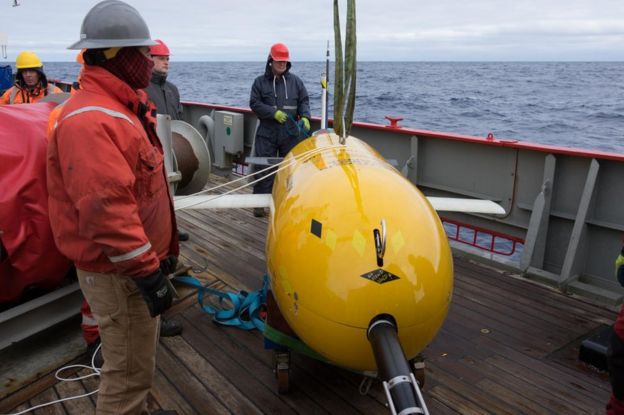
Boaty McBoatface lives on in the form of yellow submarines. The National Oceanography Centre in Southampton has several of these long-range autonomous underwater vehicles.
When one of these is out on patrol, it carries the Boaty moniker.
The intention is that these Boaty-class subs will frequently operate from the Attenborough. They will be asked to go into places the ship itself cannot reach, such as under the colossal floating ice shelves that surround Antarctica.
Image copyrightP.ABRAHAMSEN/BASImage captionBoaty McBoatface: The submarines can go places the ship cannot