The Atlantic
SCIENCE
Elon Musk Is Maybe, Actually, Strangely, Going to Do This Mars Thing
From his private Cape Canaveral, the billionaire is manifesting his own interplanetary reality—whatever it costs.
Story by Marina Koren
The little havanese likes to sit in a window of the one-story house, looking out onto the quiet street in Boca Chica, Texas. From its perch, it can watch neighbors passing by, glossy black grackles pecking in the grass, and palm trees swaying in the breeze. The dog’s presence is usually a sign that its owner, Elon Musk, is in town. That, and the Tesla parked in the driveway.
There are other, more conspicuous signs that Musk has gotten comfortable in this remote part of South Texas, near the U.S.-Mexico border. The hulking manufacturing tents just down the road. The steel strewn on the ground. The mechanical hum of machinery as workers in hard hats assemble spaceship after spaceship.
Musk has built a shipyard here. This is the staging area for SpaceX’s founding dream, the reason Musk got into the rocket business: to put human beings on Mars, not to drop a flag and go home, but to stay and survive. That Mars might be a terrible place to live is irrelevant. Musk believes that humankind should exist on more than one planet, and that we should start soon.
Musk intends to make a leap in that direction with Starship, a reusable spaceship-and-rocket system that he hopes will redefine travel—first by jetting from continent to continent, then from Earth to the moon, and finally from Earth to Mars. At a glance, this plan sounds like the kind of idealistic dream you’d expect from a wealthy entrepreneur who is often compared, without irony, to a comic-book hero. Or maybe, depending on your view of Musk, a self-aggrandizing fantasy from one of the most trollish, publicly chaotic figures of our time. But the fantasy is swiftly crystallizing into a feasible reality. The South Texas shipyard is churning at all hours. A Starship prototype finally stuck its landing last night (without bursting into flames minutes later). And the world’s top space agency believes in the effort too.
NASA has given SpaceX a $2.9 billion contract to develop a version of Starship to land American astronauts on the surface of the moon for the first time since the Apollo program. Jeff Bezos’s rocket company, Blue Origin, which partnered with a few longtime NASA contractors to bid on the same job, has formally challenged NASA over its decision to choose a single contractor. The agency has put the contract on hold for the time being, but it appears that the next visitors to the moon—including, NASA has promised, the first woman and person of color—could be flying SpaceX.
America has now tied one of its biggest space dreams to SpaceX, which means the country has tied it to Elon Musk, the company’s CEO and chief engineer. To build Starship, the billionaire has overhauled Boca Chica into his private Cape Canaveral, and has started referring to the area as “Starbase.” He has mocked Bezos and other competitors; he has chafed at federal oversight. He has also made Boca Chica the one place on Earth where the dream of getting to Mars feels most real. The Starship work that SpaceX is doing now, if it pans out, will be the company’s most impressive achievement. More impressive than landing rocket boosters upright on a ship in the ocean. More impressive than enveloping the planet in a bubble of hundreds of internet satellites. More impressive than launching astronauts to the International Space Station, and bringing them home safely.
Musk now says that Starship could land people on the moon in 2024, and take them to Mars within the decade. He is famous for his aspirational, and usually unrealistic, timelines. But the Starship project could bring humankind closer than it has been in 50 years to reaching another world again. If the idea of SpaceX sending people to the moon, let alone Mars, seemed like an abstraction a decade ago, then a decade from now, it might seem like a given.
Twenty years ago, if people were familiar with Elon Musk, they knew him as the nerdy powerhouse behind a couple of internet companies—Zip2, a software company that was eventually folded into the AltaVista search engine, and X.com, an online bank that eventually merged with PayPal. In 2002, after the entrepreneur from South Africa had sold off one business and left the other, a friend asked what he wanted to do next. Space exploration, Musk said—he’d always been interested in that. Born in 1971, the year of the third moon landing, Musk assumed that NASA had a plan to reach Mars, and soon. When he went searching for a schedule on NASA’s website, he told Wired in 2012, he found that the agency had no plans, nor a big enough budget for an Apollo-style rush to reach the red planet. “At first I thought, jeez, maybe I’m just looking in the wrong place! Why was there no plan, no schedule?” Musk said in the interview. “There was nothing.”
There had been a moment, after the moon landings, when the rest of the solar system had suddenly felt within reach, Mars especially. Even some of the Apollo astronauts had thought so, and had held out hope for a Mars mission. Instead, they became the last people to travel beyond low-Earth orbit. In the decades that followed, a wonderful assortment of space probes ventured into the solar system, to Mars and Saturn and Pluto, but human beings remained close to home, flying shuttles and building space stations.
Musk decided that he would rally some support for a Mars shot; perhaps a small greenhouse on the red planet’s surface—a beautiful juxtaposition of terrestrial life and an alien world—would capture the public’s attention. But when he looked into rocket launches, he was surprised by their steep price tags. Surely someone had figured out how to make space travel cheaper by now?
Read: The world’s richest men are brawling over the moon
Within a decade, SpaceX successfully launched a rocket into orbit, in 2008. By 2016, it had landed a 14-story rocket booster back on Earth in one piece—on the ground, and on a ship at sea—a triumph in an industry used to discarding expensive rocket bits in the ocean. SpaceX had sacrificed about a dozen boosters in this quest; there were big explosions, small explosions, mid-air explosions, made-it-to-the-barge-but-then-the-landing-legs-crumpled explosions. (The company eventually compiled the attempts all into a blooper reel.) A couple of Falcon 9 rockets carrying expensive payloads also exploded, but those failures feel distant now, and these days, the company’s mood is buoyant. To longtime SpaceX workers, the manic Muskian approach always pays off. “It went from, Holy crap, how are we going to do this? to what I would consider a quiet professional confidence,” a former SpaceX employee who worked on the company’s human-spaceflight efforts, and who requested anonymity in order to maintain future business ties with the company, told me. The Starship team’s confidence, the former employee said, is likely “sky high.”
Today, SpaceX regularly flies astronauts into orbit on a transportation system it designed from start to finish, and is the only private company to have earned that responsibility. But the Dragon capsule doing that work is a cozy, gumdrop-shaped container, not a giant spaceship, and can carry seven people at a time, not the 100 passengers Musk imagines boarding Starship someday. If successful, Starship would be unlike any other space vehicle in history, especially on its return to Earth. America’s now-retired fleet of space shuttles landed on runways like planes, Russian Soyuz capsules parachute down to the desert, and SpaceX’s Dragon capsules splash down in open water, but Musk envisions Starship landing vertically, as upright as it stood before liftoff. It is an enormous technical challenge.
Since December, workers at the Boca Chica shipyard have constructed several Starship prototypes—stocky, 150-foot-tall towers of stainless steel with fins—hauled them to a launchpad on a nearby beach on the Gulf of Mexico, and watched them launch. None of them survived until last night—the fifth attempt—when the prototype nailed the intricate maneuver it was designed to do: The spacecraft rose more than 30,000 feet into the sky, quieting its engines as it went, then flipped onto its belly and fell down, down, down, before firing up again and righting itself for a gentle landing, like a falling cat twisting around at the last minute to find its feet.
The string of fiery flights might have made it seem as if SpaceX was struggling, or unsure. But the opposite is true. SpaceX engineers jokingly call explosions RUDs, for “rapid unscheduled disassembly,” and the names of Starship prototypes start with SN, for “serial number,” a signifier that the product is not precious, but a good production line is. When one prototype is destroyed, another promptly takes its place. In the company’s early years, all those explosions might have given it pause, but now barely any SpaceX doubters are left in the industry.
Read: Why SpaceX wants a tiny Texas neighborhood so badly
Musk moved from California, where SpaceX is headquartered, to Texas last year. He appears in Boca Chica often, along with his children and his dog. SpaceX did not respond to requests for comment on this story, and hasn’t replied to other inquiries from The Atlantic in more than a year. The company has had little imperative to be forthcoming about Starship development, and it doesn’t have the same obligations to the public or the press as NASA does. Musk has also been impatient with the Federal Aviation Administration, which handles licenses for space launches and dispatches safety inspectors to Boca Chica, and has accused the agency of slowing SpaceX down. The new moon contract—a high-profile, taxpayer-funded assignment—might force a shade more transparency. SpaceX does broadcast Boca Chica’s test launches, but the best views of Starship work come from a small community that has formed to monitor the company’s efforts. Most days, anyone can drive past the secluded Starship site and take pictures, though security guards might ask you to move along if you get too close.
One of the most well-known chroniclers, Mary McConnaughey, who goes by BocaChicaGal online, has been following SpaceX’s operations since the company arrived in 2014. She lives within sight of the house where the Havanese likes to perch. McConnaughey and her neighbors in Boca Chica Village never imagined that someone might try to build a spaceship in their little coastal paradise. When I visited the village in the fall of 2019, SpaceX was trying to buy the residents’ homes. Some residents sold and left, but others remained, refusing the price SpaceX had offered them. Although Musk once indicated that SpaceX’s job would be easier if they would leave, the company appears to have stopped pursuing their properties for now. On test days, the residents are used to receiving warning notices and going somewhere else. One resident, Celia Garcia-Johnson, who wanted to avoid traveling far from home during the coronavirus pandemic, spends launch days with her dog in an Airstream parked a few miles from the village, courtesy of SpaceX.
The village is now an expanding space town. There are more Airstreams, for spaceship workers who stay overnight, and a restaurant called Prancing Pony. (In J. R. R. Tolkien’s Middle-earth, an inn of the same name provisioned travelers before they embarked on a long journey.) Boca Chica “will grow by several thousand people over the next year or two,” Musk said in March, filling up with engineers, technicians, and support personnel “of all kinds.” In April, SpaceX threw a block party in the village, with a live band, and invited everyone, employees and remaining homeowners alike. Garcia-Johnson told me she enjoyed socializing with the SpaceX employees, some of whom live in the village themselves. But she can’t shake her uneasy feelings about the future of Boca Chica. Garcia-Johnson has owned her home here for nearly 30 years. “Scripture says ‘love thy neighbor,’ and if SpaceX is my neighbor, I guess I have to love SpaceX,” she told me.
If Boca Chica becomes a 21st-century spaceport, the last stop on Earth before Mars, it is difficult to imagine SpaceX tolerating straggling residents. Musk recently said that he would donate $20 million to schools in Cameron County, where Boca Chica is located, and $10 million to Brownsville, the nearest city, for “downtown revitalization.” Some of the homeowners here have feared that county officials, who are thrilled about SpaceX’s presence, could take over their properties through eminent domain. Using that power to make way for a private spaceport—rather than, say, a highway or a stadium—would be unusual, but not a surprise. SpaceX has launched hundreds of little satellites into Earth’s orbit without much input from the rest of Earth’s inhabitants. Musk has rarely faced resistance in his attempts to shape the world around him, and this world could be just the beginning.
The first city on mars, according to musk, will be made of pressurized glass domes. No breathable air on the red planet, after all. After that, Musk has said, we’ll terraform Mars to make the planet resemble Earth. Musk is, obviously, mostly focused on the getting-there part, and his living-there plan sometimes seems almost cavalier. In a 2019 interview with Popular Mechanics, he called life on Mars “quite manageable.” “But the planning that will have gone into knowing what you’re going to do when you get there—for food, for water, for fuel,” the journalist interviewing him said, apparently giving Musk some room to address potential challenges. “Once you get there,” Musk replied, “that stuff is relatively straightforward.” Other times, he is more direct about the scale of the effort and the risks it entails. “It’s an arduous and dangerous journey where you may not come back alive, but it’s a glorious adventure,” Musk said at a recent speaking event.
Musk can get away with talking like this not just because he is the second-richest person in the world, but because he has made himself into a figure who can make outlandish plans sound plausible—who has already made outlandish plans possible. He can talk forever about the importance of turning humankind into a multiplanetary species, of bringing Earth’s plants and wildlife with us to Mars if or when some doomsday event wipes us out on this planet. The people who run NASA can’t inspire us—or scare us—like that. They certainly want to build a base on the moon, and someday plant an American flag on Mars. But they can invoke only the usual ideas, of American exceptionalism and spirit, that have underpinned the country’s space effort since its beginnings, and hold up the wonder of space travel as proof that “we can meet any challenge” on Earth, as President Joe Biden said recently. NASA can’t replicate Musk’s attitude to hardware, either. “We’re definitely going to build a lot of rockets, and probably smash a lot of them,” Musk said in a recent press conference.
And yet, the brash billionaire and the storied space agency have now linked their futures to each other. The first moon missions of the 21st century are bound to be repeats of the Apollo landings, only with much better footage from the surface. With SpaceX, Musk has brought the country back to the intoxicating moment that followed Neil Armstrong’s small step, when the air seemed to buzz with the possibility of more steps on other alien surfaces. This is the same Elon Musk who launched a Tesla into space, tweets about putting Dogecoin on the moon, and shares NSFW memes; whose posts have led to lawsuits on more than one occasion; and who is hosting Saturday Night Live this weekend, alongside the musical guest Miley Cyrus. At this point, Iron Man taking NASA astronauts to the moon would sound more believable. Until you remember that Musk really has made it this far.
Read: America’s new vision of astronauts
“NASA still does fantastic work, but when it comes to really changing the space sector as a whole, SpaceX is the one that people think of the most,” Laura Forczyk, a space analyst and the author of Rise of the Space Age Millennials, told me. Her book’s Millennial subjects pointed to SpaceX’s achievements as their source of inspiration, and she’s working on a new edition featuring interviews with members of the younger Generation Z, who say the same.
A triumphant return to the moon, or a historic voyage to Mars, is bound to captivate the public as the Apollo landings did. But it will not inspire America, or the world, in some magical, universal way. The majority of Americans believed that the Apollo program wasn’t worth the effort throughout the 1960s, with the exception of the awestruck reaction to Armstrong’s first moonwalk. Today, most Americans don’t believe going back to the moon should be a priority, and they’re not all that jazzed about astronauts setting off for Mars, either. The government can still push for the moon, regardless of public opinion, but unlike a private company like SpaceX, NASA at least has to explain where all that money is going and why. Meanwhile, a growing industry of private space tourism, with vehicles capable of flying more autonomously than ever before, is changing the profile of astronauts, and soon, perhaps, most people who go to space will not be highly trained pilots or scientists, but simply rich people. Already, a Japanese entrepreneur has purchased an entire Starship flight for as many as 12 passengers for a loop around the moon in 2024.
This future depends on Starship leaving the planet at all. The project still has a long way to go—more prototypes, more hours of tests and troubleshooting, a separate effort to engineer the behemoth rocket booster that will loft the spaceship into orbit and then return to Earth in the delicate sequence that SpaceX has nearly perfected with its other boosters. The South Texas shipyard will continue its sprawl along the coast, like a fast-growing invasive species. When Garcia-Johnson returned home after an explosive test in late March, she discovered a sign of the changing habitat—one of her windows had shattered from the force of the blast. SpaceX summoned a window company to repair it the next day, down the two-lane state highway that SpaceX fans call “the highway to Mars,” the only way into Boca Chica. Take this path all the way to Boca Chica, past the solar-panel farms and storage sheds, past the little street that used to be called Joanna Street until Musk renamed it Rocket Road, and you end up on the beach, with sky and sea stretching out before you. It’s a beautiful view on any day, and maybe, one day, it’ll be someone’s last look at Earth.
MARINA KOREN is a staff writer at The Atlantic. Twitter
Showing posts with label moon. Show all posts
Showing posts with label moon. Show all posts
Thursday, May 6, 2021


Wednesday, May 5, 2021
New York Times - SpaceX Successfully Lands Prototype of Mars and Moon Rocket After Test Flight
New York Times
SpaceX Successfully Lands Prototype of Mars and Moon Rocket After Test Flight
After a series of high-altitude test flights that ended in explosions, the new vehicle set down in one piece on a Texas launchpad.
By Kenneth Chang and Michael Roston
May 5, 2021
A prototype of a spacecraft that SpaceX hopes one day to send to the moon and Mars touched down in one piece on a landing pad in South Texas on Wednesday. It was the fifth high-altitude flight test of Starship, a vehicle that in several earlier test flights exploded either during or after landing.
“We are down, the Starship has landed,” said John Insprucker, a SpaceX engineer, during a live video stream of the SN15 launch.
Flames continued to emerge from the base of the rocket after it landed, a result of the fuel used by the rocket, Mr. Insprucker said. Shortly after SpaceX concluded its official video feed, Elon Musk, the founder of the private space company, wrote a tweet calling the landing a success in the jargon of rocket engineering:
Elon Musk
@elonmusk
Starship landing nominal!
A future model of the vehicle is central to Mr. Musk’s goal of one day carrying humans far beyond Earth’s orbit. NASA also recently awarded SpaceX a contract to build a version of Starship that would carry astronauts to the moon’s surface later this decade.
In four previous tests, conducted since December, the rockets launched successfully and, after reaching an altitude of several miles, demonstrated controlled belly-flops back toward the ground. But each time, problems during landing or after the rocket touched down resulted in spectacular explosions.
Wednesday’s flight was free of any such excitement. The vehicle, powered by its three engines, raced into the cloudy skies over Boca Chica, adjacent to the Gulf of Mexico. It traveled for four minutes to an altitude of about six miles, powering down engines and hovering for a time before beginning its trip back toward Earth’s surface.
During the return to the landing pad, it flipped over into a horizontal orientation to begin its descent. As it neared the surface, it reactivated its engines and brought itself back into a vertical orientation, slowing its approach to the ground in a cloud of smoke. As the vapor cleared, the spacecraft stood upright, plumes continuing to vent from its sides.
SpaceX takes a fail-fast, fix-fast approach, using the tests to identify shortcomings of design and making adjustments on subsequent flights. An announcement NASA made last month is certain to bring more attention to Starship’s progress and setbacks.
A few weeks ago, NASA awarded a contract to SpaceX for $2.9 billion to use Starship to take astronauts from lunar orbit to the surface of the moon. The contract is part of the Artemis program, and NASA had been expected to choose more than one company to build a moon lander, mirroring the approach the space agency has used for hiring companies to take cargo and now astronauts to the International Space Station.
After the announcement, NASA’s decision was challenged by the two other companies that were competing for the contract: Blue Origin, the private company founded by Jeff Bezos, the chief executive of Amazon; and Dynetics, a defense contractor in Huntsville, Ala. NASA has now instructed SpaceX to halt work on the lunar Starship until the Government Accountability Office makes a decision on the protests. The challenge does not affect SpaceX’s work on the Starship models currently being tested in Texas.
Mr. Musk’s company has become successful in the launch business, and it is now one of the world’s most valuable privately held companies. Its Falcon 9 rockets have become a dominant workhorse for sending satellites into orbit. It routinely transports cargo and astronauts to the International Space Station. In the last month, it has launched four astronauts to the space station for NASA, and later brought home another crew in a nighttime splashdown on Saturday.
However, many are skeptical of Mr. Musk’s assertion that the company is just a few years from sending a Starship to Mars, noting that he has repeatedly set timelines for SpaceX that proved far too optimistic.
In 2019, when he provided an update on the development of Starship, he said that a high-altitude test would occur within months and that orbital flights could occur early in 2020.
Instead, several catastrophic failures happened because of faulty welding. When the propellant tanks stopped rupturing, two of the prototypes made short successful flights last year. Those earlier Starship prototypes resembled spray paint cans with their labels removed, rising nearly 500 feet using a single rocket engine before setting back down at the Texas test site.
Although it has lifted off the ground many times, Starship is a long way from being ready for a trip to orbit. But SpaceX already has its eyes on future tests that will send subsequent Starship prototypes to much greater altitudes. In March, Mr. Musk shared a picture of a prototype of the large booster stage that will be needed for a trip to space. It is over 200 feet tall.
Although this prototype will not itself take flight, Mr. Musk said the company’s goal was for a second model to launch by July.
Kenneth Chang has been at The Times since 2000, writing about physics, geology, chemistry, and the planets. Before becoming a science writer, he was a graduate student whose research involved the control of chaos. @kchangnyt
Michael Roston is the senior staff editor for science. He was previously a social media editor for The Times and a home page producer. @michaelroston
"It’s the first time the vehicle didn’t explode."
New York Times
BREAKING NEWS |
SpaceX successfully landed a prototype of a spacecraft it hopes to one day send to the moon and Mars. It’s the first time the vehicle didn’t explode. |
Wednesday, May 5, 2021 7:20 PM EST |
A future model of the vehicle, known as Starship, is central to the company's goal of one day carrying humans far beyond Earth’s orbit. NASA also recently awarded SpaceX a contract to build a version that would carry astronauts to the moon’s surface later this decade. |
This time the thing didn't blow up. Way to go SpaceX. America is going back to the moon.
 |
 |
|
|
Saturday, May 1, 2021
Buzz Aldrin is still alive. He was the 2nd human to walk on the moon.
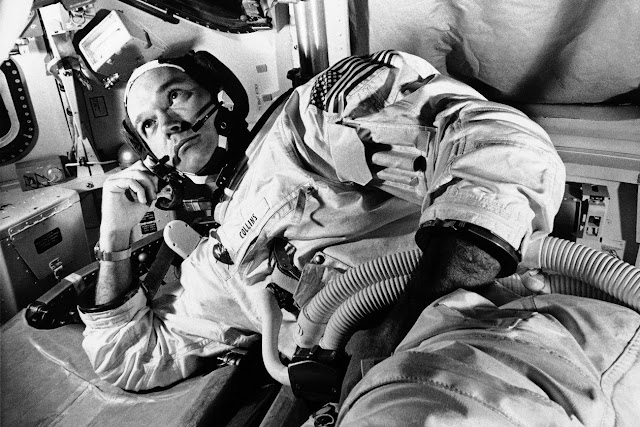
Apollo 11 command-module pilot Michael Collins during training for the first lunar mission in Cape Kennedy, Fla., June 19, 1969.
Wall Street journal
OPINION
COMMENTARY
To the Moon and Back With Michael Collins, 1930-2021
My fellow astronaut was a great pilot, a great friend and a great patriot.
By Buzz Aldrin
April 30, 2021
Finding words is hard. The death at age 90 of Michael Collins, command-module pilot for Apollo 11, is the loss of a friend, an unswerving patriot and an intrepid explorer. Neil Armstrong and I were blessed to have had Mike as our crewmate on America’s first manned mission to the moon’s surface, in July 1969. No one is more responsible for our success—taking us out and bringing us home safely—than Mike.
What Mike gave our nation is hard to express. He was a fearless test pilot, inveterate scholar, cheerful crewmate; he was calm under pressure, self-disciplined, knew every detail of the Columbia command module. He was also a lifelong friend, focused on others and often hardest on himself.
Mike’s book, “Carrying the Fire: An Astronaut’s Journeys” (1974), is detailed and aptly named. A gifted writer, Mike put into words the extraordinariness of our shared experience—his, Neil’s, mine and our nation’s. He focused on the mission, team, nation and journey, less on himself.
Mike was the one who orbited the moon 30 times alone, focused on us, making sure we stayed close. He was the one who, on Gemini 10 in 1966, walked in space and proved orbital rendezvous with another spacecraft, a vital step in America’s eventual moon missions. And Mike was first among friends—gracious, self-deprecating and always quick with a smile.
In a sense, Mike was our engine, the one who “carried the fire” to the moon and back. His mastery of the command module preceded him. The entire astronaut corps revered his dedication. His mastery gave us confidence. Whatever happened on that first mission, Mike would figure out how to get us home. And he did.
After the moon, Mike kept serving. In 1970 he became assistant secretary of state for public affairs, helping America inspire others, lead with grace, spread “peace for all mankind.” The following year he became director of the Air and Space Museum, and in 1978 he earned a promotion to undersecretary of the Smithsonian.
Personally, Mike was a source of peace and cheer, whimsically growing a mustache on our moon mission, which he showcased later, in quarantine, with his hallmark smile. Mike was the best of America, someone who instinctively put himself out for others, a lifetime commitment. He felt no mission was too hard, no challenge beyond trying, and that we should always be ready to serve. He was that example. I will miss my friend. America had no better friend.
Mr. Aldrin is a former astronaut. As part of the Apollo 11 mission, he was one of the first men to walk on the moon.
Appeared in the May 1, 2021, print edition.
••••••••••••••••••••••••••••••••••••••••••••
Somebody wrote this comment:
Mr. Aldrin, as an 8 year old kid in the Soviet Union, I remember struggling hard with a short wave radio trying to make out the words of Voice of America over the jamming noise of USSR trying to shut out this miracle of man's achievement and America's greatness from its citizens. My imagination was fired up and I was proud for humankind and in awe of America. I never imagined that I would live here and be adopted by this amazing country.
Thank you and Mr. Collins for inspiring the world. Thank you for your words of good bye to this brave man. You and your fellow astronauts are the very best America has to offer.
-- Yuri Vizitei
Friday, April 30, 2021
July 21, 1969

Thursday, April 29, 2021
China

In this photo released by Xinhua News Agency, the core module of China’s space station, Tianhe, on the the Long March-5B Y2 rocket is moved to the launching area of the Wenchang Spacecraft Launch Site in southern China’s Hainan Province on April 23, 2021. China plans to launch the core module for its first permanent space station this week in the latest big step forward for the country’s space exploration program. The Tianhe, or “Heavenly Harmony” module is set to be hurtled into space aboard a Long March 5B rocket from the Wenchang Launch Center on the southern island of Hainan. The launch could come as early as Thursday night, April 29, 2021 if all goes as planned.
Business
China to launch Heavenly Harmony space station core module
By Associated Press
April 28, 2021
BEIJING — China plans to launch the core module for its first permanent space station this week in the latest big step forward for the country’s space exploration program.
The Tianhe, or “Heavenly Harmony” module is set to be hurtled into space aboard a Long March 5B rocket from the Wenchang Launch Center on the southern island of Hainan. The launch could come as early as Thursday night if all goes as planned.
It would be the first of 11 missions to build and supply the space station for a three-person crew.
Here’s a look at the planned launch and the past and future of China’s space program.
11 MISSIONS PLANNED TO COMPLETE SPACE STATION BY END OF 2022
Another 10 launches will send up two more modules; four cargo supply shipments and four missions with crews. At least 12 astronauts are training to fly to and live in the station, including veterans of previous flights, newcomers and women.
When completed by late 2022, Tianhe is expected to weigh about 66 tons, a fraction the size of the International Space Station, which launched its first module in 1998 and will weigh about 450 tons when completed. Tianhe will have a docking port and will also be able to connect with a powerful Chinese space satellite. Theoretically, it could be expanded with more modules.
Tianhe’s main module will initially be about the size of the American Skylab space station of the 1970s and the former Soviet/Russian Mir, which operated for more than 14 years after launching in 1986.
SPACE STATION A LONG-TERM GOAL
China has launched two experimental modules over the past decade in preparation for a permanent station. One, Tiangong-1, which means “Heavenly Palace-1” was abandoned and burned up during an uncontrolled loss of orbit. Its successor, Tiangong-2, was successfully taken out of orbit in 2018.
China began preparations for a space station in the early 1990s as its space program gained momentum. It was excluded from the International Space Station largely due to U.S. objections over the Chinese program’s secretive nature and close military ties.
SPEEDY PROGRESS IN SPACE
After years of successful rocket and commercial satellite launches, China put its first astronaut into space in October 2003. It was only the third country to independently do so after the former Soviet Union and the United States. Since that Shenzhou 5 mission, China has sent other astronauts into orbit, placed crews on the original Tiangong station and conducted a space walk.
It also has increased cooperation with space experts from other countries, including France, Sweden, Russia and Italy. NASA must get permission from a reluctant Congress to engage in such contacts.
China also has pushed ahead with crewless missions, particularly in lunar exploration and has landed a rover on the little-explored far side of the Moon. In December, its Chang’e 5 probe returned lunar rocks to Earth for the first time since the U.S. missions of the 1970s.
MARS ROVER AND FUTURE AMBITIONS
The Tianhe mission comes just weeks before a Chinese probe is due to land on Mars, which would make China only the second country to successfully accomplish that after the U.S. The Tianwen-1 space probe has been orbiting the red planet since February while collecting data. Its Zhurong rover will be looking for evidence of life.
Another Chinese program aims to collect soil from an asteroid, a key focus of Japan’s space program.
China plans another mission in 2024 to bring back lunar samples and has said it wants to land people on the moon and possibly build a scientific base there. No timeline has been proposed for such projects. A highly secretive space plane is also reportedly under development.
HOW COMPETITIVE IS CHINA’S PROGRAM?
China’s program has advanced in a steady, cautious manner on a carefully designed schedule, largely avoiding the failures seen in the U.S. and Russian efforts when they were locked in intense competition during the heady early days of spaceflight. One recent setback came when a Long March 5 rocket failed in 2017 during the development of the Long March 5B variant that will be used to put the Tianhe module into orbit, but engineers moved swiftly to fix the problem.
Critics say China’s space program has successfully reproduced the achievements of the U.S. and Russia without breaking much new ground. The country’s rising technological prowess may end such talk in coming years. The country may need greater private sector involvement to spur innovation, as the U.S. has done with SpaceX and Blue Origin, and to apply new technologies such as reusable rockets.
Wednesday, April 28, 2021
The Washington Post: Michael Collins, Apollo 11 astronaut, dies at 90

Michael Collins, Apollo 11 astronaut, dies at 90
By Sarah Kaplan
April 28, 2021 at 11:36 a.m. CDT
On July 20, 1969, eight years after President John F. Kennedy pledged to land a man on the lunar surface and return him safely to Earth, astronaut Michael Collins sat alone in the command module Columbia. He was floating 60 miles above what he later called the “withered, sun-seared peach pit” of the moon.
A lander carrying his fellow Apollo 11 crewmen, Neil Armstrong and Edwin “Buzz” Aldrin, sped away from the main craft, en route to fulfilling Kennedy’s goal.
“You cats take it easy,” Mr. Collins radioed to his crew mates.
While Armstrong and Aldrin took their giant leap for mankind, in Armstrong’s memorable phrase, Mr. Collins circled the moon alone, keeping the command module going and running through the 117-page list of contingencies he’d prepared in the event anything went awry.
He was a quarter of a million miles from home — further than any traveler had ever gone on his own — without even radio communication to tether him to the rest of humanity. The moon’s bulk blocked the Earth from view and cut off contact with mission control for large portions of his orbit.
“Not since Adam has any human known such solitude,” NASA public affairs officer Douglas Ward remarked to reporters at the time.
The diffident Mr. Collins, who died April 28 at 90, later brushed off the comparison to the biblical first man, but he admitted to feeling petrified. In his 17 years as a fighter pilot, test pilot and astronaut, no flight had worried him as much as the lunar lander’s 31/2 -hour trip to reunite with the Apollo 11 command module.
“My secret terror for the last six months has been leaving them on the moon and returning to earth alone; now I am within minutes of finding out the truth of the matter,” he wrote in his 1974 memoir, “Carrying the Fire.” He had resolved not to commit suicide if Armstrong and Aldrin didn’t make it, but he knew that being the mission’s sole survivor would make him “a marked man for life.”
That foreboding never came to pass. All three crew members were present for Apollo 11’s triumphant splashdown in the Pacific and the subsequent victory tour. At its close, three weeks later in Los Angeles, they were awarded the Presidential Medal of Freedom, the nation’s highest civilian honor.
“His contribution to this great undertaking,” each man’s citation read, “will be remembered so long as men wonder and dream and search for truth on this planet and among the stars.”
That was not always true of Mr. Collins, whose name never gained the universal recognition of Armstrong’s and Aldrin’s.
This was partly a function of personality. Genial and levelheaded, he had stayed clear of the rivalries and showdowns that marked life at Johnson Space Center in Houston — including the reported bitterness between Armstrong and Aldrin over who would get to set foot on the moon first. Post-Apollo, when Armstrong turned recluse and Aldrin struggled with alcoholism, Mr. Collins thrived outside the glare of publicity.
Still, Mr. Collins had the deep respect of those who understood what his mission entailed. The pioneering transatlantic aviator Charles A. Lindbergh, who would later write the foreword to “Carrying the Fire,” sent a letter to Mr. Collins after the moon landing lauding his role in the mission.
“I watched every minute of the walk-out, and it certainly was of indescribable interest. But it seems to me you had an experience of in some ways great profundity,” Lindbergh wrote. He went on to compare Mr. Collins’s solitude to his own solo flight across the Atlantic: “I felt closer to you in orbit than to your fellow astronauts I watched walking on the surface of the moon.”
Mr. Collins went on to become an eloquent advocate for space exploration, in his many books and as founding director of Smithsonian’s National Air and Space Museum in Washington. He was an inductee of the U.S. Astronaut Hall of Fame and the International Space Hall of Fame and a recipient of the Congressional Gold Medal, among other honors. He retired from the Air Force Reserve in 1982 at the rank of major general.
Michael Collins was born in Rome on Oct. 31, 1930, to a distinguished military family. His father, Army Maj. Gen. James Lawton Collins, had long served as an aide-de-camp to Gen. John J. Pershing, commander of the American Expeditionary Forces in World War I.
The elder Collins was a military attache in Italy when his son was born. His father’s brother, Gen. Joseph Lawton “Lightning Joe” Collins, was Army chief of staff during the Korean War. Michael’s older brother, the late James L. Collins Jr., was an Army brigadier general and military historian.
Mr. Collins grew up following his father on assignments to Oklahoma, New York City and Puerto Rico, among other places, before settling in Washington after America’s entry into World War II.
He graduated in 1948 from the private St. Albans School, where classmates nicknamed him “Scarecrow” for his tall and trim frame. He was an intense athletic competitor and proved more adept on the playing fields there and at the U.S. Military Academy at West Point, N.Y., than in the classroom.
After completing his bachelor’s degree in 1952, he joined the Air Force — pointedly, a branch of the military where he didn’t have family. He was drawn to test piloting because of what he called the thrill of flying planes no one ever has before.
Described as reserved and levelheaded, but with flashes of wry wit, he once told Life magazine of his work as a test pilot: “People think we’re baked in heat chambers and whirled in centrifuges until our eyeballs fall out. There is little of that. Essentially, we’re learning an incredibly complex array of machines — and learning what to do if some of it doesn’t go as advertised.”
Mr. Collins said he would have been content to remain in the Air Force, had it not been for astronaut John Glenn’s history-making solo orbit around Earth in 1962. Whereas most of the great barriers in flight had already been broken, he said, space travel offered countless opportunities to be first at something.
He immediately applied when NASA announced it was looking for candidates to supplement Glenn’s original astronaut class. He was accepted on his second attempt. In addition to the wide-ranging scientific and survival training all astronauts go through, he was assigned to work with the engineers developing pressure suits for spacewalks. The mission patch that adorned his, Aldrin’s and Armstrong’s suits — an eagle holding an olive branch over the pockmarked lunar surface — was largely his design.
Before his trek to the moon, Mr. Collins orbited the Earth in 1966 as the pilot for Gemini 10. The three-day mission saw him and crew mate John Young, a spaceflight veteran, establish a new orbital altitude record and rendezvous with two unmanned Agena target vehicles. In addition, Mr. Collins became the first astronaut in history to journey outside his spacecraft twice.
A slipped disk in 1968 nearly derailed his astronaut career, but Mr. Collins recovered from surgery in time to be included on the Apollo 11 roster. He freely acknowledged that his was not the best job on the mission but claimed that he didn’t resent being confined to the command module.
“This venture has been structured for three men, and I consider my third to be as necessary as either of the other two,” he wrote in “Carrying the Fire.”
He might have had another chance at a moon walk — according to NASA’s rotation system for crew selection, he was slated to be named commander of Apollo 17, which would take flight three years later and was the last mission to put men on the moon.
But in 1970, chafing from the constant attention and reluctant to undergo three more years of the exhausting physical training required for astronauts, Mr. Collins opted to retire from NASA. “My mind-set was ‘It’s over, we did it,’ ” he explained in a 2015 talk at MIT.
He had married Patricia Finnegan in 1957, and they had three children, Kate, Ann and Michael. His wife died in 2014, and their son died decades earlier, reportedly by suicide.
Mr. Collins died of cancer, his family announced in a statement on Twitter. Additional details, including information on survivors, were not immediately available.
After leaving NASA, Mr. Collins told the New York Times, he was determined to “prevent the rest of my life from being an anticlimax.” He spent a year as assistant secretary for public affairs at the State Department, then was named founding director of the National Air and Space Museum, overseeing its opening in time for the nation’s bicentennial festivities. In the late 1970s, he was undersecretary of the Smithsonian Institution before moving into the directorship of a private aerospace and defense company. He later ran an aerospace consulting firm.
In several books, including “Flying to the Moon and Other Strange Places” (1976) and “Mission to Mars” (1990), Mr. Collins was also an eloquent advocate for continued space exploration. In his New York Times book review, journalist and space flight author Henry S.F. Cooper Jr. said of “Carrying the Fire” that “no other person who has flown in space has captured the experience so vividly.”
Although Mr. Collins never got to leave his footprints on the moon, one small spot there bears his name: a tiny impact crater in the Sea of Tranquility, about 15 miles from the Apollo 11 landing site.
That was about as much recognition as he wanted. In a 2009 interview with NASA, Mr. Collins expressed irritation with “the adulation of celebrities and the inflation of heroism.”
“Heroes abound, and should be revered as such, but don’t count astronauts among them,” he said. “We work very hard; we did our jobs to near perfection, but that was what we had hired on to do. . . . Celebrities? What nonsense.”
He sounded grumpy, the interviewer remarked.
“No, no, lucky!” Mr. Collins replied. “Usually, you find yourself either too young or too old to do what you really want, but consider: Neil Armstrong was born in 1930. Buzz Aldrin was born in 1930, and Mike Collins, 1930. We came along at exactly the right time. We survived hazardous careers and were successful in them. But in my own case at least, it was 10 percent shrewd planning and 90 percent blind luck. Put Lucky on my tombstone.”
Read more Washington Post obituaries
Sarah Kaplan Follow
Sarah Kaplan is a climate reporter covering humanity's response to a warming world. She previously reported on Earth science and the universe.
Apollo 11. The first manned spacecraft landed on the Moon on July 20, 1969. I watched as it happened, Armstrong walking on the moon for the 1st time in human history. Armstrong is dead. Michael Collins is dead. Buzz Aldrin is still alive at age 91.
|
|
|
|
Friday, April 16, 2021
Elon Musk’s SpaceX wins.
The Washington Post
Space
Elon Musk’s SpaceX wins contract to develop spacecraft to land astronauts on the moon
The company beat out Jeff Bezos’ Blue Origin and Dynetics, a defense contractor.
By Christian Davenport
April 16, 2021
NASA on Friday selected Elon Musk’s SpaceX to build spacecraft that would land astronauts on the moon for the first time since the last Apollo mission, according to a source selection document obtained by The Washington Post.
The contract marks another major victory for the hard-charging company that vaults it to the top tier of the nation’s aerospace companies and solidifies it as one of the space agency’s most trusted partners.
In winning the $2.9 billion contract, SpaceX beat out Jeff Bezos’ Blue Origin, which had formed what it called a “national team” by partnering with aerospace giants Lockheed Martin, Northrop Grumman and Draper. SpaceX also won over Dynetics, a defense contractor based in Huntsville, Ala. (Bezos owns The Washington Post.)
NASA had originally chosen all three companies for the initial phase of the contract, and was expected to choose two of them to build the lunar lander. In other major programs, NASA has chosen multiple providers to foster competition and to ensure it has redundancy in case one can’t deliver.
But in choosing SpaceX alone, it sent a message that it fully trusts the growing company to fly its astronauts for its signature human exploration program — Artemis, a campaign to return astronauts to the moon for the first time since 1972.
NASA is set to make the official announcement at 4 p.m. Eastern, according to a person with knowledge but not authorized to speak publicly on the matter.
Over the past several years, SpaceX, founded by Musk in 2002 with the goal of eventually flying humans to Mars, has completely upended the space industry, moving through fast, and at times fiery test campaigns that have unsettled traditional industry officials but also ignited new waves of enthusiasm not seen since the early days of the Space Age.
For the Artemis program, SpaceX bid its reusable Starship spacecraft, which is being designed to fly large numbers of people into deep space and land on celestial bodies as well as back on Earth.
The company has been putting it through a fast-paced test campaign at its facility in south Texas, launching prototypes without any people on board several miles up in the air then flying them back to a landing site.
So far, all the test vehicles have crash landed in a series of fireballs that triggered investigations overseen by the Federal Aviation Administration. But the company is expected to try again soon with a test vehicle that Musk has said is outfitted with several upgrades. And it hopes to be able to fly the spacecraft to orbit this year.
SpaceX was one of two providers hired by NASA to fly its astronauts to the International Space Station. It flew two missions with astronauts last year and has its next mission scheduled for Thursday. Boeing is the other company hired to ferry crews to the station and back. But it has stumbled badly, and has yet to fly a test mission with astronauts.
That’s a reason why NASA is best suited having at least two providers, officials said, and the pressure will be on SpaceX to perform. According to the source selection document, SpaceX’s bid “was the lowest among the offerors by a wide margin." NASA also liked Starship’s ability to ferry a lot of cargo to and from the surface of the moon as well, which it said “has the potential to greatly improve scientific operations.”
The Artemis program began under the administration of former president Trump and has been embraced by the Biden administration. But unlike Trump, which mandated that astronauts land on the moon by 2024, the White House now says the timeline is under review as it works to develop its rockets and spacecraft. It is also working with Congress to get the funding it needs.
For this fiscal year, Congress appropriated $850 million for the effort—well short of the $3.3 billion NASA said it needed to meet the 2024 timeline.
Earlier this month, the Biden administration proposed a $24.7 billion budget for NASA, a 6.3 percent increase that included an additional $325 million for the Artemis program.
Acting NASA Administrator Steve Jurczyk praised the request and said it “supports the development of capabilities for sustainable, long-duration human exploration beyond Earth, and eventually to Mars.”
Previously NASA vowed that it would land a woman on the moon as part of the first Artemis lunar landing. But in his statement, Jurczyk said the agency would also include the “first person of color,” as part of the program.
The White House recently nominated former Florida Sen. Bill Nelson to lead the agency. His confirmation hearing is scheduled for next week, and he is expected to win confirmation easily. During his time in Congress, Nelson was a strong advocate for space exploration, and he flew on the Space Shuttle in 1986 as a member of the House. If confirmed, he has said he would push to get the funding the Artemis program needs, as the agency reassesses the timeline for returning astronauts to the moon.
The contracts for the lunar landers come a year after NASA awarded three initial contracts to Blue Origin, Dynetics and SpaceX.
In awarding those contracts, NASA said Blue Origin and its team was furthest along and awarded it the largest contract, $579 million. Dynetics, which is partnering with the Sierra Nevada Corp, received $253 million, and SpaceX won $135 million.
The defeat is a huge blow Blue Origin, and to Bezos, who has long been fascinated by the moon and has for years wanted to be part of the effort to return there. He has said that watching Neil Armstrong and Buzz Aldrin walk on the moon when he was 5 years old was “a seminal moment” for him.
Blue Origin has been pitching its landing system, known as Blue Moon, since 2017, and Bezos has said he would invest in it heavily himself. In 2019, Bezos said that the program is “so ambitious that it needs to be done with partners. This is the only way to get back to the moon fast. We’re not going back to the moon to visit. We’re going back to the moon to stay."
Christian Davenport
Christian Davenport covers the defense and space industries for The Washington Post's Financial desk. He joined The Post in 2000 and has served as an editor on the Metro desk and as a reporter covering military affairs. He is the author of "The Space Barons: Elon Musk, Jeff Bezos and the Quest to Colonize the Cosmos" (PublicAffairs, 2018).Follow
Good choice. SpaceX is the best. Elon Musk is going to have more billions dollars. Again, America will be going to the moon before anyone else.
|
|
|
|
Thursday, April 15, 2021
"Mars Meets the Moon!"

Mars and Moon: Celestial Buddies
On April 17, the Moon and Mars will meet in the sky. The two astronomical bodies will be so close to each other that some observers in South and Southeast Asia will see the Moon entirely cover or occult Mars!
Monday, March 29, 2021
The moon helped fix a problem here on Earth.
New York Times
BREAKING NEWS |
After five days, the mammoth cargo ship blocking the Suez Canal was finally wrenched free, clearing the way for global trade to resume. |
Monday, March 29, 2021 9:32 AM EST |
Salvage teams, working on land and water for five days and nights, were ultimately assisted by forces more powerful than any machine rushed to the scene: the moon and the tides. The ship was ultimately set free at around 3 p.m., according to shipping officials. Horns blared in celebration as images emerged on social media of the once stuck ship on the move. |
Sunday, February 7, 2021
Walter Cronkite (November 4, 1916 – July 17, 2009) was an American broadcast journalist who served as anchorman for the CBS Evening News for 19 years (1962–1981). During the 1960s and 1970s, he was often cited as "the most trusted man in America" after being so named in an opinion poll. Cronkite reported many events from 1937 to 1981, including bombings in World War II; the Nuremberg trials; combat in the Vietnam War; the Dawson's Field hijackings; Watergate; the Iran Hostage Crisis; and the assassinations of President John F. Kennedy, civil rights pioneer Martin Luther King Jr., and Beatles musician John Lennon. He was also known for his extensive coverage of the U.S. space program, from Project Mercury to the Moon landings to the Space Shuttle. He was the only non-NASA recipient of an Ambassador of Exploration award. Cronkite is known for his departing catchphrase, "And that's the way it is", followed by the date of the broadcast.

Tuesday, October 13, 2020
8 countries agreed to rules and behavior on the moon.
The Washington Post
|
|
|
Subscribe to:
Posts (Atom)