Showing posts with label Nigeria. Show all posts

Monday, February 1, 2021

My opponent who killed me wrote in his profile "I'm not that good at chess."

Oladimeji Afeez Bello

Am not that good at chess, but I wish to be better and hope one day be a GM.

Lagos Nigeria 

UPDATE:

My next opponent lives in Algeria. I was able to win an interesting game.

TAOUFIK TAZEBINTE

GHARDAIA Algeria

Wednesday, January 27, 2021

This chess player lives in Nigeria. I think he is a poet.

Trueblood Enod

Instincts and aggressive play are flavours, I can't take away from my chess games... We fall but in all we spring up with burning 💥FLAMES💥 enough to light up your chess study rooms. I am your board, give me your respect otherwise you have no King. I WIN, I LOSE, I WIN; So, I keep on WINNING ON WINGS!

Lekki, Lagos & Port Harcourt city, Rivers Nigeria

Member since Oct 18, 2018

Saturday, October 31, 2020

BBC News - This is more evidence for the idea that Muslims are stupid fucking assholes.

Niger: American hostage rescued by US special forces

Published
3 hours ago
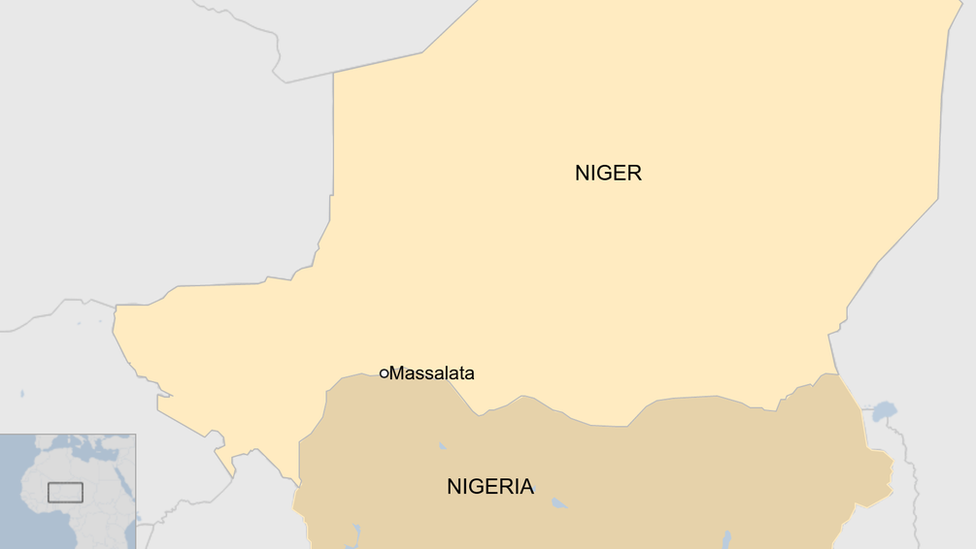
A map showing Niger

An American hostage kidnapped in Niger earlier this week has been freed in a raid by US special forces, the Pentagon has announced.

Philip Walton was abducted on Monday from a village close to the border with Nigeria.

He was taken across the border into Nigeria and rescued on Saturday.

Jihadist and criminal groups are known to operate in the area. It's thought at least six hostages are currently being held captive in the Sahel area.

Mr Walton was abducted from the village of Massalata, where he had been living with his wife and child for two years, his father told AFP news agency.

Locals said six men armed with AK47s arrived in the village on motorbikes.

It's unclear why Mr Walton was targeted and who the armed group were.

"This American citizen is safe and is now in the care of the US Department of State," a statement from Jonathan Hoffman, assistant to the Secretary of State for Public Affairs said.

He added that no American service personnel were harmed in the operation to rescue Mr Walton from the "armed men".

US President Donald Trump sent a tweet praising the elite special forces.

Niger is battling various armed groups. In August, six French aid workers as well as their driver and local guide were killed by gunmen in the Koure area of Tillebery region, which attracts tourists who want to see the last herds of giraffe in West Africa.

At least six Western hostages are being held in Niger, Mali and Burkina Faso, including the American aid worker Jeffery Woodke, who was kidnapped in central Niger four years ago.

More on this story

Thursday, July 9, 2020

This is Islam, the religion of never ending violence: In Nigeria, Islamist militants took advantage of a police force weakened by the novel coronavirus to rampage through the country’s northern Borno province, slaughtering 81 people in a single day.

The Washington Post

National Security

Covid-19 pandemic is stoking extremist flames worldwide, analysts warn


By Joby Warrick

July 9, 2020

In India, mobs smashed stores and beat up shopkeepers in some town or village every week in June. The victims were mostly Muslims whom the rioters falsely accused of spreading the virus that causes covid-19.

During the same month in Nigeria, Islamist militants took advantage of a police force weakened by the novel coronavirus to rampage through the country’s northern Borno province, slaughtering 81 people in a single day. In the United States, police investigated dozens of death threats against elected and public health officials, including an emailed vow to “put a bullet” through the brain of Illinois Gov. J.B. Pritzker (D).

Across the globe, violence has emerged a major and persistent side effect of the pandemic that has stricken 12 million people and killed more than 550,000. Even as it overwhelms hospitals, covid-19 is also straining security forces in scores of countries, exacerbating long-standing conflicts while fueling grievances and spurring the growth of extremist groups, security officials and analysts say in a series of new studies and interviews.

The pandemic is creating new opportunities for the Islamic State and other militants in the Middle East and Africa, where hard-hit local governments are being forced to redeploy security forces to battle the disease, the analyses show. In the United States and other Western countries, meanwhile, far-right extremist groups are building entire propaganda campaigns around it, stoking resentments against an array of supposed villains, from immigrants and ethnic minorities to politicians and health officials.

Just as climate change spawns bigger and stronger storms, the pandemic threatens to make nearly every existing security problem even more dangerous, the officials and experts said.

“It is an adverse-force multiplier,” said Ben West, a global analyst for Stratfor, a private intelligence firm that advises governments and corporations on security threats. “If you have a crisis, this is pushing it, making it worse.”

The problems are emerging at a time when many governments are squeezed by extreme financial and logistical challenges stemming from the pandemic. In Yemen, a country already convulsed by civil war, covid-19 has strained government services to the point of collapse, prompting a warning by the United Nations chief of humanitarian affairs last month that the country was poised to “fall off the cliff” without a massive intervention.

In Europe and North America, law enforcement officials and security experts say the pandemic is energizing far-right groups, including some that are openly advocating anti-government and anti-immigrant violence. Since the start of the outbreak, such groups have been able to connect with a large and rapidly growing audience: the legions of the anxious and unemployed, many of whom are confined to their houses with near-limitless time to spend on social media.

Armed protests spread amid backlash to coronavirus restrictions

A recent analysis prepared by a panel of U.S. and British security experts warned of a growing risk of political violence tied to upcoming elections, fueled by pandemic-linked “grievances, conspiracies and narratives” and amplified in some cases by foreign governments.

“This environment has exacerbated the enabling conditions that foster mobilization to violence,” said the report by London-based CHC Global, a private consulting firm, and the National Consortium for the Study of Terrorism and Responses to Terrorism in College Park, Md. “We are already seeing the system straining in some jurisdictions to keep unrest at bay.”

Retooling propaganda

While the staggeringly high rates of infection and death have commanded most of the attention, the coronavirus has been steadily racking up other kinds of casualties as well.

Since January, thousands of civil disturbances directly related to the virus have been reported, including nearly 1,800 violent incidents, according to the Armed Conflict Location & Event Data Project. The Wisconsin-based nonprofit has kept a running list of events as part of a project called the Covid-19 Disorder Tracker.

The data records hundreds of attacks against health workers, government officials and minority groups, as well as official violence by police and paramilitary forces against peaceful protesters. Some conflicts that quieted in the early months of the outbreak have come roaring back, said Roudabeh Kishi, research director. “The health crisis has only served to further exacerbate many of the original grievances,” Kishi said.

Fear of the coronavirus and anger over government-imposed restrictions have sparked riots in cities from the Middle East to central Africa to South Asia. In Pakistan’s Fakhar Province, nearly two dozen attacks on hospital workers were recorded, as well as riots over the lack of access to coronavirus tests.

In countries already plagued by conflict, covid-19 appears to be partly to blame for an upsurge in violence in recent months. In Iraq, the Islamic State carried out 566 bombings, shootings and assassinations in the first three months of 2020, nearly twice as many as in the same period last year. The terrorist group has routinely cited the pandemic — which it describes as “divine punishment” against Islam’s enemies — in calling on followers to take advantage of a weakened security environment to carry out such attacks.

Western countries also are explicitly mentioned among the group’s intended targets. In postings to social media sites in recent weeks, Islamic State leaders have predicted the imminent collapse of the United States, crediting covid-19 for helping to achieve a goal set by terrorist leaders decades ago: the draining of resources from the U.S. treasury until Washington is bankrupt and no longer capable of intervening in Middle Eastern affairs.

“This will be an exhausting factor to the unbeliever countries, which could reduce their interest in what is happening in Muslim countries and weakening their ability in fighting them,” the Islamic State’s official newsletter al-Naba said in a June 4 editorial.

Other Islamist groups have highlighted the West’s failures in dealing with the virus as evidence of a greater moral decay. Al-Qaeda’s media arm al-Sahab last month accused U.S. and European governments of abandoning and abusing their elderly, citing the high mortality rates at nursing homes. The article called the deaths of older adults a “shocking” reflection of the “savage reality of Western materialism.”

ISIS exploits coronavirus lockdown with fresh attacks inside Iraq
The postings exemplify what analysts described as a striking shift that has occurred since early spring: Islamists and other extremists have rapidly retooled their online campaigns to incorporate the coronavirus in their core messaging, from recruitment videos to official statements and propaganda. Each group promotes its own conspiracy theories, but nearly all now use the outbreak to vilify enemies, attract recruits and rile up followers, said Ali Soufan, a former FBI counterterrorism agent and now chairman of the Soufan Group, a New York consultancy.

“It’s a buffet of crazy conspiracy theories out there,” Soufan said. “They’re all jumping onto the bandwagon because covid-19 is the big thing now. If you want to get attention, you don’t go to your usual ideological narrative. You go to covid, and you include your ideological narrative within covid.”

Inspiring violence

The propaganda tidal wave is cresting at a moment when the audience is vastly larger than at any point in history. The quarantining of hundreds of millions of people — most of them with smartphones and Internet connections — ensures that some of the messages will fall on fertile ground.

A U.N. report last month estimated that over 1 billion children and young adults were confined to their houses after the pandemic closed their schools and universities, and many of them were spending more time online. “The increase in the number of young people engaging in unsupervised Internet usage — particularly on gaming platforms — offers terrorist groups an opportunity to expose a great number of people to their ideas,” according to the U.N. report.

The Islamic State has long specialized in crafting videos that are designed to resemble popular computer games. But given the sheer size of the audience, extremists of every ideological stripe can find ways to connect with the vulnerable, said Nicholas Rasmussen, former director of the U.S. National Counterterrorism Center.

“The quarantine lockdown means that everybody is spending a whole lot more time in front of their computers, and that includes young people who constitute a pool of potential targets for radicalization,” said Rasmussen, now the executive director of the Global Internet Forum to Counter Terrorism, an independent organization that works with social media giants such as Twitter and Facebook on keeping extremist content off their pages. Extremists are seizing the opportunity, while also recognizing that a global pandemic “can be used almost without limits to bolster their narrative,” he said.

Inevitably, the messages have inspired some individuals to commit acts of violence, including in the United States.

In March, FBI agents thwarted a plot by a 36-year-old Missouri man to firebomb a hospital where covid-19 patients were being treated. The man, who later was killed in a shootout with federal agents, was described as a “potentially violent extremist” who harbored racist and anti-government views and had also contemplated attacks on a mosque, a synagogue and a majority-black school.

A noose, an ax: Hateful symbols ratchet up rhetoric in anti-lockdown protests

William Braniff, a University of Maryland counterterrorism expert and a co-author of the U.S.-U.K. report on the pandemic’s global security impact, said the Missouri incident exemplified a kind “vigilantism” adopted by some extremists in reaction to pandemic-related restrictions, or as a backlash to the Black Lives Matter protests.

Braniff said the potential for violence in the United States has gradually increased over a series of distinct phases since the start of the coronavirus outbreak. The first stage was typified by the series of large demonstrations by heavily armed protesters who briefly occupied government buildings in several state capitals over the spring to express opposition to virus-related restrictions.

The protesters’ core complaint — the “idea that government overreach was stripping us of our freedoms,” Braniff said — was overlaid in some cases by conspiracy theories that blamed an array of different actors and groups, from Chinese communists, to the so-called deep state, to billionaire philanthropist Bill Gates.

Braniff said he is increasingly worried that polarization over the government’s covid-19 response could lead to politically-inspired violence during an emotionally charged election season.

“All of this has created an energy, and I don’t think that energy has been released yet,” Braniff said. “Add the fallout from high unemployment and the re-closing of states and businesses that had been reopening — all within this political pressure-cooker — and you have the potential for serious partisan-inspired violence, both before and after the election.”

Tuesday, July 7, 2020

Lagos, Nigeria

Lagos, City in Nigeria

Lagos, Nigeria’s largest city, sprawls inland from the Gulf of Guinea across Lagos Lagoon. Victoria Island, the financial center of the metropolis, is known for its beach resorts, boutiques and nightlife. To the north, Lagos Island is home to the National Museum Lagos, displaying cultural artifacts and craftworks. Nearby is Freedom Park, once a colonial-era prison and now a major venue for concerts and public events.

Is Lagos Nigeria Safe?

Avoid non-essential travel beyond this area. The level of criminality in Lagos is high and incidents of violent crime, including assaults and armed attacks, have occurred against foreign nationals and in areas frequented by foreigners. Avoid all unnecessary travel after dark.

•••••••••••••••••••••••••••••

It couldn't be worse than Chicago.

•••••••••••••••••••••••••••••

I just played chess with someone in Nigeria. He lost but he was not a quitter. There is always a chance I could make a mistake and then there would be a stalemate which is a draw.

I had the Black pieces.

https://lichess.org/Muq0WqU4/black

•••••••••••••••••••••••••••••


Sunday, May 3, 2020

Muslim scum can't defend their disgusting ridiculous violent cult and that's why have Sharia courts. Under Sharia law, blasphemy is punishable by death. Muslims are stupid fucking assholes and they need to be wiped off this planet.

To be clear, Nigeria’s Constitution guarantees freedom of religion and expression. His comments didn’t block anyone from practicing or expressing their faith. The problem is that Nigeria doesn’t even care about its own Constitution in these cases. Despite promoting religious freedom, the Constitution also allows Nigerian states to create Sharia courts. Under Sharia law, blasphemy is punishable by death.

Please click the link to read the whole thing:

Nigerian Police Arrest Humanist Leader Mubarak Bala for Alleged “Blasphemy”

Saturday, March 7, 2020

The world would be a much better place if every Muslim was wiped off this planet.

Today is March 7, 2020. 5 years ago on March 7, 2015, there was some violence for Allah. Five cowardly Muslim assholes blew themselves up. 5 in one day. And that's typical. Muslims like to blow themselves up every chance they get. It's an insanity problem. Normal people never blow themselves up.

Wikipedia - March 2015 Maiduguri suicide bombing

On March 7, 2015, a suicide bomber blew himself up on a cycle rickshaw near a fish market in Maiduguri in northeast Nigeria, and killed at least 10 people.[1][2][3] Later, it was officially reported that there were a series of five bomb blasts carried out by suicide bombers on the same day in five different areas of the city. According to multiple sources, 58 people were killed and over 143 people wounded.[4][2][5]

According to witnesses and various news reports, the first bomber was probably a 16-year-old boy[6] who tried to enter Baga fish market in Maiduguri.[6]

The second blast is thought to have been a twin explosion which hit another market known as Monday market at around 12:30. According to BBC reports, the attack was carried out by two women.[6] The third explosion took place at around 12:52 near a Department of State Security office. According to the BBC report, "several witnesses believed it was a twin explosion as well".[6]

No terrorist group claimed responsibility for the explosions immediately, but multiple sources noted that the terror group Boko Haram may be responsible for the attack[7][8] as the blasts have similarities to previous Boko Haram attacks.[9]

On March 8, 2015, the death toll increased to 58, according to Nigerian police.[10]

Saturday, June 22, 2019

The Religion of Peace

Nigeria: 'Children used' as suicide bombers in Borno attack


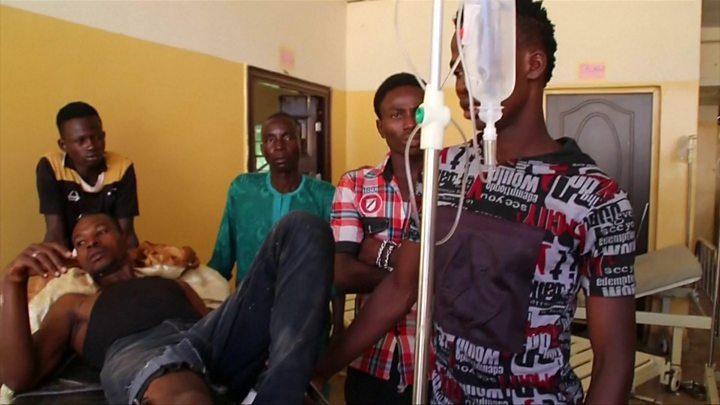
Media captionVictims are receiving medical care after an attack on a video hall

Children were used as suicide bombers in a triple attack in Nigeria on Monday, Unicef has said.
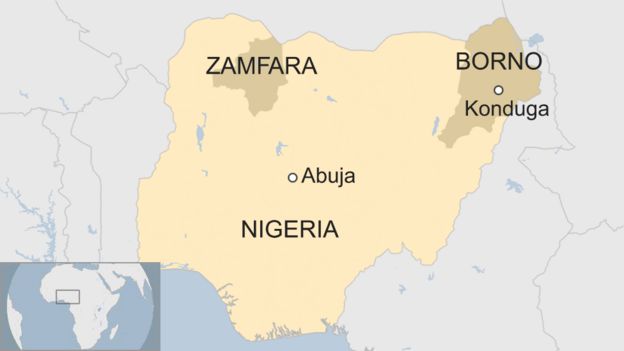
Two girls and a boy carried out the bombing outside a video hall in Konduga village in north-eastern Borno State, the UN children's charity said. Their ages are not yet known.
Officials say at least 30 people were killed and 40 injured in the attack.
The bombing is believed to have been carried out by the Boko Haram jihadist group. It has not yet commented.
According to Unicef, five children have been used in suicide attacks since the beginning of the year.
In 2018, 48 children were used as human bombs in Nigeria, including 38 girls.
"Unicef appeals to all those involved in this terrible conflict to protect children at all times and to keep them out of harm's way," the organisation said.
Formed in Borno State, Boko Haram has waged a brutal insurgency across the north-east for a decade.
As part of the ongoing armed conflict, thousands of children have been recruited and used by armed groups as combatants and non-combatants.
Unicef said girls are raped and forced to marry, with some becoming pregnant in captivity and giving birth without medical care.

What happened in the attack?

The blast took place outside a hall as a group of people gathered to watch television.
Ali Hassan, leader of a self-defence group in Konduga, told AFP news agency that the owner of the hall had prevented one bomber from entering.
"There was a heated argument between the operator and the bomber who blew himself up," he said.
Two other attackers who were nearby then set off their devices.
The number of casualties was high because emergency services arrived late at the site of the blast. They were not adequately equipped to deal with such a large number of wounded people, Usman Kachalla, head of operations at the State Emergency Management Agency (Sema) told AFP.
Video halls are common across northern Nigeria. They are usually rudimentary buildings where people pay a small fee to watch football matches or films.
Boko Haram has targeted them on several occasions, saying they are un-Islamic.

Map of Nigeria

Konduga has been targeted before. In July 2018, eight people were killed after a suicide bomber detonated explosives in a mosque.
President Muhammadu Buhari has commiserated with the families of the victims and promised to bring the perpetrators to justice.
At least 27,000 lives have been lost and about two million people forced to flee their homes in the conflict with Boko Haram.

Presentational grey line

'Daunting and complex security challenges'


Analysis box by Mayeni Jones, Nigeria correspondent

This latest attack came at the end of a bloody weekend in northern Nigeria. There is rising concern of insecurity in other parts of the country.
On Friday night an armed gang killed at least 34 people in the north-western state of Zamfara, which has been at the centre of a wave of attacks by bandits since the beginning of the year.
The Boko Haram insurgency has been terrorising people in the north-east for the past decade, and has been the main area of focus for Nigeria's armed forces.
But the triple suicide bombings in Borno on Sunday reflect just how complex the security challenges are.
The government has said that Boko Haram and the rival Islamic State of West Africa Province (Iswap) group are on their last legs. But both the military and population of the north-east continue to suffer regular attacks.
Although Boko Haram has lost a lot of the territory it held in the north-east in the last four years, it is still attacking soft targets in mosques, markets and public gatherings.
Combine this with the ongoing banditry attacks in the north-west, and kidnappings across the country's highways, and the scale of the security challenge is daunting.

Related Topics