Rice criticized the current administration’s handling of the pandemic, saying there are “absolutely many more Americans dead because of Donald Trump’s failed leadership.”
--- Susan Rice
Showing posts with label Susan Rice. Show all posts
Showing posts with label Susan Rice. Show all posts
Saturday, August 8, 2020


This got my attention because I have been a big fan of Susan Rice for a long time. I'm hoping the moron Biden selects her to be the next Vice-President. If some day she became the President of the United States, that would be a very good thing.
Wikipedia:
The Atlantic
POLITICS
This Is Exactly What Susan Rice Feared
The Biden vice-presidential-nominee finalist discusses Trump’s pandemic response, Benghazi, and her family’s politics.
EDWARD-ISAAC DOVERE
August 8, 2020
A few days before Donald Trump’s inauguration, then-National Security Adviser Susan Rice held a press briefing in her office to talk about the threats she saw on the horizon as Barack Obama’s presidency drew to a close. “What keeps you up at night? one reporter asked toward the end of the meeting. Her answer: a pandemic that spirals out of control.
Yesterday afternoon, I asked Rice how the past five months have compared to what she’d been worried about in the early days of 2017. “This is about in the realm of my worst nightmare,” she told me. That’s why, Rice said, she worked to put together plans, and why she oversaw the creation of the pandemic-preparedness office that Trump famously closed. “We knew it was going to happen. We just couldn’t know when.”
Rice criticized the current administration’s handling of the pandemic, saying there are “absolutely many more Americans dead because of Donald Trump’s failed leadership.” Our conversation can be heard in full on the latest episode of The Ticket.
These days, Rice isn’t speaking just as a former national security adviser and a former United Nations ambassador, or an author whose memoir, Tough Love, just happens to have come out in paperback at the beginning of August. Rice is among the finalists under consideration to be Joe Biden’s running mate, and an announcement is expected within the next few days. If she is picked, she’ll be the first vice-presidential candidate since Henry Wallace, Franklin D. Roosevelt’s third running mate, to have never run for office before.
MORE STORIES

The VP Choice Everyone Is Missing
Did Susan Rice Do Anything Wrong By Asking to 'Unmask' Trump Officials?
Joe Biden Doesn’t Have a Plan for That
She joked that no call from Biden had come in while we were talking.
Read: Could it be Vice President Susan Rice?
What follows is an edited and condensed transcript:
Edward-Isaac Dovere: You’re a huge supporter of statehood for your native Washington, D.C. To some people, it is a ridiculous idea that Washington should ever be a state. To others, like Arkansas Senator Tom Cotton, Washington, D.C., shouldn’t be a state and Wyoming should because “Wyoming is a well-rounded, working-class state.” What do you make of that?
Susan Rice: What are the demographics of Wyoming versus Washington, D.C.? I think it’s an important priority, particularly when we have 700,000 disenfranchised Americans here who are, as you know, red-blooded, hardworking, decent, tax-paying as any others. And there’s a large history to this, which is that the Constitution has established something called the federal enclave. But the Constitution doesn’t require that that federal enclave be any larger than the federal buildings and territory within the city. So you could take the capital in the Mall and the White House and the Supreme Court and the Smithsonian and the federal entities and continue to reserve them as the federal enclave per the Constitution and allow the rest of the city, which is where the population is anyway, to have statehood. And if we had statehood, it would have been a lot harder for President Trump, for political purposes, to call out federal forces to club and beat and terrorize people in the District of Columbia who are peacefully protesting.
Dovere: You’re known as someone who curses, and you write about being known as “direct” and being called a “hothead.” Why do you think that’s been a focus?
Rice: I am accused of using profanity. I cop guilty to that. I do occasionally use profanity. Not in my official functions. Not when the circumstances make it inappropriate. But it is the case that I have used the occasional profanity. Does anybody remember what Dick Cheney said on the Senate floor? Told [Vermont Senator Patrick Leahy] to go F himself. On the Senate floor. Does anybody talk about Dick Cheney’s foul mouth? Or does that in any way define him as the vice president of the United States? I think it’s sexist; that’s what it is.
Dovere: The Sunday-show appearances around the Benghazi attack have become so much of your public identity. Your mother actually warned you not to do it, and thought Hillary Clinton should have instead. In the end, that became an issue getting in your way to be Obama’s secretary of state, and continues to be an issue Republicans attack you over now.
Rice: She said, “Why you?” And I said, “The White House asked me to do it.” And she’s like, “Well, where’s Hillary?” And I said that she’d been asked, but declined. And I presumed—I hadn’t had this conversation with her—that she had had an extraordinarily draining week, having lost four Americans in an American overseas facility, and all the pain and trauma that that entails for the people of the State Department, for the families, for everybody. But I agreed, as a team player. And her instinct was, “I smell a rat. You shouldn’t do it.” And I said, “Mom, don’t be ridiculous. I’ve done this many times before.” She was absolutely right.
Read: What happened the night of the Benghazi attack
Dovere: What did that experience teach you about the way that politics, and at least cable news, political media work?
Rice: First of all, the core lesson is always: Listen to your mother. I think this was what she was getting at, and what I suspect in retrospect that Secretary Clinton and other senior officials understood is, when you have a tragedy, a crisis of the sort we had in Benghazi and the terrorist attack, particularly in the height of a presidential campaign, a hot electoral season—it’s going to be politicized and the opposition is going to be looking to shoot the messenger as much as shoot at the message. And that’s what happened.
I wasn’t thinking about myself. I’m part of a team, a team that had a very hard week. We’ve lost our colleagues. Christopher Stevens, our ambassador in Libya, was somebody that I knew and worked with and respected and liked. It was painful for all of us and for me to think about myself, rather than think about the responsibility that the administration had to communicate to the American people, was not where my head was. And in retrospect, maybe it should have been. Maybe I should have been more self-centered in how I thought about it, because clearly it has not redounded to my benefit in right-wing circles. But if not that, I’m sure they would have found something else.
That was eight years ago, and it was sort of an early leading indicator of how ugly and dishonest our politics were going to get. Eight congressional committees investigated Benghazi ad nauseam through 2016, and not one of them found that I had done anything wrong or that I had deliberately misled the American people or anything else. The fact that really only one piece of that information later turned out to be inaccurate doesn’t make me a liar for having shared it and caveated it as our best current information. That could change. But it shows you how the right wing latches on to a meme or a caricature and drives it relentlessly, and they do it to this day. This one is tired and overwrought, and there’s no substance to it.
Frankly, for the Republicans to be harping on Benghazi in 2020, when under Donald Trump’s watch, three Americans were killed on a U.S. military base in Pensacola, Florida, last year in a terrorist attack inspired by al-Qaeda—what appears to be the first foreign-directed terrorist attack on U.S. soil since 9/11—because the Defense Department failed to adequately vet the Saudi military personnel who are being trained on that base. But no investigation, no outrage, not a boo out of congressional Republicans. Four American servicemen were killed in a terrorist attack in Niger in West Africa on Donald Trump’s watch, and not a boo, not an investigation. Not an expression of concern. So this is all political distraction. And in a year when over 160,000 Americans have died from COVID-19 because of this president’s ineptitude and incompetence and disregard for human life, putting his own political interests above the health and well-being and the economy of the United States and the ability to educate our kids … they’re going to talk about Benghazi? I say fine, let them.
Dovere: You were the national security adviser when the office was set up in the National Security Council to deal with pandemic response under President Obama. That’s the office that Trump famously disbanded. With your experiences and the awareness you had of the dangers of a pandemic, how does what has actually happened compare to the fears that you had?
Rice: This is about in the realm of my worst nightmare. The only thing that would be worse, potentially, is a very deadly flu virus that’s as transmissible as COVID, but much more deadly. Some of the avian flus have a mortality rate of 50 percent. So think about that. Yeah. But in terms of the number of infections, the number of deaths, the economic implications, the complete disruption to our domestic and global economy, this is exactly what I worried about and wrote about in the book when it was published almost a year ago. So this is entirely foreseeable, which is why we tried to put in place plans, offices, equipment, preparatory briefings to help the incoming administration be ready for such a scenario, because we knew it was going to happen. We just couldn’t know when.
Dovere: You write in the new afterword to the book, “I find it exhausting and difficult to remain hopeful in the face of such immoral and incompetent leadership.” Is it strange to watch what’s going on, having been on the inside?
Rice: Strange is to put it mildly. It’s infuriating because it didn’t need to be this bad.
Dovere: Are Americans dead because of Donald Trump?
Rice: I’ve said that repeatedly. There are absolutely many more Americans dead because of Donald Trump’s failed leadership.
Read: How the pandemic defeated America
Dovere: Your son is an outspoken conservative, who’s been identified as a Trump supporter. You are outspoken against Trump. How does that family dynamic work, and what does that tell you about the larger divisions in America right now?
Rice: You should not accept press characterizations of my son. You should read what I say about what his views are. And I write about them in the last chapter of the book. And he and I worked on that portion together to fairly reflect his views, and where we agree and where we disagree. He likes to characterize himself as a Reagan Republican. We have really fundamental disagreements on a lot of issues. And sometimes they get heated, as I write about in the book. But at the end of the day, it’s so much more important to us to be united as a family, to recognize that we have a shared history. We have shared interests. We love each other. We want to stay together, and we fight not to let political differences or any other kind of differences divide us in any kind of irreparable way. As much as I disagree with Donald Trump and his policies, I can’t write off or discount or fear or hate or dismiss those Americans who support him. If everybody did that, we would literally be irreparably divided as a nation. And I don’t think we can afford to do that. I can’t afford to do that in my family.
Dovere: You were a diplomat. You were a behind-the-scenes person. How has it been getting into the political fray yourself?
Rice: What I discovered the hard way was, even when I was serving in New York as our ambassador to the United Nations trying to be very much a policy maker in a policy role, and then went on to be national security adviser, I was sucked into the political fray. I didn’t ask for that. But that’s the nature of the way Washington has devolved. I was sucked in, and I know as long as I was a sitting U.S. official, I was responsible to the interest of the United States. I was speaking on behalf of the United States and on behalf of the president and our administration. Now that I’m a private citizen, I have the ability to speak in my own voice.
It’s telling my own story in my own voice, and because of how governing has transpired under Donald Trump, I feel compelled not to be silent about the many ways in which I think he is disserving our nation. Americans are dying who didn’t need to die because of failed leadership. And I refused to be silent about that, whether I’m a private citizen or not.
Susan Rice
| |
|---|---|
 | |
| 24th United States National Security Advisor | |
| In office July 1, 2013 – January 20, 2017 | |
| President | Barack Obama |
The Atlantic
POLITICS
This Is Exactly What Susan Rice Feared
The Biden vice-presidential-nominee finalist discusses Trump’s pandemic response, Benghazi, and her family’s politics.
EDWARD-ISAAC DOVERE
August 8, 2020
A few days before Donald Trump’s inauguration, then-National Security Adviser Susan Rice held a press briefing in her office to talk about the threats she saw on the horizon as Barack Obama’s presidency drew to a close. “What keeps you up at night? one reporter asked toward the end of the meeting. Her answer: a pandemic that spirals out of control.
Yesterday afternoon, I asked Rice how the past five months have compared to what she’d been worried about in the early days of 2017. “This is about in the realm of my worst nightmare,” she told me. That’s why, Rice said, she worked to put together plans, and why she oversaw the creation of the pandemic-preparedness office that Trump famously closed. “We knew it was going to happen. We just couldn’t know when.”
Rice criticized the current administration’s handling of the pandemic, saying there are “absolutely many more Americans dead because of Donald Trump’s failed leadership.” Our conversation can be heard in full on the latest episode of The Ticket.
These days, Rice isn’t speaking just as a former national security adviser and a former United Nations ambassador, or an author whose memoir, Tough Love, just happens to have come out in paperback at the beginning of August. Rice is among the finalists under consideration to be Joe Biden’s running mate, and an announcement is expected within the next few days. If she is picked, she’ll be the first vice-presidential candidate since Henry Wallace, Franklin D. Roosevelt’s third running mate, to have never run for office before.
MORE STORIES
The VP Choice Everyone Is Missing
Did Susan Rice Do Anything Wrong By Asking to 'Unmask' Trump Officials?
Joe Biden Doesn’t Have a Plan for That
She joked that no call from Biden had come in while we were talking.
Read: Could it be Vice President Susan Rice?
What follows is an edited and condensed transcript:
Edward-Isaac Dovere: You’re a huge supporter of statehood for your native Washington, D.C. To some people, it is a ridiculous idea that Washington should ever be a state. To others, like Arkansas Senator Tom Cotton, Washington, D.C., shouldn’t be a state and Wyoming should because “Wyoming is a well-rounded, working-class state.” What do you make of that?
Susan Rice: What are the demographics of Wyoming versus Washington, D.C.? I think it’s an important priority, particularly when we have 700,000 disenfranchised Americans here who are, as you know, red-blooded, hardworking, decent, tax-paying as any others. And there’s a large history to this, which is that the Constitution has established something called the federal enclave. But the Constitution doesn’t require that that federal enclave be any larger than the federal buildings and territory within the city. So you could take the capital in the Mall and the White House and the Supreme Court and the Smithsonian and the federal entities and continue to reserve them as the federal enclave per the Constitution and allow the rest of the city, which is where the population is anyway, to have statehood. And if we had statehood, it would have been a lot harder for President Trump, for political purposes, to call out federal forces to club and beat and terrorize people in the District of Columbia who are peacefully protesting.
Dovere: You’re known as someone who curses, and you write about being known as “direct” and being called a “hothead.” Why do you think that’s been a focus?
Rice: I am accused of using profanity. I cop guilty to that. I do occasionally use profanity. Not in my official functions. Not when the circumstances make it inappropriate. But it is the case that I have used the occasional profanity. Does anybody remember what Dick Cheney said on the Senate floor? Told [Vermont Senator Patrick Leahy] to go F himself. On the Senate floor. Does anybody talk about Dick Cheney’s foul mouth? Or does that in any way define him as the vice president of the United States? I think it’s sexist; that’s what it is.
Dovere: The Sunday-show appearances around the Benghazi attack have become so much of your public identity. Your mother actually warned you not to do it, and thought Hillary Clinton should have instead. In the end, that became an issue getting in your way to be Obama’s secretary of state, and continues to be an issue Republicans attack you over now.
Rice: She said, “Why you?” And I said, “The White House asked me to do it.” And she’s like, “Well, where’s Hillary?” And I said that she’d been asked, but declined. And I presumed—I hadn’t had this conversation with her—that she had had an extraordinarily draining week, having lost four Americans in an American overseas facility, and all the pain and trauma that that entails for the people of the State Department, for the families, for everybody. But I agreed, as a team player. And her instinct was, “I smell a rat. You shouldn’t do it.” And I said, “Mom, don’t be ridiculous. I’ve done this many times before.” She was absolutely right.
Read: What happened the night of the Benghazi attack
Dovere: What did that experience teach you about the way that politics, and at least cable news, political media work?
Rice: First of all, the core lesson is always: Listen to your mother. I think this was what she was getting at, and what I suspect in retrospect that Secretary Clinton and other senior officials understood is, when you have a tragedy, a crisis of the sort we had in Benghazi and the terrorist attack, particularly in the height of a presidential campaign, a hot electoral season—it’s going to be politicized and the opposition is going to be looking to shoot the messenger as much as shoot at the message. And that’s what happened.
I wasn’t thinking about myself. I’m part of a team, a team that had a very hard week. We’ve lost our colleagues. Christopher Stevens, our ambassador in Libya, was somebody that I knew and worked with and respected and liked. It was painful for all of us and for me to think about myself, rather than think about the responsibility that the administration had to communicate to the American people, was not where my head was. And in retrospect, maybe it should have been. Maybe I should have been more self-centered in how I thought about it, because clearly it has not redounded to my benefit in right-wing circles. But if not that, I’m sure they would have found something else.
That was eight years ago, and it was sort of an early leading indicator of how ugly and dishonest our politics were going to get. Eight congressional committees investigated Benghazi ad nauseam through 2016, and not one of them found that I had done anything wrong or that I had deliberately misled the American people or anything else. The fact that really only one piece of that information later turned out to be inaccurate doesn’t make me a liar for having shared it and caveated it as our best current information. That could change. But it shows you how the right wing latches on to a meme or a caricature and drives it relentlessly, and they do it to this day. This one is tired and overwrought, and there’s no substance to it.
Frankly, for the Republicans to be harping on Benghazi in 2020, when under Donald Trump’s watch, three Americans were killed on a U.S. military base in Pensacola, Florida, last year in a terrorist attack inspired by al-Qaeda—what appears to be the first foreign-directed terrorist attack on U.S. soil since 9/11—because the Defense Department failed to adequately vet the Saudi military personnel who are being trained on that base. But no investigation, no outrage, not a boo out of congressional Republicans. Four American servicemen were killed in a terrorist attack in Niger in West Africa on Donald Trump’s watch, and not a boo, not an investigation. Not an expression of concern. So this is all political distraction. And in a year when over 160,000 Americans have died from COVID-19 because of this president’s ineptitude and incompetence and disregard for human life, putting his own political interests above the health and well-being and the economy of the United States and the ability to educate our kids … they’re going to talk about Benghazi? I say fine, let them.
Dovere: You were the national security adviser when the office was set up in the National Security Council to deal with pandemic response under President Obama. That’s the office that Trump famously disbanded. With your experiences and the awareness you had of the dangers of a pandemic, how does what has actually happened compare to the fears that you had?
Rice: This is about in the realm of my worst nightmare. The only thing that would be worse, potentially, is a very deadly flu virus that’s as transmissible as COVID, but much more deadly. Some of the avian flus have a mortality rate of 50 percent. So think about that. Yeah. But in terms of the number of infections, the number of deaths, the economic implications, the complete disruption to our domestic and global economy, this is exactly what I worried about and wrote about in the book when it was published almost a year ago. So this is entirely foreseeable, which is why we tried to put in place plans, offices, equipment, preparatory briefings to help the incoming administration be ready for such a scenario, because we knew it was going to happen. We just couldn’t know when.
Dovere: You write in the new afterword to the book, “I find it exhausting and difficult to remain hopeful in the face of such immoral and incompetent leadership.” Is it strange to watch what’s going on, having been on the inside?
Rice: Strange is to put it mildly. It’s infuriating because it didn’t need to be this bad.
Dovere: Are Americans dead because of Donald Trump?
Rice: I’ve said that repeatedly. There are absolutely many more Americans dead because of Donald Trump’s failed leadership.
Read: How the pandemic defeated America
Dovere: Your son is an outspoken conservative, who’s been identified as a Trump supporter. You are outspoken against Trump. How does that family dynamic work, and what does that tell you about the larger divisions in America right now?
Rice: You should not accept press characterizations of my son. You should read what I say about what his views are. And I write about them in the last chapter of the book. And he and I worked on that portion together to fairly reflect his views, and where we agree and where we disagree. He likes to characterize himself as a Reagan Republican. We have really fundamental disagreements on a lot of issues. And sometimes they get heated, as I write about in the book. But at the end of the day, it’s so much more important to us to be united as a family, to recognize that we have a shared history. We have shared interests. We love each other. We want to stay together, and we fight not to let political differences or any other kind of differences divide us in any kind of irreparable way. As much as I disagree with Donald Trump and his policies, I can’t write off or discount or fear or hate or dismiss those Americans who support him. If everybody did that, we would literally be irreparably divided as a nation. And I don’t think we can afford to do that. I can’t afford to do that in my family.
Dovere: You were a diplomat. You were a behind-the-scenes person. How has it been getting into the political fray yourself?
Rice: What I discovered the hard way was, even when I was serving in New York as our ambassador to the United Nations trying to be very much a policy maker in a policy role, and then went on to be national security adviser, I was sucked into the political fray. I didn’t ask for that. But that’s the nature of the way Washington has devolved. I was sucked in, and I know as long as I was a sitting U.S. official, I was responsible to the interest of the United States. I was speaking on behalf of the United States and on behalf of the president and our administration. Now that I’m a private citizen, I have the ability to speak in my own voice.
It’s telling my own story in my own voice, and because of how governing has transpired under Donald Trump, I feel compelled not to be silent about the many ways in which I think he is disserving our nation. Americans are dying who didn’t need to die because of failed leadership. And I refused to be silent about that, whether I’m a private citizen or not.
Friday, July 31, 2020
I will forgive Biden for being a moron if he selects this brilliant person for the Vice-President job.
 |
| Former U.S. ambassador to the United Nations and national security adviser Susan Rice poses for a portrait at her home in Washington in September. |
For Susan Rice, diplomacy began at home — at age 7
Dec. 6, 2019
Scholars and journalists pounce on the memoirs of senior government officials, especially those written soon after departure from high office, in search of juicy revelations and new insights about how the policy sausage got made. More often than not, we are disappointed. Amid the relitigated debates and the overly detailed recounting of episodes that are either already defined by history or too recent to judge, scoops are rare.
Some veterans of the Obama administration — Ben Rhodes and Samantha Power, to name the authors of two recent memoirs — came to the exercise as writers, with at least the expectation of some literary flair. Hillary Clinton, no surprise, published a cautious book during the campaign about her four years as Barack Obama’s secretary of state. Robert Gates vented his frustration, as defense secretary, with a craven Congress and a president he felt lacked his passion for the troops.
What I enjoy about these books is less their recounting of high-level debates and bureaucratic infighting than the window into lives beyond the closed doors of power. Who are they when they leave the office at night?
Susan Rice’s contribution to the genre, “Tough Love: My Story of the Things Worth Fighting For,” is the tale of a black child of privilege, raised in the overwhelmingly white world of official Washington by accomplished parents in a troubled marriage, who rose fast in the foreign policy ranks while learning to claim and celebrate her race and juggle her own marriage and motherhood without asserting special dispensation.
Rice, who served eight years in the Obama administration, first as ambassador to the United Nations and then as national security adviser, is widely known as smart, sharp-tongued and relentless. She cops freely to her reputation, delivered in a warning from a mentor early in her career, as “too hard-charging and hardheaded,” someone who tends to “quell dissent and stifle contrary advice.” As with many women in high places, the B-word is not unfamiliar to her.
Nor is the N-word, first directed at Rice by a beloved high school basketball coach she played for as a student at Washington’s prestigious National Cathedral School. “Reflexively and immediately, I replied, ‘F--- you,’ ” she reports, before going on to praise the coach’s skills and regretting her departure for another job two years later.
For someone who has covered Rice, and interviewed her a number of times over the years, that and other elements of her life story explain a lot.
Beginning at age 7, Rice reports, she took it upon herself to serve as peacemaker in her parents’ deteriorating relationship. As their combat escalated, her father, Emmett Rice, a descendant of slaves, who was scarred by decades of discrimination in his native South but ultimately became a governor of the Federal Reserve, “hired a private investigator to spy on my mother.” Her mother, Lois Rice, the New England-bred, Ivy League-educated daughter of Jamaican immigrants who long served as a senior official in the organization that runs the College Board, “clandestinely installed recording devices in our house to entrap my father.” With young Susan as confidante, Lois frequently threatened suicide.
“They really didn’t like each other and maybe rarely had,” she says of her parents. As their mutual abuse moved from verbal to physical, and even divorce did not keep them from the attack, “I learned how to compartmentalize conflict, protect myself emotionally and psychically, and bounce back from adversity,” she writes.
Rice delves into the major policy issues she dealt with during four years as U.N. ambassador, although her account mainly chronicles her own actions and says little about contributions from other members of the administration. She places most in the success column. U.S. leadership, she writes, was reestablished at a U.N. Security Council still smarting over George Bush’s Iraq War. North Korean sanctions were won. Initial lines of dialogue with Iran were established.
Among the less-happy outcomes Rice describes, South Sudan, a place of particular interest to her from her youthful days as an Africa specialist, became a new country, then sadly unraveled. In 2011, the United States and its allies bombed Libya to prevent a mass slaughter by Moammar Gaddafi of his political opponents in the eastern part of the country, a mission that “initially . . . seemed a triumph of good over evil.” But while “the U.S. intervened for the right reasons,” she writes, the result echoed the disaster of an earlier American intervention in Somalia: “We made fewer mistakes and paid a far lesser price for our success protecting civilians in Libya than we did in Somalia. And yet what we left behind is not dissimilar — a fractured state without an effective central government, continued factional fighting, a lingering terrorist threat, and a source of insecurity in the region.”
Part of the extended fallout from the failure “to try hard enough and early enough to win the peace” in Libya was the 2012 killing by extremists of four U.S. officials, including Ambassador Chris Stevens, in Benghazi. Rice devotes a chapter to the repercussions of her TV talk show appearances on the Sunday after the attack, when her first-draft report of what happened later became evidence in the Republican case against Obama and made her a punching bag for the right. But she sheds little new light on a story that was subsequently investigated and heavily covered, and about which she has since often spoken and written.
Similarly, she provides few surprises about her time as national security adviser, including the decisions she opposed, such as Obama’s refusal to take military action after a chemical weapons attack in Syria; her overall respect and affection for him; and her frustration at his often cold-blooded intellectualizing about life-and-death choices. She applauds the opening to Cuba and the Iran nuclear deal, and adds some details to the known universe of how the administration responded to the rise of the Islamic State and initial reports of Russian interference in the 2016 election.
Interspersed among these dutiful brussels sprouts, however, are gossipy descriptions of important people, along with stories of sisterhood, occasional insecurity, raucous dance parties among bureaucrats and an uncomfortable encounter with pre-presidential Donald Trump. There are lessons on pumping breast milk on an official trip to Africa while your infant is thousands of miles away, conducting a long-distance marriage, relating to a grown son whose politics and ideology are 180 degrees from your own, and enduring the loss of parents. Real-life stuff.
Tough Love
My Story of the Things Worth Fighting For
By Susan Rice
Simon & Schuster. 531 pp. $30
Tuesday, July 28, 2020
Susan Rice might be the next Vice-President.
Wikipedia - Susan Rice
Susan Rice
| |
|---|---|
| |
| 24th United States National Security Advisor | |
| In office July 1, 2013 – January 20, 2017 | |
| President | Barack Obama |
| Deputy | Tony Blinken Avril Haines |
| Preceded by | Thomas E. Donilon |
| Succeeded by | Michael Flynn |
| 27th United States Ambassador to the United Nations | |
| In office January 26, 2009 – June 30, 2013 | |
| President | Barack Obama |
| Deputy | Brooke Anderson Rosemary DiCarlo |
| Preceded by | Zalmay Khalilzad |
| Succeeded by | Samantha Power |
| 12th Assistant Secretary of State for African Affairs | |
| In office October 14, 1997 – January 20, 2001 | |
| President | Bill Clinton |
| Preceded by | George Moose |
| Succeeded by | Walter H. Kansteiner III |
| Personal details | |
| Born |
Susan Elizabeth Rice
November 17, 1964 Washington, D.C., U.S. |
| Political party | Democratic |
| Spouse(s) |
Ian Cameron (m. 1992)
|
| Children | 2 |
| Parents | Emmett J. Rice (father) Lois Dickson Rice (mother) |
| Education | Stanford University (BA) New College, Oxford (MPhil, DPhil) |
| Occupation |
|
| Profession | Politician |
New York Times article about Susan Rice who could be the next Vice-President. I like this person. I hope she gets the job.
Considering a Biden-Rice ticket |
|
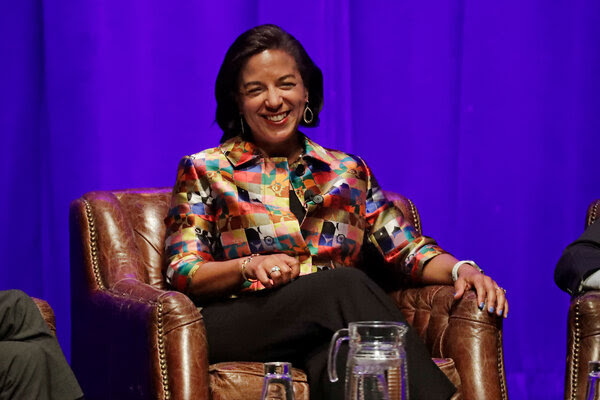
Joe Biden said this spring that he hoped to choose a vice-presidential nominee by Aug. 1 — which is Saturday. His advisers now say that deadline could slide, partly because he does not need a running mate until the Democratic convention, which is scheduled to start Aug. 17.
|
But a fairly consistent short list of candidates has emerged. The top of that list appears to include three senators (Kamala Harris, Elizabeth Warren and Tammy Duckworth), two House members (Karen Bass and Val Demings) and one person who has never held elected office: Susan Rice, President Barack Obama’s former national security adviser.
|
As The Times’s Alexander Burns — who has just written a story on Rice — told me yesterday: “Rice’s strengths as a V.P. candidate say so much about the strange and scary kind of campaign we’re in. In a normal campaign, Democrats would probably be deeply wary of choosing someone who’s never been shouted at by voters in an unruly town hall meeting. But there aren’t going to be unruly town hall meetings because of a terrifying pandemic, and Rice has a profile that seems to convey seriousness in that context.”
|
Subscribe to:
Posts (Atom)