Showing posts with label gorillas. Show all posts

Sunday, November 29, 2020

I wrote this 5 years ago. It was about one of my favorite cousins.

The other ape species are very intelligent creatures.

Several years ago I was at Chicago’s Lincoln Park Zoo standing next to a huge gorilla who was sitting on a stool. I turned my head to talk to my friends. When I was about to look at the gorilla he threw his entire weight at me. Completely forgetting the thick glass between us I was terrified. Then he smashed into the glass. He planned the whole thing. Best practical joke ever. Perfect timing. It was obvious he was laughing at me. Because of the glass I did not know if this was silent laughing but he was definitely laughing. I learned that day gorillas are very intelligent creatures which makes sense because we share an ancestor with them.

Thursday, October 8, 2020

An interesting fact: Human apes need less sleep than any other primate.

Babies need far more sleep than adults
Three million years ago, our ancestors still had ape-like bodies. These Australopithecines probably slept in the trees, like modern chimpanzees.


Homo erectus (right) was bigger brained than earlier hominins (left)
H. erectus was starting to build better tools. Technologies like the Acheulean hand-axes pictured above were more advanced than older stone tools. This knowledge was widely shared, so they must have learned it quickly.
Gorillas build new sleeping nests each night
Sleeping in trees means there is a risk of falling
Hadza hunter-gatherers do not need much sleep
Our closest living relatives sleep for longer than we do
Dolphins never completely switch off

BBC Earth

Why humans need less sleep than any other primate

Most of us feel like we need more sleep, but as a species we have actually evolved to sleep less than our ape and monkey relatives. Could that be the key to our success?

By Melissa Hogenboom

21 January 2016

I have always been envious of people who can get by with only six hours' sleep. I prefer eight, sometimes more. I can function on six, but after a few days my brain will be way below full capacity.

How much sleep we get affects us all. Too much sleep makes us groggy and disorientated. Sleep too little and our mood and concentration suffer. If this carries on it can also cause serious health issues, heightening the risk of diabetes, obesity and high blood pressure.

Most of us sleep between six to nine hours a night, meaning we spend about a third of our lives asleep. This may seem like a long time, but we actually sleep the least among all the primates – the group that includes monkeys, apes and us.

So says a new analysis looking at the impact sleep has had on our evolution. The new research suggests that humans have evolved to sleep less, but also to sleep very deeply. This may help explain our success as a species.

But by two million years ago, hominins had become fully upright. Homo erectus spent its life on the ground, and may have been the first hominin to make beds there. If that is true, we have been sleeping on the ground for a long time.

Sleeping on the ground may have gifted H. erectus with a higher-quality, more restful sleep.

For one thing, they did not have to worry about falling out of the trees. What's more, while the risk from predators was higher on the ground, they had ways to protect themselves.

In particular, H. erectus may have mastered the use of fire. The flames and smoke would have scared away both mosquitoes and larger predators, keeping them safe. They may also have hidden away in sheltered places like caves.

We do not have direct evidence that H. erectus used fire at this time. But 10 years ago, Richard Wrangham of Harvard University proposed that our ancestors must have eaten cooked food to get enough calories to fuel their bigger brains.

As BBC Earth has covered before, fuelling our energy-hungry brains with enough calories has been crucial to our evolution. If our ancestors did not cook, Wrangham argued, they would have had to spend too much time chewing and digesting.

There is also evidence that at the same time hominins came down from the trees, they became smarter and acquired better weapons.

Group sizes also increased around this time, perhaps aided by better weaponry and communication skills.

According to David Samson and Charles Nunn of Duke University in North Carolina, US, all these changes – from larger groups to more advanced tools – can be linked to a change in the way our ancestors slept.

They have set out their ideas in a new study published in the journal Evolutionary Anthropology.

They argue that moving from the trees to the ground allowed our ancestors to sleep more deeply – "which could in turn have affected cognition", says Samson.

The theory goes that although we sleep for fewer hours than other primates, the sleep that we have is of high quality so we do not need as much.

To understand whether human sleep is unique, Samson and Nunn compared the sleep patterns of 21 primates, whose slumber patterns had already been analyzed.

As well as noting how long the animals slept for, they looked at how much time they spent in rapid-eye movement (REM) sleep. This is when we dream, and when our brain consolidates our memories into long-term storage.

Humans slept the least. The sleepiest primates were grey mouse lemurs and night monkeys, which slept for 15 and 17 hours respectively.

But in contrast, humans spent the highest proportion of their sleep in an REM state: almost 25%. "Humans therefore have the deepest sleep of any primate," says Samson.

Other primates get much less REM sleep, between 5-10%.

Samson previously compared ape and monkey sleep, and found a similar pattern: apes seem to have better-quality sleep than monkeys.

This may be because apes sleep in specially-built nests in the trees. Monkeys do not, and their environment is often less secure. That means they have to sleep more lightly, allowing them to wake quickly if a predator approaches.

Just as apes get better sleep than monkeys, so we get better sleep than apes. "From an evolutionary perspective, just as the transition from tree branches to sleeping platforms had adaptive benefits, so too did the early hominin transition from sleeping platforms to secure ground sleep," Samson previously told BBC Earth.

He argues that we could not have slept so deeply until we found ways to sleep safely. During REM sleep, you are "essentially as close to dead in the outside world as you'll ever be", says Samson. "You need to have a unique sleep environment to be able to pull this off."

The idea that humans have evolved to sleep briefly but deeply runs counter to a cherished folk belief. Surely modern technologies like artificial lighting have disrupted our natural sleep patterns? Isn't that why we are all so sleep-deprived?

Surprisingly, this may not be entirely true.

A study published in November 2015 looked at the sleep habits of three preindustrial societies: two hunter-gatherer groups from Africa and one horticultural group from Bolivia.

All three groups slept for an average of 6.4 hours per night, ranging from 5.7–7.1 hours. That is even less than the average for an industrial society.

The people in the study woke before sunrise and went to bed several hours after sunset, suggesting that the natural light and dark cycles were not determining when they went to sleep.

What's more, getting less sleep did not appear to reduce their cognitive abilities, and they were all generally healthy, says lead author Jerome Siegel of the University of California, Los Angeles in the US. This suggests they were sleeping enough.

Siegel's study does not tell us anything about ancestral species like H. erectus. But it does suggest that the earliest modern humans, who lived in similar environments to the people in the study, also needed surprisingly little sleep.

It is tricky to be sure about this, because some people need more sleep than others. There could even be population-level patterns: certain groups of people may have inherited genes that allow them to get by on less sleep.

Samson and Nunn's study focused on average amounts of sleep, taken across entire populations. But that might be missing the point, says sleep specialist Jeffrey Durmer of Georgia State University in Atlanta, US.

Sleep is particularly important when we are very young, especially REM sleep. Infants spend far more time in REM sleep than children or adults.

If you compare a child's REM sleep to that of an adult, the difference is much greater than it is between humans and chimpanzees, he says. This might mean that getting enough quality sleep early on in life was more important in helping our ancestors develop into ever big-brained hominins.

"REM sleep is very important in the development of the nervous system," says Durmer. "That means that cognition in particular is ultimately very reliant on REM sleep."

The biggest problem with Samson and Nunn's idea is that we do not yet understand all the functions of sleep, so we cannot say for sure what benefits we might get from extra REM sleep.

In particular, we periodically switch from REM sleep to other kinds of sleep. We do not know why these transitions happen, or how important they are, says Derk-Jan Dijk of the University of Surrey in the UK. "There may be a little secret there."

The picture gets even muddier when we start to compare our own REM sleep to that of other animals, beyond our close relatives the primates.

Siegel thinks that REM sleep is not that important to humans after all.

He argues that we should consider all mammals, not just primates. When we do so, humans do not stand out as needing a particularly large proportion of REM sleep.

The link between REM sleep and intelligence also fades away. For example, dolphins are intelligent and have large brains, yet they do not need any REM sleep. Meanwhile opossums, which are not noted for their deep thinking, need over six hours.

Samson disagrees. He points out that species' distinct lifestyles can result in differing needs for sleep.

Famously, dolphins only sleep on one side of their brain at a time. The reason for this is simple: if they switched off completely they would drown. Looked at in that light, it makes sense that dolphins do not sleep deeply.

"When you use animal studies to compare to humans we aren't comparing apples to apples," agrees Durmer. "We may have a very different use of REM sleep compared to other species."

Regardless of why it happened, the fact remains that human sleep is strange compared to our closest living relatives. This suggests that we have evolved to need less of it.

Obviously, we cannot ever study how long our hominin ancestors slept for, because they have gone extinct. The best we can do is to compare ourselves to other living animals.

It seems that, at some point, bigger-brained hominins became more efficient sleepers. The bad news for above-average sleepers like me is that we may be genetically predisposed to need more of it.

But the third of our lives we spend doing so is certainly not wasted. Our big brains took millions of years of evolution to get there, so it's only fair that we reward ourselves with a lifetime of adequate rest.

Melissa Hogenboom is BBC Earth's feature writer. She is @melissasuzanneh on Twitter.

Follow BBC Earth on Facebook, Twitter, and Instagram

Monday, September 28, 2020

The most interesting fact of science: "Humans, chimpanzees, and bonobos are more closely related to one another than either is to gorillas or any other primate. From the perspective of this powerful test of biological kinship, humans are not only related to the great apes – we are one. The DNA evidence leaves us with one of the greatest surprises in biology: the wall between human, on the one hand, and ape or animal, on the other, has been breached. The human evolutionary tree is embedded within the great apes."

The most interesting fact of science: We are apes.

•••••••••••••••••••••••••••••••••••••

Here in Idiot America where I live, the most recent Gallop poll shows that 40% of Americans think human apes were magically created by a magic god fairy who waved its magic wand to make it happen.

The same poll:

33% of Americans think Jeebus was one of the mechanisms of evolution.

Only 22% of Americans accept evolution without any supernatural magic.

And most of these American idiots don't know we are apes and they would never agree we are apes.

What a waste of a life to not know what you are.

Saturday, September 26, 2020

Can this problem be fixed? I hope so but I doubt it.

The Washington Post

Animals

Humans are decimating wildlife, and the pandemic is a sign, report says

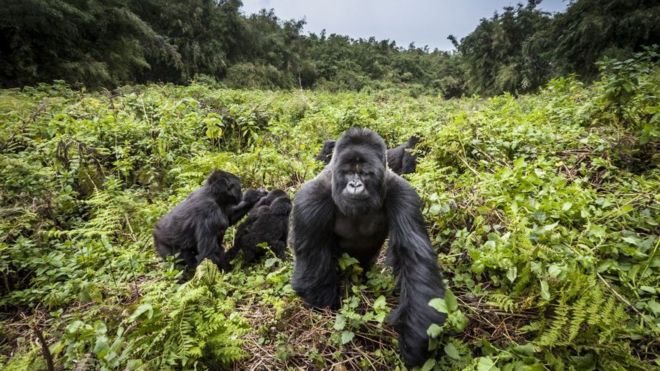
An endangered mountain gorilla in Congo's Virunga National Park. (Brett Stirton/Reportage for Getty Images/WWF)
An endangered mountain gorilla in Congo's Virunga National Park.

The giant freshwater stingray is in decline in Laos's Mekong River. (Zeb Hogan/WWF)
The giant freshwater stingray is in decline in Laos's Mekong River.

By Karin Brulliard

September 10, 2020

Humanity’s expansion, consumption and transformation of land and sea have caused wildlife populations to plunge over five decades, signaling a “broken” relationship with nature that helped trigger the global coronavirus pandemic, a report says.

Average populations of nearly 4,400 mammals, amphibians, birds, fish and reptiles dropped by 68 percent since 1970, according to the World Wildlife Fund report, which is based on vertebrate monitoring projects around the world. The losses have been driven primarily by habitat loss, it says, along with pollution, invasive species, overhunting and overfishing and, increasingly, climate change.

The result is dysfunctional ecosystems — bereft of important pollinators, predators and scavengers — less able to support human or animal health, said Rebecca Shaw, the fund’s chief scientist.

The “Living Planet Report,” published every two years, is the latest to describe stunning declines in biodiversity resulting from human activity. The United Nations warned last year that 1 million plant and animal species are on the verge of extinction. Also in 2019, ornithologists and government agencies reported North America had lost nearly 3 billion birds over 50 years.

But World Wildlife Fund officials emphasized one catastrophic consequence of the declines is now before our eyes. The coronavirus pandemic, caused by the sort of “spillover” of a zoonotic virus that is becoming more common as humans expand their footprint, should be viewed as “an SOS signal for the human enterprise,” the report says.

The report “provides unequivocal evidence that nature is unraveling and that our planet is flashing red warning signs,” wrote Marco Lambertini, director general of WWF International. “Covid-19 is a clear manifestation of our broken relationship with nature and highlights the deep interconnection between the health of both people and the planet.”

More than two-thirds of emerging infectious diseases in humans have origins in animals, and scientists say the virus that causes covid-19 probably originated in a horseshoe bat, though the virus’s precise path to people remains unknown. What’s clear is that animal viruses have more chances to hop to humans as we develop formerly wild spaces, fly around the globe, trade in wildlife and intensify livestock production.

“If you start deforesting and are grabbing those animals out of the forest and putting them on trains and putting them on trucks and boats, alive, with domestic animals and humans, you have all this viral mixing,” Shaw said. “We’re disrupting nature and creating the opportunity for these spillover events.”

Wildlife losses were particularly precipitous for freshwater species, which saw an average decline of 84 percent, in part because of the near disappearance of most wetlands that existed 500 years ago, the report said. The average drop in species monitored in Central and South America was an astonishing 94 percent, it said.

Populations of animals large and small are dwindling, and are changing differently in different regions, according to the report.

While tigers are on the rise in Nepal, the big cats’ numbers have fallen by more than 20 percent in Russia’s far east, where habitat loss, a decline in prey and poaching pose threats. Agriculture has caused gray partridges in the United Kingdom to plummet, while illegal hunting and mining have driven down the Grauer’s gorilla population in the Congo by 87 percent.

Several species of vibrantly speckled harlequin frogs in Colombia, Ecuador and Venezuela have faced “catastrophic” losses and extinctions, mostly attributable to a fungal disease that may have originated in East Asia in the 20th century and then shot around the planet with the boom in global trade and the exotic pet market.

Despite the declines, Shaw said urgent changes could blunt or even reverse some of the damage. Modeling carried out by the World Wildlife Fund and 50 partners as part of a two-year-old initiative called “Bending The Curve” found recovery will require a combination of increasing land conservation efforts and, crucially, overhauling food production to make it more sustainable and efficient and less wasteful. Those findings were described Thursday in the journal Nature.

The “Living Planet Report” describes wildlife population declines not only because they act as a barometer for ecosystem health, but also because they contain glimmers of hope, Shaw added.

“If you only measure threatened and endangered species, which has really been the focus for the conservation community for many, many years,” Shaw said, “you’re way too late.”


Karin Brulliard

Karin Brulliard is a national reporter who writes about animals. Previously, she was an international news editor; a foreign correspondent in South Africa, Pakistan and Israel; and a local reporter. She joined The Post in 2003. Follow

The next pandemic is already coming, unless humans change how we interact with wildlife, scientists say

People probably caught coronavirus from minks. That’s a wake-up call to study infections in animals, researchers say.

North America has lost 3 billion birds in 50 years

Saturday, August 22, 2020

There is not much difference between human apes and gorilla apes.

Baby gorilla born at Bristol Zoo
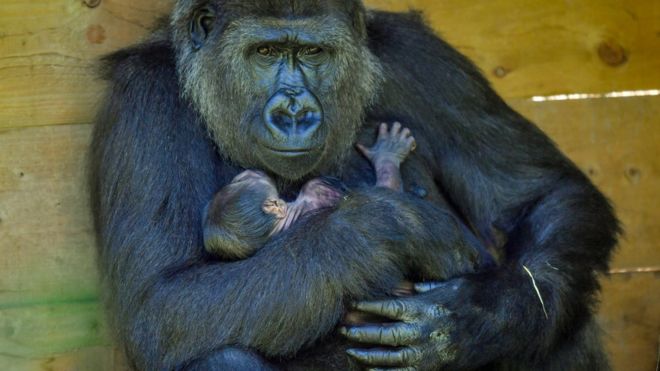
Kala the western lowland gorilla and her babyImage copyrightPA MEDIA
Image captionThe baby gorilla arrived in the early hours of Wednesday
A baby gorilla has been born at Bristol Zoo.
Keepers arrived to find the new arrival nestling in the arms of its mother.
Photographs taken just hours after the birth on Wednesday show Kala - a nine-year-old western lowland gorilla - cradling the newborn. Staff said both were "doing well".
The zoo said Kala gave birth naturally with the baby's father, Jock, nearby. Her first baby died last year a week after it was born.
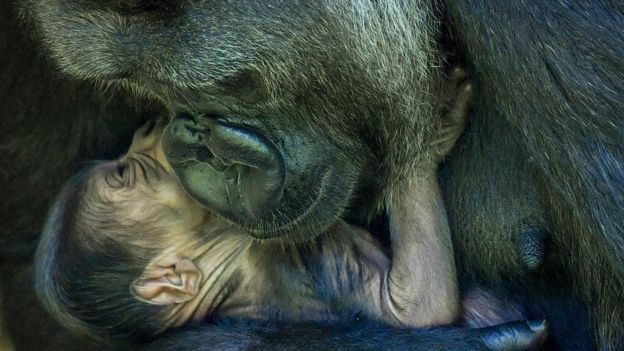
Kala the western lowland gorilla and her babyImage copyrightPA MEDIA
Image captionMother and both are both said to be doing well
Lynsey Bugg, the zoo's curator of mammals, said: "We knew we were having a baby gorilla due and we've been on baby watch for a little while.
"On Tuesday Kala looked nice and comfortable and not causing us any concerns or worries.
"I came in [on Wednesday] morning to find a brand new baby in the house. It was lovely."
Kala the western lowland gorilla and her babyImage copyrightPA MEDIA
Image captionLynsey Bugg said Kala was "a very attentive mother"
She said staff had been "on tenterhooks" following the death of Kala's first baby last September, a week after she underwent an emergency caesarean.
"It is so lovely that she was able to give birth naturally and baby and mum are really well.
"She's a very attentive mother and very nurturing and you see lots of suckling from the baby, and the baby looks really strong and a good size."
It will be a while before the zoo knows if the baby is male or female, Ms Bugg said.
"They are not all that easy to sex and we want to have a few looks before we are certain."
The new gorilla joins a troop of six at the zoo, which are part of a breeding programme.
The western lowland gorilla is classed as critically endangered, with some estimates putting the number left in the wild at about 100,000.
Kala the western lowland gorilla and her babyImage copyrightPA MEDIA
Image captionThe sex of the baby is not yet known

Related Topics

Saturday, August 1, 2020

One of the most interesting facts of science. Humans are apes. The Magic Jeebus Man was an ape. Christians worship a dead ape.

The Australian Museum

Humans are apes – ‘Great Apes’

Humans are classified in the sub-group of primates known as the Great Apes.

Humans are primates, but the primates that we most closely resemble are the apes. We are therefore classified along with all other apes in a primate sub-group known as the hominoids (Superfamily Hominoidea).

This ape group can be further subdivided into the Great Apes and Lesser Apes. Humans have bodies that are genetically and structurally very similar to those of the Great Apes and so we are classified in the Great Apes sub-group which is also known as the hominids (Family Hominidae).

Ape diversity

The first apes evolved about 25 million years ago and by 20 million years ago were a very diverse group. Within the last 10 million years, however, many ape species became extinct as the earth’s climate cooled and dried and their forested environments changed to woodland and grassland. There are now only about 20 living species of apes and they are divided into two major groups. These are the:

Lesser Apes, containing the gibbons

Great Apes, containing the orang-utans, gorillas, chimpanzees and humans

Ape features

Apes (including humans) possess the same general features that all primates share but they differ from other primates in a number of distinctive ways.

Features that separate the apes from other groups of primates include:

a brain that is larger and more complex than other primates
distinctive molar teeth in the lower jaw which have a ‘Y5’ pattern (five cusps or raised bumps arranged in a Y-shape)
a shoulder and arm structure that enables the arms to freely rotate around the shoulder
a ribcage that forms a wide but shallow chest
an appendix
no external tail

The Lesser Apes

There are about 14 species of relatively small-bodied apes known as Lesser Apes. These are the gibbons, which live in trees, rarely descend to the ground and are active during the day. Gibbons are found in the forests of South-east Asia.

The gibbons have the following features:
body size which is similar in males and females
bodies adapted for living in trees which they rarely leave. These adaptations include very long arms with a shoulder structure that enables them to rapidly swing from one branch to the next and long curved finger and toe bones to powerfully grip tree branches
hardened pads of skin (callosites) on their buttocks for prolonged sitting
a diet of fruit or leaves
long, pointed canine teeth and long jaws
a social lifestyle consisting of small family groups consisting of an adult male-female pair and their juvenile offspring

The Great Apes

The Great Apes are named for their large bodies. They also have larger brains than other primates. Like Lesser Apes, the Great Apes are active during the day. There are four types of Great Apes – the orang-utans, gorillas, chimpanzees and humans.

Orang-utans

There are two living species of orang-utan – the Bornean Orang-utan, Pongo pygmaeus, and the Sumatran Orang-utan, Pongo abelii. Orang-utans live in dense rainforests of Borneo and Sumatra in South-east Asia.

Orang-utans have the following features:
considerable sexual dimorphism in which the males are about twice as big as the females
bodies adapted for living in trees which they rarely leave and also for quadrupedal (four-legged) movement on the ground. These adaptations include very long arms with a shoulder structure that enables them to move slowly from branch to branch (especially in young, lighter bodied orang-utans) and long curved finger and toe bones to powerfully grip tree branches
a diet of fruit supplemented by insects
long, pointed canine teeth and long jaws
occasional use of tools, such as twigs and sticks
a solitary lifestyle except when breeding or when mothers have offspring

Gorillas

There are two living species of gorilla – the Western Gorilla, Gorilla gorilla, and the Eastern Gorilla, Gorilla beringei. Gorillas live in dense forests in western and central tropical Africa. Gorillas are the largest of all primates. Their features include:

considerable sexual dimorphism in which the males are about twice as big as the females
bodies adapted for climbing trees (when young) and also for quadrupedal (four-legged) movement on the ground. These adaptations include arms and shoulders that enable them to swing from branch to branch (in lighter bodied, young gorillas); finger and toe bones that are long and curved for gripping tree branches and strongly built to support their large body weight; and knuckle walking’, in which they support themselves on the knuckles of their hands.
a diet of fruit, leaves and shoots
long, pointed canine teeth and long jaws
a social lifestyle in which about 10–20 individuals live in small, permanent groups

Chimpanzees

There are two living species of chimpanzee – the Common Chimpanzee, Pan troglodytes, and the Bonobo or Pygmy Chimpanzee, Pan paniscus. Chimpanzees live in woodland and forests in western and central tropical Africa. Chimpanzees are the smallest of the Great Apes and our closest living relatives. Their features include:

moderate sexual dimorphism in which males are slightly larger than females although this is reduced in Bonobos

bodies adapted for climbing trees and also for quadrupedal (four-legged) movement on the ground. These adaptations include arms and shoulders that enable them to swing from branch to branch (especially in young, lighter bodied chimpanzees); long, curved finger and toe bones to powerfully grip tree branches; and ‘knuckle walking’, in which they support themselves on the knuckles of their hands.

a diet of fruit supplemented by meat
long, pointed canine teeth and long jaws
frequent use of tools, such as sticks, twigs and stones
complex social groups consisting of a dispersed community containing from 10 to 100 or more individuals that often divide into small foraging groups with a constantly changing membership of about 3–10 individuals

Humans

There is only one living species of human – Modern Humans, Homo sapiens. Humans now live in almost every part of the world.

Monday, July 13, 2020

I think this is the most interesting fact of science: We are apes.

"Geneticists have come up with a variety of ways of calculating the percentages, which give different impressions about how similar chimpanzees and humans are. The 1.2% chimp-human distinction, for example, involves a measurement of only substitutions in the base building blocks of those genes that chimpanzees and humans share. A comparison of the entire genome, however, indicates that segments of DNA have also been deleted, duplicated over and over, or inserted from one part of the genome into another. When these differences are counted, there is an additional 4 to 5% distinction between the human and chimpanzee genomes."

"No matter how the calculation is done, the big point still holds: humans, chimpanzees, and bonobos are more closely related to one another than either is to gorillas or any other primate. From the perspective of this powerful test of biological kinship, humans are not only related to the great apes – we are one. The DNA evidence leaves us with one of the greatest surprises in biology: the wall between human, on the one hand, and ape or animal, on the other, has been breached. The human evolutionary tree is embedded within the great apes."

The Smithsonian National Museum of Natural History.
http://humanorigins.si.edu/evidence/genetics

••••••••••••••••••••••••••••••••••••••••••••••••••••••••••••

Here is the whole thing:

Through news accounts and crime stories, we’re all familiar with the fact that the DNA in our cells reflects each individual’s unique identity and how closely related we are to one another. The same is true for the relationships among organisms. DNA, or deoxyribonucleic acid, is the molecule that makes up an organism’s genome in the nucleus of every cell. It consists of genes, which are the molecular codes for proteins – the building blocks of our tissues and their functions. It also consists of the molecular codes that regulate the output of genes – that is, the timing and degree of protein-making. DNA shapes how an organism grows up and the physiology of its blood, bone, and brains.

DNA is thus especially important in the study of evolution. The amount of difference in DNA is a test of the difference between one species and another – and thus how closely or distantly related they are.

While the genetic difference between individual humans today is minuscule – about 0.1%, on average – study of the same aspects of the chimpanzee genome indicates a difference of about 1.2%. The bonobo (Pan paniscus), which is the close cousin of chimpanzees (Pan troglodytes), differs from humans to the same degree. The DNA difference with gorillas, another of the African apes, is about 1.6%. Most importantly, chimpanzees, bonobos, and humans all show this same amount of difference from gorillas. A difference of 3.1% distinguishes us and the African apes from the Asian great ape, the orangutan. How do the monkeys stack up? All of the great apes and humans differ from rhesus monkeys, for example, by about 7% in their DNA.

Geneticists have come up with a variety of ways of calculating the percentages, which give different impressions about how similar chimpanzees and humans are. The 1.2% chimp-human distinction, for example, involves a measurement of only substitutions in the base building blocks of those genes that chimpanzees and humans share. A comparison of the entire genome, however, indicates that segments of DNA have also been deleted, duplicated over and over, or inserted from one part of the genome into another. When these differences are counted, there is an additional 4 to 5% distinction between the human and chimpanzee genomes.

No matter how the calculation is done, the big point still holds: humans, chimpanzees, and bonobos are more closely related to one another than either is to gorillas or any other primate. From the perspective of this powerful test of biological kinship, humans are not only related to the great apes – we are one. The DNA evidence leaves us with one of the greatest surprises in biology: the wall between human, on the one hand, and ape or animal, on the other, has been breached. The human evolutionary tree is embedded within the great apes.

The strong similarities between humans and the African great apes led Charles Darwin in 1871 to predict that Africa was the likely place where the human lineage branched off from other animals – that is, the place where the common ancestor of chimpanzees, humans, and gorillas once lived. The DNA evidence shows an amazing confirmation of this daring prediction. The African great apes, including humans, have a closer kinship bond with one another than the African apes have with orangutans or other primates. Hardly ever has a scientific prediction so bold, so ‘out there’ for its time, been upheld as the one made in 1871 – that human evolution began in Africa.

The DNA evidence informs this conclusion, and the fossils do, too. Even though Europe and Asia were scoured for early human fossils long before Africa was even thought of, ongoing fossil discoveries confirm that the first 4 million years or so of human evolutionary history took place exclusively on the African continent. It is there that the search continues for fossils at or near the branching point of the chimpanzee and human lineages from our last common ancestor.

Monday, May 18, 2020

One of my favorite cousins.

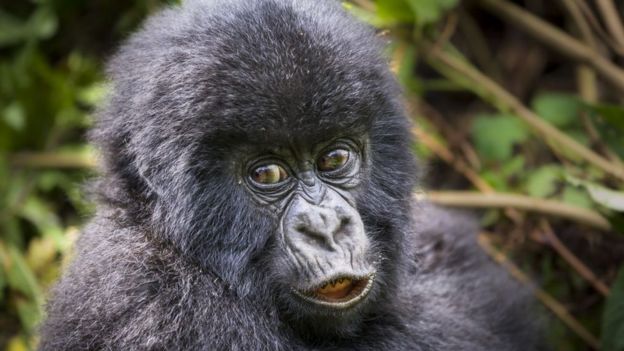
A 25-year old silverback mountain gorilla pictured in the jungle of the Virunga National Park

https://www.bbc.com/news/entertainment-arts-52678624

If you're a Christian moron you need to read this.

Humans share an ancestor with chimpanzee apes. When our ancestors separated from the ancestors of chimps, we evolved differently. Humans have a larger brain (which Christians never use) and chimps are much stronger than we are.

Chimpanzees evolved from ancient apes and they are still apes.

Humans evolved from ancient apes and we are still apes. Humans are one of the Great Ape species. We are apes. We are most closely related to chimpanzee apes and bonobo apes.

Another interesting fact: Chimpanzee apes are more closely related to human apes than they are to gorilla apes and orangutan apes. That makes us right in the middle of this family of the Great Apes.

Everything I wrote are scientific facts supported by thousands of evidences from DNA sequencing, and thousands more evidences from numerous other branches of science.

You can deny these strongest facts of science but they are still facts.

What are the religious implications?

Your dead Magic Jeebus Man was an ape. You morons worship a dead ape.

I suggest, Christain fucktards, it's about time for you to grow up and face facts. Your ridiculous cult needs to be thrown out.

But you won't throw out your favorite dead ape because reality makes you cowards cry.

Sunday, February 9, 2020

We are human apes. The Magic Jeebus Man was an ape. Christians worship a dead ape.

BBC News - Lightning strike killed gorillas in Uganda.

Four rare mountain gorillas 'die in Uganda lightning strike'

Mountain gorillas in VirungaImage copyrightGETTY IMAGES
Image captionThere are just over 1,000 mountain gorillas in existence
Four rare mountain gorillas, including a pregnant female, have died in Uganda after being hit by lightning, a conservation group says.
The three adult females and a male infant were found in Uganda's Mgahinga National Park with "gross lesions" on their bodies indicating electrocution.
The Greater Virunga Transboundary Collaboration (GVTC) called this a "big loss for the species".
There are just over 1,000 mountain gorillas in existence.
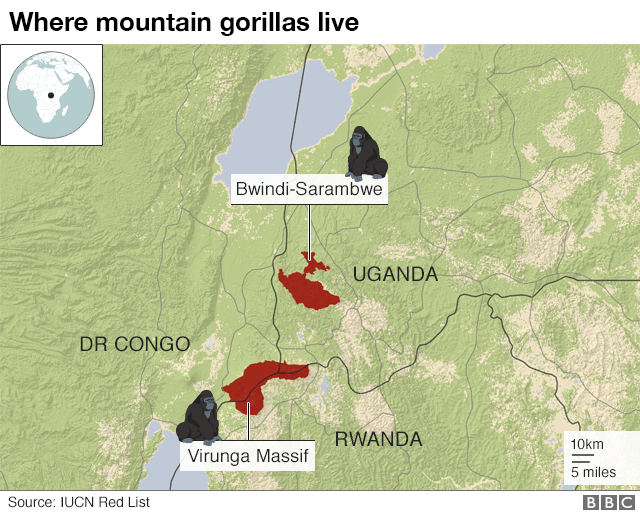
The species is restricted to protected areas in the Democratic Republic of Congo, Rwanda and Uganda.
The four that died were part of a 17-member group, which has been called the Hirwa family by the authorities.
An infant mountain gorillaImage copyrightGETTY IMAGES
Image captionMembers of the Hirwa group were photographed in 2012
The Hirwa group had crossed the border from Rwanda into Uganda last year and had been living in Uganda's Mgahinga National Park.
Mgahinga is in the Virunga Massif range of mountains which straddle the borders of Uganda, Rwanda and DR Congo.
"This was extremely sad," Andrew Seguya, executive secretary of the GVTC, told the BBC.
"The potential of the three females for their contribution to the population was immense," Dr Seguya said.
He added that the 13 surviving members of the Hirwa family have been found and are feeding well.
Infographic
Presentational white space
Samples from the post-mortem are currently being tested and confirmation of the cause of death is expected within the next three weeks, GVTC said.
In 2018, the mountain gorilla was removed from the list of critically endangered species, after intensive conservation efforts, including anti-poaching patrols, paid off.

Related Topics