"Darwin was the first to use data from nature to convince people that evolution is true, and his idea of natural selection was truly novel. It testifies to his genius that the concept of natural theology, accepted by most educated Westerners before 1859, was vanquished within only a few years by a single five-hundred-page book. On the Origin of Species turned the mysteries of life's diversity from mythology into genuine science." -- Jerry Coyne
The billionaire founder of Blue Origin announced in an Instagram post Monday that he and his brother will be on the New Shepard when it takes flight July 20 — roughly two weeks after he steps down as chief executive of Amazon. Bezos owns The Washington Post.
The landing follows China’s launch last month of the core module of a new orbiting space station and a successful mission in December that collected nearly four pounds of rocks and soil from the moon and brought them back to Earth.
Next month, the country’s space program plans to send three astronauts back to space, inaugurating what could become a regular Chinese presence in Earth’s orbit.
In this photo released by Xinhua News Agency, the core module of China’s space station, Tianhe, on the the Long March-5B Y2 rocket is moved to the launching area of the Wenchang Spacecraft Launch Site in southern China’s Hainan Province on April 23, 2021. China plans to launch the core module for its first permanent space station this week in the latest big step forward for the country’s space exploration program. The Tianhe, or “Heavenly Harmony” module is set to be hurtled into space aboard a Long March 5B rocket from the Wenchang Launch Center on the southern island of Hainan. The launch could come as early as Thursday night, April 29, 2021 if all goes as planned.
BEIJING — China plans to launch the core module for its first permanent space station this week in the latest big step forward for the country’s space exploration program.
The Tianhe, or “Heavenly Harmony” module is set to be hurtled into space aboard a Long March 5B rocket from the Wenchang Launch Center on the southern island of Hainan. The launch could come as early as Thursday night if all goes as planned.
It would be the first of 11 missions to build and supply the space station for a three-person crew.
Here’s a look at the planned launch and the past and future of China’s space program.
11 MISSIONS PLANNED TO COMPLETE SPACE STATION BY END OF 2022
Another 10 launches will send up two more modules; four cargo supply shipments and four missions with crews. At least 12 astronauts are training to fly to and live in the station, including veterans of previous flights, newcomers and women.
When completed by late 2022, Tianhe is expected to weigh about 66 tons, a fraction the size of the International Space Station, which launched its first module in 1998 and will weigh about 450 tons when completed. Tianhe will have a docking port and will also be able to connect with a powerful Chinese space satellite. Theoretically, it could be expanded with more modules.
Tianhe’s main module will initially be about the size of the American Skylab space station of the 1970s and the former Soviet/Russian Mir, which operated for more than 14 years after launching in 1986.
SPACE STATION A LONG-TERM GOAL
China has launched two experimental modules over the past decade in preparation for a permanent station. One, Tiangong-1, which means “Heavenly Palace-1” was abandoned and burned up during an uncontrolled loss of orbit. Its successor, Tiangong-2, was successfully taken out of orbit in 2018.
China began preparations for a space station in the early 1990s as its space program gained momentum. It was excluded from the International Space Station largely due to U.S. objections over the Chinese program’s secretive nature and close military ties.
SPEEDY PROGRESS IN SPACE
After years of successful rocket and commercial satellite launches, China put its first astronaut into space in October 2003. It was only the third country to independently do so after the former Soviet Union and the United States. Since that Shenzhou 5 mission, China has sent other astronauts into orbit, placed crews on the original Tiangong station and conducted a space walk.
It also has increased cooperation with space experts from other countries, including France, Sweden, Russia and Italy. NASA must get permission from a reluctant Congress to engage in such contacts.
China also has pushed ahead with crewless missions, particularly in lunar exploration and has landed a rover on the little-explored far side of the Moon. In December, its Chang’e 5 probe returned lunar rocks to Earth for the first time since the U.S. missions of the 1970s.
MARS ROVER AND FUTURE AMBITIONS
The Tianhe mission comes just weeks before a Chinese probe is due to land on Mars, which would make China only the second country to successfully accomplish that after the U.S. The Tianwen-1 space probe has been orbiting the red planet since February while collecting data. Its Zhurong rover will be looking for evidence of life.
Another Chinese program aims to collect soil from an asteroid, a key focus of Japan’s space program.
China plans another mission in 2024 to bring back lunar samples and has said it wants to land people on the moon and possibly build a scientific base there. No timeline has been proposed for such projects. A highly secretive space plane is also reportedly under development.
HOW COMPETITIVE IS CHINA’S PROGRAM?
China’s program has advanced in a steady, cautious manner on a carefully designed schedule, largely avoiding the failures seen in the U.S. and Russian efforts when they were locked in intense competition during the heady early days of spaceflight. One recent setback came when a Long March 5 rocket failed in 2017 during the development of the Long March 5B variant that will be used to put the Tianhe module into orbit, but engineers moved swiftly to fix the problem.
Critics say China’s space program has successfully reproduced the achievements of the U.S. and Russia without breaking much new ground. The country’s rising technological prowess may end such talk in coming years. The country may need greater private sector involvement to spur innovation, as the U.S. has done with SpaceX and Blue Origin, and to apply new technologies such as reusable rockets.
The LauncherOne rocket was dropped from a 747 aircraft as it flew over the Pacific Ocean, marking a triumph for Richard Branson, the British billionaire who now has two companies that have reached space successfully with two different vehicles. Virgin Orbit hopes to compete in the growing business of launching small satellites to space.
NASA astronauts Bob Behnken and Doug Hurley landed in the Gulf of Mexico near Pensacola around 2:45 p.m. local time, marking the first time a commercially built and operated spacecraft carried and returned people from the orbiting International Space Station. The Crew Dragon capsule, named Endeavour, performed as expected during the lengthy, fiery approach and slower final phase of the closely watched mission, with its four main, brightly colored parachutes braking its final descent.
Elon Musk’s Space Exploration Technologies Corp., as the company is formally called, overcame years of technical problems, nagging delays, a launchpad explosion during a test and hordes of skeptics inside and outside government to reach the historic goal. SpaceX previously pioneered reusable boosters, which increasingly have been accepted by commercial and U.S. government customers, including the Pentagon.
With plans to start regular crewed trips to the orbiting international laboratory within months, SpaceX has vaulted ahead of Boeing Co. as the National Aeronautics and Space Administration’s most prominent example of joint government-industry endeavors beyond the atmosphere. NASA plans to use the same principles to send astronauts to the surface of the moon later in the decade, and ultimately to Mars.
Boeing, which also has an agency contract to transport astronauts into orbit, seeks to conduct a test flight of its capsule without crew later this year, following a botched attempt in December.
“Welcome back to planet Earth and thanks for flying SpaceX,” mission control radioed the crew as the capsule bobbed in calm seas.
When the smiling astronauts exited some two hours later in front of video cameras, with the assistance of ground staff, Mr. Hurley had a pithy comment for average citizens: “You should take a moment to just cherish this day, especially given all the things that have happened this year.”
Waiting to be picked up by the company’s recovery vessel, the crew radioed they were in good condition.
Since the retirement of NASA’s winged Space Shuttle fleet in 2011—which landed on runways after space missions—the U.S. has relied on Russian rockets and capsules to ferry U.S. astronauts into orbit. NASA moved away from water landings in the mid-1970s, following a series of Apollo missions to the lunar surface.
In a message posted on Twitter, Vice President Mike Pence said, ”On behalf of a grateful Nation, thank you!”
In the midst of the coronavirus pandemic, NASA and White House officials have sought to use the mission to highlight U.S. persistence and scientific know-how. It also is the first step in what space experts see as a longer-term foundation for space tourism and a way to build momentum for proposed public-private partnerships to explore deeper into the solar system.
But President Trump’s administration faces stiff budget problems and major opposition on Capitol Hill regarding its plans for space travel.
Regardless of how political winds and legislative squabbles affect NASA’s existing plans, Mr. Musk and his management team earlier racked up a series of other technical coups, ranging from being the first to fuel rockets with astronauts on board to vertically landing parts of used boosters on floating platforms and reusing those sections multiple times.
The first American woman to walk in space has become the first woman to reach the deepest known spot in the ocean.
On Sunday, Kathy Sullivan, 68, an astronaut and oceanographer, emerged from her 35,810-foot dive to the Challenger Deep, according to EYOS Expeditions, a company coordinating the logistics of the mission.
This also makes Dr. Sullivan the first person to both walk in space and to descend to the deepest point in the ocean. The Challenger Deep is the lowest of the many seabed recesses that crisscross the globe.
Dr. Sullivan and Victor L. Vescovo, an explorer funding the mission, spent about an hour and a half at their destination, nearly seven miles down in a muddy depression in the Mariana Trench, which is about 200 miles southwest of Guam.
After capturing images from the Limiting Factor, a specially designed deep-sea research submersible, they began the roughly four-hour ascent.
Upon returning to their ship, the pair called a group of astronauts aboard the International Space Station, around 254 miles above earth.
“As a hybrid oceanographer and astronaut this was an extraordinary day, a once in a lifetime day, seeing the moonscape of the Challenger Deep and then comparing notes with my colleagues on the ISS about our remarkable reusable inner-space outer-spacecraft,” Dr. Sullivan said in a statement released by EYOS Expeditions on Monday.
Early Sunday, Mr. Vescovo applauded Dr. Sullivan for being “the first woman to the bottom of the ocean.”
In 1978, Dr. Sullivanjoined NASA as part of the first group of U.S. astronauts to include women. On Oct. 11, 1984, she became the first American woman to walk in space.
“That is really great,” Dr. Sullivan said after she floated into the cargo bay of the shuttle Challenger, about 140 miles above Earth.
She later became the administrator of the National Oceanic and Atmospheric Administration. Dr. Sullivan had a longstanding fascination with the ocean — before becoming an astronaut, she participated in one of the first attempts to use a submersible to study the volcanic processes that make the ocean crust, according to Collect Space, a space history site.
Tim Shank, a biologist at the Woods Hole Oceanographic Institution, called Dr. Sullivan a “consummate leader” in the study of the world’s oceans. There is currently only one submarine in the world that can reach the Challenger Deep, he said.
“I’m thrilled to hear that she was in it,” he said. “Anytime we can reach such extreme places on Earth to learn about them, it’s a major event.”
The Challenger Deep was discovered by the H.M.S. Challenger, a British ship that sailed the globe from 1872 to 1876. Since then, many expeditions have sought to measure the fissure’s depth, prompting disagreements not only about the precise figures but also over who truly was the first to reach the deepest point.
In April 2019, Mr. Vescovo, Dr. Sullivan’s diving partner, said he was; the “Titanic” director James Cameron disagreed, insisting he had gone deeper in 2012.
Dr. Sullivan will remain at sea for the next few days, according to a representative from Caladan Oceanic, another company involved in the mission.
The giant red nebula, NGC 2014, and its smaller blue neighbor, NGC 2020, part of the Large Magellanic Cloud in the Milky Way, about 163,000 light years away, in this new image by the Hubble Space Telescope.
Image
F. Story Musgrave on the first mission to service the Hubble Space Telescope in 1993.
“He not busy being born is busy dying.” So said Bob Dylan in “It’s Alright Ma (I’m Only Bleeding).”
As shown in a new picture of stormy star birth in a nearby galaxy, captured by the Hubble Space Telescope, the cosmos is keeping up the tradition of both birth and death. Stars are being born out of the ashes of old ones, forever refreshing the universe.
The picture was released Friday by the Space Telescope Science Institute in Baltimore, keepers of the Hubble, in honor of the 30th anniversary of the launch of that telescope on April 24, 1990.
That, too, was a time of darkness and rebirth in our world. Astronomers had dreamed for half a century of a telescope in space above the distorting and absorbing effects of the atmosphere, but that dream of a new rebirth for astronomy almost died when the telescope was launched and astronomers found they couldn’t focus it. The primary mirror had been ground to the wrong shape.
Hubble was famously reborn in 1993 when astronauts used the space shuttle to fit it with corrective lenses. Over the next 16 years, successive servicing missions kept Hubble on top of its game, and astronomers now are confident that it will still be in prime shape when its successor, the James Webb Space Telescope, is at last launched next year, we hope, giving the world two peerless eyes in the sky.
Among Hubble’s triumphs over the decades have been charting the effects of dark energy on the growth of the universe, surveying the weather throughout the solar system and measuring the expansion of the universe precisely enough to challenge battle-tested theories of cosmology.
And in pictures such as this 30th birthday portrait, it has documented the violent births and deaths of stars obeying Mr. Dylan’s dictum. Entitled “Cosmic Reef,” in an allusion to the richness of undersea life, it shows a so-called stellar nursery in the Large Magellanic Cloud, a satellite galaxy of our Milky Way, about 163,000 light years from here.
The reddish nebula at upper right is full of stars at least 10 times as massive as the sun. Winds of particles and radiation coming off them push the gas in the nebula into waves and bubbles from which new stars will eventually form.
Below it, a single giant star 200,000 times brighter than the sun has blown its own blue bubble of gas.
On the eve of the 25th anniversary of the launching of the Hubble Space Telescope, NASA released the new image below. We asked astronomers and others involved in the telescope's groundbreaking and occasionally rocky story to tell us about their favorite photos taken over the years. RELATED ARTICLE
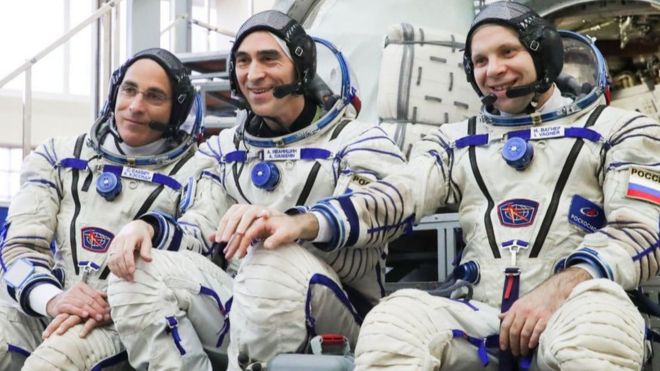
Image copyrightGETTY IMAGESImage captionNasa astronaut Christopher Cassidy (l), and cosmonauts Anatoly Ivanishin (c) and Ivan Vagner
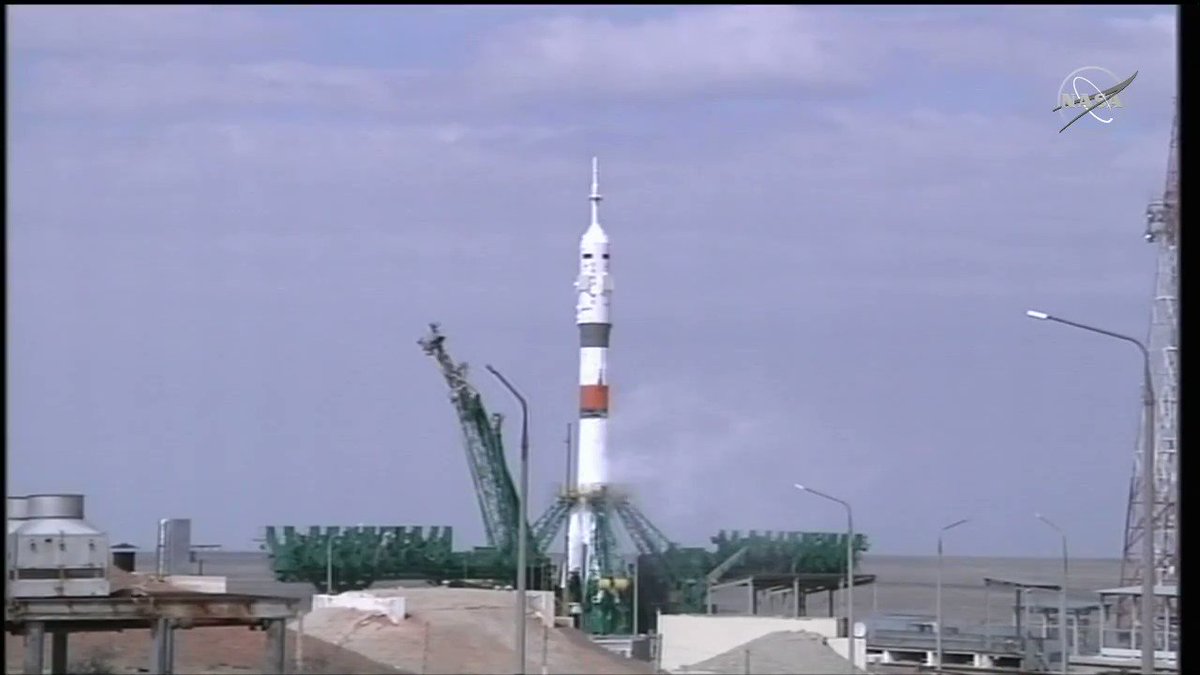
Three new crew members have arrived at the International Space Station (ISS) after a launch carried out under tight restrictions due to the coronavirus.
The Russian Soyuz rocket carrying cosmonauts Anatoly Ivanishin and Ivan Vagner and Nasa astronaut Chris Cassidy took off from Kazakhstan on Thursday.
Pre-launch protocols were changed to prevent the virus being taken to the ISS.
Only essential personnel were allowed at the launch site for the blast-off.
Support workers wore masks and kept their distance as the crew walked to the bus to take them to the spacecraft.
Earlier, Chris Cassidy said not having their families in Baikonur to cheer them on for the launch had affected the crew, but he added: "We understand that the whole world is also impacted by the same crisis.
Following the launch Nasa Administrator Jim Bridenstine tweeted his congratulations.
Chris Cassidy, Anatoly Ivanishin and Ivan Vagner are safely in orbit. No virus is stronger than the human desire to explore. I’m grateful to the entire @NASA and @roscosmos teams for their dedication to making this launch a success. https://twitter.com/nasa/status/1248161215790157827 …
The three will replace Oleg Skripochka, Andrew Morgan and Jessica Meir who are due to make their return journey from the ISS on 17 April.
ISS crew routinely go into quarantine ahead of launch day, but because of the coronavirus pandemic the process began even earlier last month.
Traditional pre-launch fanfare and visits to Moscow were abandoned as the three - along with their reserve crew - stayed in isolation at Russia's Star City training centre outside the capital.
A final press conference at Baikonur was made - as usual - from behind a glass wall as an added barrier to infection.
With millions of people around the world forced to stay indoors by the coronavirus, cosmonauts and astronauts have been offering advice on how to survive self-isolation.
Nasa's Scott Kelly wrote in the New York Times last month that the thing he missed most during nearly a year in space from 2015 to 2016 was nature - "the colour green, the smell of fresh dirt, and the feel of warm sun on my face".
He recommended walks in the fresh air for those who were able - but said time in front of a screen should not be ruled out.
He said he and his crew mates had enjoyed regular "movie nights" on the ISS.
The ISS has been orbiting the Earth since 1998. Five partners are involved - the US, Russia, Japan, Canada and the European Space Agency.


 GETTY IMAGES


 Shooting into the sky at 4:05am ET, the Soyuz rocket carrying Chris Cassidy of