Showing posts with label My favorite trees. Show all posts

Sunday, May 23, 2021

Friday, November 27, 2020

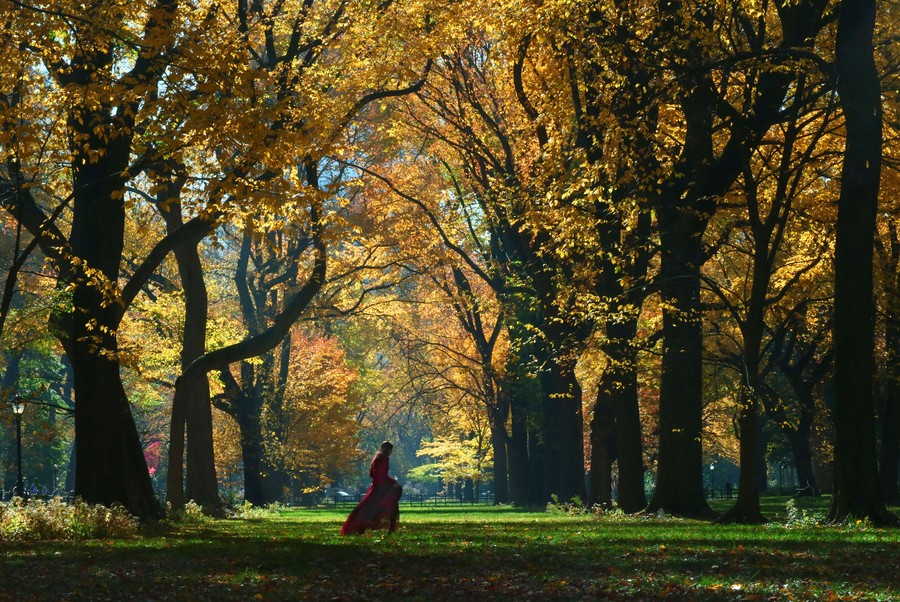
Central Park, New York City

A woman in a red dress walks across a field under trees turning color in Central Park on November 9, 2020, in New York City.

Sunday, October 18, 2020

Tuesday, October 6, 2020

73 degrees Fahrenheit equals 22.778 Celsius. Google is my friend.

A beautiful autumn day here in northwestern Illinois. Mostly blue sky. 73 degrees. Green grass, happy squirrels, and the leaves on my big fat tree are turning red. Leaves are falling from my other 2 trees. My numerous wonderful plants are dying but they still look nice. I saw a spider web. The spider was having lunch.

Friday, August 21, 2020

There is a heaven and I'm living in it.

I live in a beautiful farm town in northwestern Illinois. Everyone is nice. I never lock my doors. Huge trees are everywhere. My beautiful wonderful house is surrounded by beautiful trees and plants. The price of living here is so cheap it's almost free.

Monday, July 27, 2020

Some interesting facts: I live in a northwestern Illinois farm town. My house is 130 years old. My town has a tree that's 180 years old.

Credit...

New York Times

Can Trees Live Forever? New Kindling for an Immortal Debate

Some trees can live for thousands of years, but we may not be around long enough to really know whether they can die of old age.

By Cara Giaimo

July 27, 2020

Trees do not pay taxes. Some seem to avoid death as well. Many of the world’s most ancient organisms are trees, including a 3,600-year-old cypress in Chile and a sacred fig in Sri Lanka that was planted in the third century B.C. One bristlecone pine known as Methuselah has been alive for nearly five millenniums, standing in a forest in what is now called California.

But according to a paper published Monday in the journal Trends in Plant Science, time ravages us all in the end. The paper, “Long-Lived Trees Are Not Immortal,” argues that even the most venerable trees have physiological limits — though we, with our puny life spans, may never be able to tell.

Sergi Munné-Bosch, a plant biologist at the University of Barcelona, wrote the article in response to a January study on ginkgo trees, which can live for over a thousand years. The study found that 600-year-old ginkgos are as reproductively and photosynthetically vigorous as their 20-year-old peers. Genetic analysis of the trees’ vascular cambium — a thin layer of cells that lies just underneath the bark, and creates new living tissue — showed “no evidence of senescence,” or cell death, the authors wrote.

Dr. Munné-Bosch said he found the paper “very interesting,” but disagreed with how some readers of the study in popular media and beyond had interpreted it.

“In my opinion at least, there is no immortality,” he said.

Those tree species that can live for centuries or millenniums have a lot of tricks for staying youthful. They have simple body plans, and develop modularly, so they can replace parts they lose. They also build on their own dead tissue, which provides support and volume at a low metabolic cost. The trunk of a very old tree might be 95 percent dead, Dr. Munné-Bosch said, a strategy used also by other plants.

For these reasons, it’s much more likely that such a tree will die of external causes than age-related ones. In some populations, this can result in “negative senescence” — a phenomenon where the durability of older trees means they actually have a greater chance of survival than younger ones, Dr. Munné-Bosch said.

Still, “everything seems to indicate” that individual trees are mortal, he said.

But others have a different take.

“A modular organism such as a tree could hypothetically live forever,” said Peter Brown, a forest scientist who runs an ancient tree database called the OldList. “I don’t think there is any real physiological or anatomical limitation for them not to just keep going.”

In practice, though, “something always comes along” and interrupts, whether that’s a windstorm, a logging harvester or a swarm of bark beetles, he said. Many trees on the OldList won the placement lottery, Dr. Brown said — they’re rooted deep into rocks, hard to get to with an ax, and far enough from other trees that pests can’t spread.

Dr. Munné-Bosch points to some potential limits. For instance, the vascular tissue that ginkgos produce gets thinner and thinner each year. At some point, it could become too thin to function, killing the tree, he said.

Ginkgos also suffer more physiological stress as time goes by, along with a depleted supply of growth hormone. Despite their miraculous vascular cambiums, “it’s probable that even ginkgo trees may die from ‘natural causes,’” said Richard Dixon, one of the authors of January’s ginkgo paper.

Dr. Brown and Dr. Munné-Bosch agree that the question is almost impossible to answer experimentally. Very old trees are rare, and the same tricks that allow for their long-term survival make them hard to find. (The oldest age group in the ginkgo study contained just three trees, all younger than 700.) So it’s difficult to design a comprehensive study on them.

Plus, our own life spans are simply too short. Even if a scientist dedicated her whole career to very old trees, she would be able to follow her research subjects for only a small percentage of their lives. And a long enough multigenerational study might see its own methods go obsolete.

For these reasons, Dr. Munné-Bosch thinks “we will never prove” whether long-lived trees experience senescence, he said. So in his own experimental work, he now focuses on shrubs with more manageable life spans, of around 30 years.

“I think at the end,” he said, “we have to accept that we will all die.”

Monday, May 25, 2020

Northwestern Illinois is a beautiful place.

The wonderful farm town I live in has given every house a garbage container. Once a week the residents put it by the curb. A truck picks the thing up and automatically empties the garbage into the truck. Humans don't have to lift anything.

Every day after I clean up the place I put a trash bag into my garbage container which I put in the driveway near the rear porch. I just did that. It's very nice out so I sat down on my rear porch which is near my favorite tree. Less than 10 feet away I saw the cardinal on that tree that's been living here. Then I saw another cardinal that visited her. It looks like there will be some baby cardinals here eventually I think.

Both the cardinals and I love my favorite but strange tree. It has long branches which have no leaves until the end of the branch. Thanks to lots of rain and lots of sunshine, there are a lot of beautiful leaves at the end of the branches. Much more than I saw last year.

Next to it is another tree which is short but very fat. I can't see the branches because the entire tree is 100% full of beautiful green leaves, and it's growing like crazy.

Underneath both trees there are two species of beautiful green plants that magically appear every spring, as do numerous other extremely beautiful plants all over the property near the house.

I do nothing. I just watch this stuff grow, and I thank goodness for the brilliant people who used to live here. They knew what they were doing when they created all this beautiful stuff.

Tuesday, May 5, 2020

Madagascar


These trees are found only in Madagascar.

More Madagascar stuff here:

New York Times - Madagascar: A Cornucopia of Beauty

Join us for a visual tour of the island nation of Madagascar, about 90 percent of whose flora and fauna is found nowhere else on Earth.

Sunday, May 3, 2020

The Earth is a wonderful place.

Cherry blossoms along the Cherry Walk at the Brooklyn garden.
David Lanz - Variations on a Theme From Pachelbel's Canon in D Major

Wednesday, April 1, 2020

Please click the BBC News link to see the video. It's a beautiful thing.

The man who grew his own Amazon rainforest

A corner of the Amazon that had been cleared and used as farmland has been restored to rainforest.

The man who owns it, Omar Tello, gave up his job as an accountant and spent 40 years recreating a patch of pristine forest in Ecuador, stretching just a few hundred metres in each direction.

He’s trying to encourage other landowners to do the same, so they can turn the tide of deforestation.

Saturday, August 17, 2019

I would like to visit Australia just to listen to their wonderful Australian accent. I would probably never come back to America.


coolibah tree

"Waltzing Matilda" is Australia's best-known bush ballad, and has been described as the country's "unofficial national anthem".

The title was Australian slang for travelling on foot (waltzing) with one's belongings in a "matilda" (swag) slung over one's back. The song narrates the story of an itinerant worker, or "swagman", making a drink of billy tea at a bush camp and capturing a jumbuck (sheep) to eat. When the jumbuck's owner, a squatter (landowner), and three troopers (mounted policemen) pursue the swagman for theft, he declares "You'll never catch me alive!" and commits suicide by drowning himself in a nearby billabong (watering hole), after which his ghost haunts the site.

The original lyrics were written in 1895 by Australian poet Banjo Paterson, and were first published as sheet music in 1903. Extensive folklore surrounds the song and the process of its creation, to the extent that it has its own museum, the Waltzing Matilda Centre in Winton, in the Queensland outback, where Paterson wrote the lyrics. In 2012, to remind Australians of the song's significance, Winton organised the inaugural Waltzing Matilda Day to be held on 6 April, the anniversary of its first performance.

The song was first recorded in 1926 as performed by John Collinson and Russell Callow. In 2008, this recording of "Waltzing Matilda" was added to the Sounds of Australia registry in the National Film and Sound Archive, which says that there are more recordings of "Waltzing Matilda" than any other Australian song.

Once a jolly swagman camped by a billabong
Under the shade of a coolibah tree,
And he sang as he watched and waited till his "Billy" boiled,
"You'll come a-waltzing Matilda, with me."

Chorus:
Waltzing Matilda, waltzing Matilda,
You'll come a-waltzing Matilda, with me,
And he sang as he watched and waited till his "Billy" boiled,
"You'll come a-waltzing Matilda, with me."

Down came a jumbuck to drink at that billabong,
Up jumped the swagman and grabbed him with glee,
And he sang as he shoved that jumbuck in his tucker bag,
"You'll come a-waltzing Matilda, with me."

(Chorus)

Up rode the squatter, mounted on his thoroughbred.
Down came the troopers, one, two, and three.
"Whose is that jumbuck you've got in your tucker bag?
You'll come a-waltzing Matilda, with me."

(Chorus)

Up jumped the swagman and sprang into the billabong.
"You'll never catch me alive!" said he
And his ghost may be heard as you pass by that billabong:
"You'll come a-waltzing Matilda, with me."

(Chorus)

Thursday, June 20, 2019

Everything you always wanted to know about my favorite farm town.

Wikipedia - Kewanee, Illinois

Kewanee is a city in Henry County, Illinois, United States. "Kewanee" is the Winnebago word for greater prairie chicken, which lived there. The population was 12,916 at the 2010 census, down from 12,944 in 2000.

According to the 2010 census, Kewanee has a total area of 6.722 square miles (17.41 km2), of which 6.71 square miles (17.38 km2) (or 99.82%) is land and 0.012 square miles (0.03 km2) (or 0.18%) is water.

2000 census

As of the census of 2000, there were 12,944 people, 5,353 households, and 3,377 families residing in the city. The population density was 2,062.1 people per square mile (795.8/km²). There were 5,879 housing units at an average density of 936.6 per square mile (361.4/km²). The racial makeup of the city was 90.27% White, 3.68% African American, 0.06% Native American, 0.35% Asian, 0.02% Pacific Islander, 3.69% from other races, and 1.95% from two or more races. Hispanic or Latino of any race were 6.10% of the population.

There were 5,353 households out of which 28.5% had children under the age of 18 living with them, 47.0% were married couples living together, 12.3% had a female householder with no husband present, and 36.9% were non-families. 32.2% of all households were made up of individuals and 17.7% had someone living alone who was 65 years of age or older. The average household size was 2.38 and the average family size was 2.98.

In the city, the population was spread out with 24.8% under the age of 18, 8.9% from 18 to 24, 25.4% from 25 to 44, 20.5% from 45 to 64, and 20.5% who were 65 years of age or older. The median age was 38 years. For every 100 females, there were 88.8 males. For every 100 females age 18 and over, there were 84.7 males.

The median income for a household in the city was $29,895, and the median income for a family was $37,730. Males had a median income of $29,065 versus $19,792 for females. The per capita income for the city was $15,746. About 10.7% of families and 13.9% of the population were below the poverty line, including 21.0% of those under age 18 and 8.9% of those age 65 or over.

2010 census

According to the 2010 census, the city had a population of 12,916. Of this, 11,241 (87.03%) were white, 633 (4.90%) were black or African American, 624 (4.83%) were some other race, 325 (2.52%) were two or more races, 51 (0.39%) were Asian, 38 (0.29%) were American Indian or Alaska Native. 1,350 (10.45%) were Hispanic or Latino of any race.

Industry

Kewanee was well known in the steam industry for fire-tube boilers. The Kewanee Boiler Corporation manufactured and sold thousands of boilers throughout the world for well over one hundred years. However, the company failed in 2002 and was forced to go out of business. However, these boilers are still extremely common. The Kewanee High School athletic teams are nicknamed the "Boilermakers".


Parks

Kewanee has many different types of parks in the immediate area, offering a variety of activities such as boating, camping, hunting, fishing, playgrounds, baseball fields, and more. Parks inside the city limits are run by the Kewanee Park District.

Schools

Kewanee has had two school districts, dating to when the community of Wethersfield was a separate municipality. Though the towns merged long ago, the two school districts both remain in the city of 13,400, divided at Division Street in the middle of Kewanee. While Kewanee School District #229 has around 2,015 students (533 High School), Wethersfield #230 has about 600 students. The two schools enjoy a usually friendly rivalry, since both district high schools are in different divisions for most sports. However, this rivalry did become very heated in the sports the two high schools once competed in, most notably basketball.

There are also other schools in Kewanee like Visitation Catholic School: home of the Giants, and a community college, Black Hawk College. Black Hawk College-East Campus is recognized nationally for its equestrian program, as well as livestock judging teams. (Another Campus is located in the Quad Cities.)

Festivals

The most notable festival held in the community is Hog Days. It is held annually on Labor Day weekend. Events include a carnival, mud volleyball, a parade, and more.

Local media

FM radio
93.9 KQCJ "Rewind 93.9", Oldies
102.1 W271BL (Translates 93.9 KQCJ), Oldies
102.5 WJRE "HOGG Country 102.5", Country (RDS)
104.3 W282AL (Translates 1450 WKEI), News/Talk
AM radio[edit]
1450 WKEI, News/Talk

Notable businesses

Hotel Kewanee
Sandy's Drive-In National Headquarters

Notable people

Walter T. Bailey, architect
B. Frank Baker, Illinois state senator, businesman, and Mayor of Kewanee
Neville Brand, actor, decorated World War II veteran
Mike Cernovich, American alt-right social media personality and conspiracy theorist
Richard Estes, artist
Frederick Dilley Glidden (pen name Luke Short), Western writer, known for Ramrod (1947) and Blood on the Moon (1948)
Bill Goffrier, guitarist for The Embarrassment[9]
Belden Hill, MLB third baseman for the Baltimore Orioles
Em Lindbeck, MLB outfielder for the Detroit Tigers
Glenn McDonald, player for the Boston Celtics and Milwaukee Bucks
Albinus Nance, 19th Century governor of Nebraska, was raised in Kewanee
Sod Ryan, American football player
Lindsay Stalzer, professional volleyball player for the Foton Tornadoes, Philippines
Marjabelle Young Stewart, writer and expert on etiquette
Teresa A. Sullivan, President of the University of Virginia

Transportation

The Kewanee Amtrak station serves trains on the Carl Sandburg and Illinois Zephyr daily. The current station was completed April 13, 2012.


The osage-orange tree is the lone survivor of a hedgerow planted c. 1840, a concept promoted by Illinois College professor Jonathan Baldwin Turner that became the shelterbelt system saving America’s soils from the Dust Bowl of the 1930s. Because of its significance, Illinois arborist Guy Sternberg led a rally to preserve the 170-year-old tree.
THIS TREE IS NOW 179 YEARS OLD AND IT'S STILL HEALTHY.


Kewanee Library